• Steven Ponce
  • About
  • Data Visualizations
  • Projects
  • Resume
  • Email

On this page

  • Original
  • Makeover
  • Steps to Create this Graphic
    • 1. Load Packages & Setup
    • 2. Read in the Data
    • 3. Examine the Data
    • 4. Tidy Data
    • 5. Visualization Parameters
    • 6. Plot
    • 7. Save
    • 8. Session Info
    • 9. GitHub Repository
    • 10. References
    • 11. Custom Functions Documentation

Darkness ‘changes’ how UFOs are described

  • Show All Code
  • Hide All Code

  • View Source

Orb, circle, and sphere are three of the words witnesses use for a round light — and which one they reach for tracks how much daylight there was to see it.

MakeoverMonday
Data Visualization
R Programming
2026
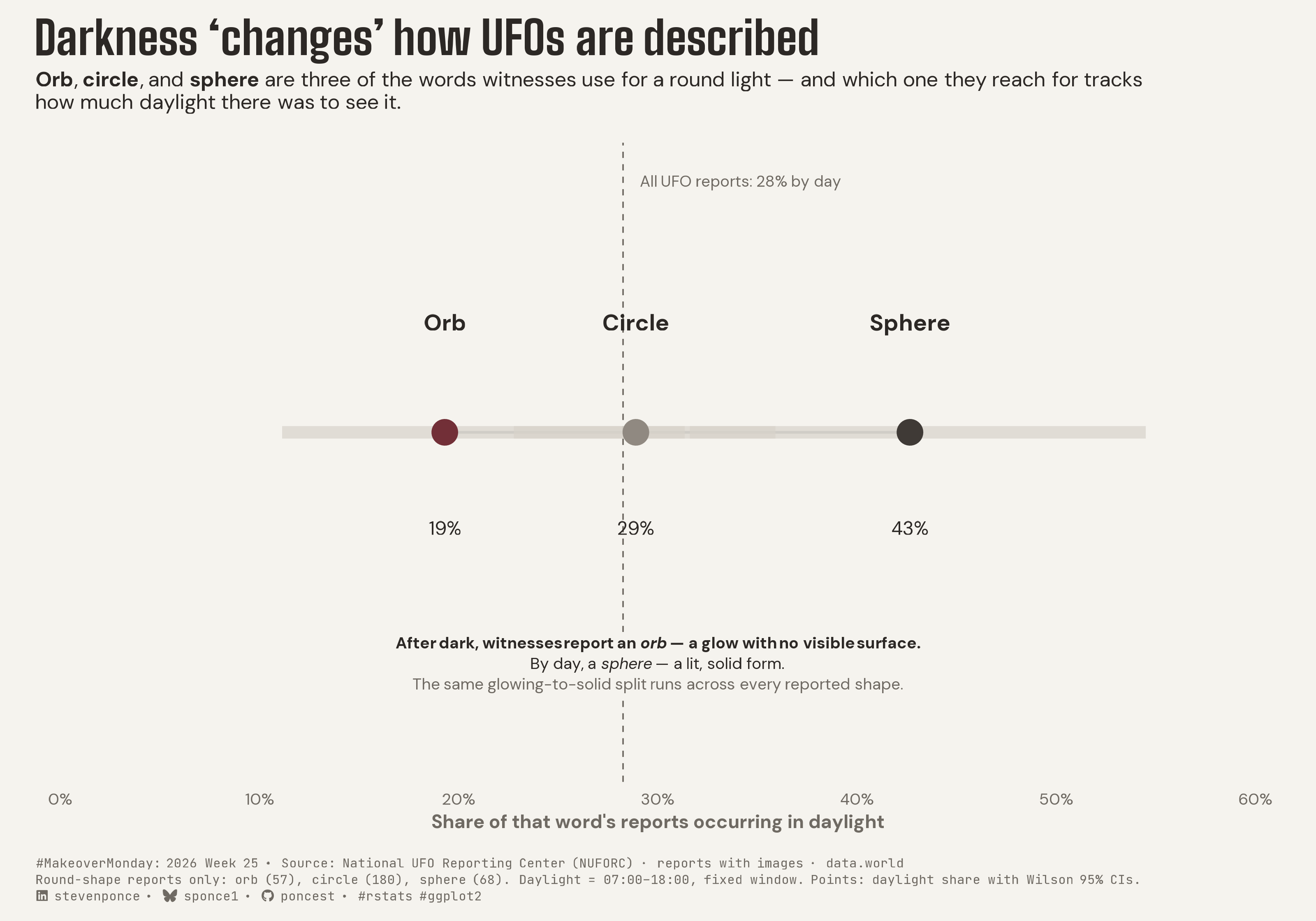
Among round-shape UFO reports, ‘sphere’ sightings occurred in daylight more than twice as often as ‘orb’ sightings, while ‘circle’ sat near the overall average — the word a witness chooses tracks how much light there was to see it. Each word’s daylight share is estimated with Wilson confidence intervals. Made in R with ggplot2, ggtext, and binom.
Author

Steven Ponce

Published

June 23, 2026

Original

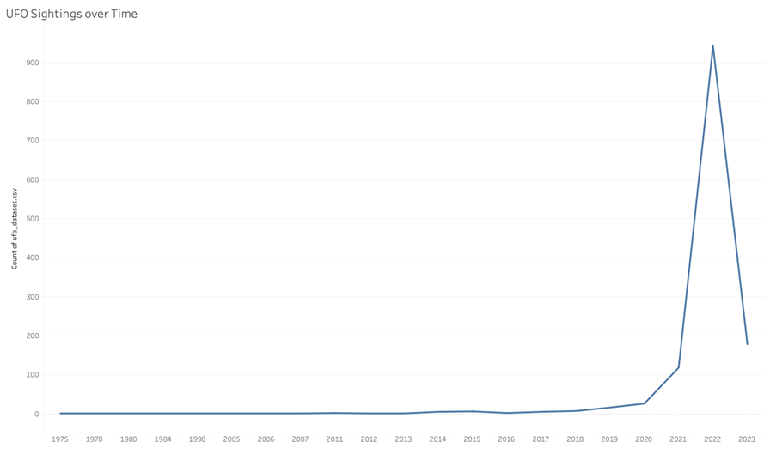
The original visualization comes from UFO Sightings

Original visualization

Makeover

Figure 1: Horizontal dot plot titled “Darkness ‘changes’ how UFOs are described.” Three words witnesses use for round UFOs are placed by the share of each word’s reports that occurred in daylight: “orb” at 19%, “circle” at 29%, and “sphere” at 43%, against a dashed reference line marking the 28% overall daylight rate for all UFO reports. The words form an ordered gradient — luminous descriptions (“orb”) skew nocturnal, solid-form descriptions (“sphere”) skew toward daylight — showing that how a round UFO is described tracks how much light there was to see it. Based on 305 round-shaped NUFORC reports (orb 57, circle 180, sphere 68).

Steps to Create this Graphic

1. Load Packages & Setup

Show code
```{r}
#| label: load
#| warning: false
#| message: false      
#| results: "hide"     

## 1. LOAD PACKAGES & SETUP ----
suppressPackageStartupMessages({
  if (!require("pacman")) install.packages("pacman")
  pacman::p_load(
    tidyverse, ggtext, showtext, scales, glue, janitor, binom
)
})

### |- figure size ----
camcorder::gg_record(
  dir    = here::here("temp_plots"),
  device = "png",
  width  = 10,
  height = 7,
  units  = "in",
  dpi    = 320
)

# Source utility functions
suppressMessages(source(here::here("R/utils/fonts.R")))
source(here::here("R/utils/social_icons.R"))
source(here::here("R/utils/image_utils.R"))
source(here::here("R/themes/base_theme.R"))
```

2. Read in the Data

Show code
```{r}
#| label: read
#| include: true
#| eval: true
#| warning: false
#| 

df_raw <- read_csv(
  here::here("data/MakeoverMonday/2026/MM2026 W25 UFO Sightings.csv")) |>
  clean_names()
```

3. Examine the Data

Show code
```{r}
#| label: examine
#| include: true
#| eval: true
#| results: 'hide'
#| warning: false

glimpse(df_raw)
skimr::skim_without_charts(df_raw)
```

4. Tidy Data

Show code
```{r}
#| label: tidy
#| warning: false

day_start <- 7
day_end <- 18

sightings <- df_raw |>
  filter(!is.na(time)) |>
  mutate(
    hour     = as.numeric(time) / 3600,
    daylight = hour >= day_start & hour < day_end
  )

overall_day <- mean(sightings$daylight)

round_data <- sightings |>
  filter(shape %in% c("Orb", "Circle", "Sphere")) |>
  summarise(n = n(), day = sum(daylight), .by = shape)

ci <- binom::binom.wilson(round_data$day, round_data$n)

round_data <- round_data |>
  mutate(
    day_share = ci$mean,
    lower = ci$lower,
    upper = ci$upper,
    pole = case_when(
      shape == "Orb" ~ "after dark",
      shape == "Sphere" ~ "by daylight",
      TRUE ~ ""
    )
  ) |>
  arrange(day_share)

# annotation values
get_r <- function(s) round_data$day_share[round_data$shape == s]
orb_pct <- percent(get_r("Orb"), accuracy = 1)
sphere_pct <- percent(get_r("Sphere"), accuracy = 1)
ratio_round <- round(get_r("Sphere") / get_r("Orb"), 1)
n_total <- sum(round_data$n)
n_orb <- round_data$n[round_data$shape == "Orb"]
n_circle <- round_data$n[round_data$shape == "Circle"]
n_sphere <- round_data$n[round_data$shape == "Sphere"]
```

5. Visualization Parameters

Show code
```{r}
#| label: params
#| include: true
#| warning: false

### |-  plot aesthetics ----
clrs <- get_theme_colors(
  palette = list(
    luminous = "#722F37",
    neutral  = "#908981",
    solid    = "#3F3A36",
    ink      = "#2C2825",
    ref_grey = "#6F6A63",
    ci_grey  = "#D7D2CA"
  )
)

ink <- clrs$palette$ink
ref_grey <- clrs$palette$ref_grey
ci_grey <- clrs$palette$ci_grey
bg_col <- clrs$background

round_pal <- c(
  "Orb"    = clrs$palette$luminous,
  "Circle" = clrs$palette$neutral,
  "Sphere" = clrs$palette$solid
)

### |-  titles and caption ----
title_text <- "Darkness 'changes' how UFOs are described"

subtitle_text <- str_glue(
  "<b>Orb</b>, <b>circle</b>, and <b>sphere</b> are three of the words witnesses use for a ",
  "round light \u2014 and which one they reach for tracks<br>how much daylight there was to see it."
)

annotation_text <- str_glue(
  "<b>After dark, witnesses report an <i>orb</i> \u2014 a glow with no visible surface.</b><br>",
  "By day, a <i>sphere</i> \u2014 a lit, solid form.<br>",
  "<span style='color:{ref_grey}'>The same glowing-to-solid split runs across every reported shape.</span>"
)

caption_text <- create_mm_caption(
  mm_year = 2026,
  mm_week = 25,
  source_text = str_glue(
    "National UFO Reporting Center (NUFORC) \u00b7 reports with images \u00b7 data.world<br>",
    "Round-shape reports only: orb ({n_orb}), circle ({n_circle}), sphere ({n_sphere}). ",
    "Daylight = 07:00\u201318:00, fixed window. Points: daylight share with Wilson 95% CIs."
  )
)

### |-  fonts ----
setup_fonts()
fonts <- get_font_families()

### |-  plot theme ----
base_theme <- create_base_theme(clrs)

weekly_theme <- extend_weekly_theme(
  base_theme,
  theme(
    plot.title = element_markdown(
      face = "bold", family = fonts$title_1,
      size = rel(1.8), color = ink, margin = margin(b = 4)
    ),
    plot.subtitle = element_textbox_simple(
      family = fonts$subtitle, size = rel(0.8),
      color = ink, lineheight = 1.1,
      width = unit(1, "npc"), margin = margin(b = 16)
    ),
    plot.caption = element_textbox_simple(
      family = fonts$caption, size = rel(0.5),
      color = ref_grey, lineheight = 1.3,
      width = unit(1, "npc"), margin = margin(t = 14)
    ),
    axis.text.y = element_blank(),
    axis.title.y = element_blank(),
    axis.text.x = element_text(family = fonts$text, size = rel(0.8), color = ref_grey),
    axis.title.x = element_text(family = fonts$text, size = rel(0.8), color = ref_grey),
    panel.grid = element_blank(),
    axis.ticks = element_blank()
  )
)

theme_set(weekly_theme)
```

6. Plot

Show code
```{r}
#| label: plot
#| warning: false

y_word <- 0.55
y_pct <- -0.48
y_anno <- -1.00
y_reflab <- 1.30

p <- ggplot(round_data, aes(x = day_share, y = 0)) +

  # Geoms
  geom_vline(
    xintercept = overall_day, linetype = "dashed",
    linewidth = 0.4, color = ref_grey
  ) +
  geom_line(aes(group = 1), linewidth = 0.7, color = "gray75") +
  geom_linerange(aes(xmin = lower, xmax = upper),
    linewidth = 3.2,
    color = ci_grey, alpha = 0.7
  ) +
  geom_point(aes(color = shape), size = 6) +
  geom_text(aes(label = shape),
    y = y_word, family = fonts$title,
    fontface = "bold", size = 4.4, color = ink
  ) +
  geom_text(aes(label = percent(day_share, accuracy = 1)),
    y = y_pct,
    family = fonts$text, size = 3.6, color = ink
  ) +
  # Annotate
  annotate("richtext",
    x = overall_day + 0.006, y = y_reflab,
    label = glue("All UFO reports: {percent(overall_day, accuracy = 1)} by day"),
    hjust = 0, vjust = 1, family = fonts$text, size = 3, color = ref_grey,
    fill = bg_col, label.color = NA,
    label.padding = unit(c(0.12, 0.3, 0.12, 0.2), "lines")
  ) +
  annotate("richtext",
    x = 0.30, y = y_anno, hjust = 0.5, vjust = 1,
    label = annotation_text, family = fonts$text, size = 3.05,
    color = ink, lineheight = 1.3,
    fill = bg_col, label.color = NA,
    label.padding = unit(c(0.2, 0.3, 0.2, 0.3), "lines")
  ) +
  # Scales
  scale_x_continuous(
    labels = percent_format(accuracy = 1),
    breaks = seq(0, 0.6, 0.1), limits = c(0, 0.6),
    expand = expansion(mult = c(0.02, 0.02))
  ) +
  scale_y_continuous(limits = c(-1.75, 1.45), expand = expansion(0)) +
  scale_color_manual(values = round_pal, guide = "none") +
  coord_cartesian(clip = "off") +
  # Labs
  labs(
    x = "Share of that word's reports occurring in daylight",
    y = NULL,
    title = title_text,
    subtitle = subtitle_text,
    caption = caption_text
  )
```

7. Save

Show code
```{r}
#| label: save
#| warning: false

### |-  plot image ----  
save_plot(
  plot = p , 
  type = "makeovermonday", 
  year = current_year,
  week = current_week,
  width = 10, 
  height = 7
  )
```

8. Session Info

TipExpand for Session Info
R version 4.5.3 (2026-03-11 ucrt)
Platform: x86_64-w64-mingw32/x64
Running under: Windows 11 x64 (build 26100)

Matrix products: default
  LAPACK version 3.12.1

locale:
[1] LC_COLLATE=English_United States.utf8 
[2] LC_CTYPE=English_United States.utf8   
[3] LC_MONETARY=English_United States.utf8
[4] LC_NUMERIC=C                          
[5] LC_TIME=English_United States.utf8    

time zone: America/New_York
tzcode source: internal

attached base packages:
[1] stats     graphics  grDevices utils     datasets  methods   base     

other attached packages:
 [1] here_1.0.2      binom_1.1-1.1   janitor_2.2.1   glue_1.8.0     
 [5] scales_1.4.0    showtext_0.9-8  showtextdb_3.0  sysfonts_0.8.9 
 [9] ggtext_0.1.2    lubridate_1.9.5 forcats_1.0.1   stringr_1.6.0  
[13] dplyr_1.2.1     purrr_1.2.2     readr_2.2.0     tidyr_1.3.2    
[17] tibble_3.3.1    ggplot2_4.0.3   tidyverse_2.0.0 pacman_0.5.1   

loaded via a namespace (and not attached):
 [1] gtable_0.3.6       xfun_0.57          htmlwidgets_1.6.4  tzdb_0.5.0        
 [5] vctrs_0.7.3        tools_4.5.3        generics_0.1.4     curl_7.0.0        
 [9] parallel_4.5.3     gifski_1.32.0-2    pkgconfig_2.0.3    skimr_2.2.2       
[13] RColorBrewer_1.1-3 S7_0.2.1           lifecycle_1.0.5    compiler_4.5.3    
[17] farver_2.1.2       textshaping_1.0.5  repr_1.1.7         codetools_0.2-20  
[21] snakecase_0.11.1   litedown_0.9       htmltools_0.5.9    yaml_2.3.12       
[25] crayon_1.5.3       pillar_1.11.1      camcorder_0.1.0    magick_2.9.1      
[29] commonmark_2.0.0   tidyselect_1.2.1   digest_0.6.39      stringi_1.8.7     
[33] labeling_0.4.3     rsvg_2.7.0         rprojroot_2.1.1    fastmap_1.2.0     
[37] grid_4.5.3         cli_3.6.6          magrittr_2.0.5     base64enc_0.1-6   
[41] withr_3.0.2        bit64_4.6.0-1      timechange_0.4.0   rmarkdown_2.31    
[45] bit_4.6.0          otel_0.2.0         ragg_1.5.2         hms_1.1.4         
[49] evaluate_1.0.5     haven_2.5.5        knitr_1.51         markdown_2.0      
[53] rlang_1.2.0        gridtext_0.1.6     Rcpp_1.1.1         xml2_1.5.2        
[57] svglite_2.2.2      rstudioapi_0.18.0  vroom_1.7.1        jsonlite_2.0.0    
[61] R6_2.6.1           systemfonts_1.3.2 

9. GitHub Repository

TipExpand for GitHub Repo

The complete code for this analysis is available in mm_2026_25.qmd.

For the full repository, click here.

10. References

TipExpand for References

Primary Data (Makeover Monday):

  1. Makeover Monday 2026 Week 25: UFO Sightings (NUFORC)
    • CSV: 1,317 rows × 13 columns (posted, date, time, city, state, shape, duration, summary, images, img_link, lat, lng, population); one row per reported sighting
    • This is NUFORC’s recent “with-images” subset (images = “Yes” for every row — a selection filter, not a variable), with reports posted across a 9-day window in March 2023; a snapshot, not a representative census
  2. Original Chart: none — this week’s MakeoverMonday supplied the dataset without an original visualization to redesign; the chart is built from scratch

Source Data:

  1. National UFO Reporting Center (NUFORC)
    • Ultimate source of the sighting records; NUFORC collects 100,000+ public UFO reports. The MakeoverMonday extract is a recent, filtered, standardized subset (cleaned city/state names, standardized dates, lat/lon) — not the full NUFORC archive
  2. Dataset packaging: Kaggle — UFO Sightings (Joe Beach Capital)
    • The cleaned, standardized CSV distribution underlying the MakeoverMonday dataset

Classification (analytical layer added in the makeover):

  1. Visibility class (self-luminous / light-pattern / ambiguous / solid) and the round-word grouping (orb, circle, sphere) are the author’s own classifications, not an official or established taxonomy
    • Assigned on physical grounds — does the shape word name something self-luminous, an arrangement of lights, or a solid reflective surface — before inspecting daylight share, to avoid circular grouping
    • The “light-pattern” assignment of triangle/chevron/formation/rectangle (reports of configured lights, e.g. the “black triangle”) is a disclosed interpretive call

Note: The chart shows round-shape reports only — orb (n = 57), circle (n = 180), sphere (n = 68); 305 of 1,317 reports. Daylight is defined as 07:00–18:00 local time, a fixed window that is not seasonally adjusted, so the values are a relative ranking rather than a seasonally-correct daylight rate. Points are each word’s share of reports occurring in daylight, with Wilson 95% confidence intervals. Annotation values verified against the data: orb 19% (11/57), circle 29% (52/180), sphere 43% (29/68), against an overall daylight share of 28% across all 1,317 reports — circle sits essentially on that baseline. No causal relationship is asserted: the chart describes an association between when a sighting was reported and which round-shape word was chosen, not why; the surface-resolution reading (a glow registers after dark, a solid form by day) is offered as interpretation, and the three words are not claimed to denote a single identical object. Because the extract is a 9-day posting snapshot of the with-images subset, no trend-over-time claim is made — all framing is cross-sectional. The statement that the “glowing-to-solid split runs across every reported shape” is backed by a supporting exhibit (daylight share by all shapes with n ≥ 20: self-luminous shapes ≈ 15% daytime, solid forms ≈ 38%), not by the three points shown here.

11. Custom Functions Documentation

Note📦 Custom Helper Functions

This analysis uses custom functions from my personal module library for efficiency and consistency across projects.

Functions Used:

  • fonts.R: setup_fonts(), get_font_families() - Font management with showtext
  • social_icons.R: create_social_caption() - Generates formatted social media captions
  • image_utils.R: save_plot() - Consistent plot saving with naming conventions
  • base_theme.R: create_base_theme(), extend_weekly_theme(), get_theme_colors() - Custom ggplot2 themes

Why custom functions?
These utilities standardize theming, fonts, and output across all my data visualizations. The core analysis (data tidying and visualization logic) uses only standard tidyverse packages.

Source Code:
View all custom functions → GitHub: R/utils

Back to top

Citation

BibTeX citation:
@online{ponce2026,
  author = {Ponce, Steven},
  title = {Darkness “Changes” How {UFOs} Are Described},
  date = {2026-06-23},
  url = {https://stevenponce.netlify.app/data_visualizations/MakeoverMonday/2026/mm_2026_25.html},
  langid = {en}
}
For attribution, please cite this work as:
Ponce, Steven. 2026. “Darkness ‘Changes’ How UFOs Are Described.” June 23. https://stevenponce.netlify.app/data_visualizations/MakeoverMonday/2026/mm_2026_25.html.
Source Code
---
title: "Darkness 'changes' how UFOs are described"
subtitle: "Orb, circle, and sphere are three of the words witnesses use for a round light — and which one they reach for tracks how much daylight there was to see it."
description: "Among round-shape UFO reports, 'sphere' sightings occurred in daylight more than twice as often as 'orb' sightings, while 'circle' sat near the overall average — the word a witness chooses tracks how much light there was to see it. Each word's daylight share is estimated with Wilson confidence intervals. Made in R with ggplot2, ggtext, and binom."
date: "2026-06-23"
author:
  - name: "Steven Ponce"
    url: "https://stevenponce.netlify.app"
citation:
  url: "https://stevenponce.netlify.app/data_visualizations/MakeoverMonday/2026/mm_2026_25.html"
categories: ["MakeoverMonday", "Data Visualization", "R Programming", "2026"]
tags: [
  "makeover-monday",
  "data-visualization",
  "ggplot2",
  "rstats",
  "dot-plot",
  "ufo",
  "nuforc",
  "vocabulary",
  "perception",
  "wilson-interval",
  "annotation",
  "2026"
]
image: "thumbnails/mm_2026_25.png"
format:
  html:
    toc: true
    toc-depth: 5
    code-link: true
    code-fold: true
    code-tools: true
    code-summary: "Show code"
    self-contained: true
    theme: 
      light: [flatly, assets/styling/custom_styles.scss]
      dark: [darkly, assets/styling/custom_styles_dark.scss]
editor_options: 
  chunk_output_type: inline
execute: 
  freeze: true
  cache: true
  error: false
  message: false
  warning: false
  eval: true
---

```{r}
#| label: setup-links
#| include: false

# CENTRALIZED LINK MANAGEMENT

## Project-specific info 
current_year <- 2026
current_week <- 25
project_file <- "mm_2026_25.qmd"
project_image <- "mm_2026_25.png"

## Data Sources
data_main <- "https://data.world/makeovermonday/2026w25-ufo-sightings"
data_secondary <- "https://data.world/makeovermonday/2026w25-ufo-sightings"

## Repository Links  
repo_main <- "https://github.com/poncest/personal-website/"
repo_file <- paste0("https://github.com/poncest/personal-website/blob/master/data_visualizations/MakeoverMonday/", current_year, "/", project_file)

## External Resources/Images
chart_original <- "https://raw.githubusercontent.com/poncest/MakeoverMonday/refs/heads/master/2026/Week_25/original_chart.png"

## Organization/Platform Links
org_primary <- "https://www.kaggle.com/datasets/joebeachcapital/ufo-sightings"
org_secondary <- "https://www.kaggle.com/datasets/joebeachcapital/ufo-sightings"

# Helper function to create markdown links
create_link <- function(text, url) {
  paste0("[", text, "](", url, ")")
}

# Helper function for citation-style links
create_citation_link <- function(text, url, title = NULL) {
  if (is.null(title)) {
    paste0("[", text, "](", url, ")")
  } else {
    paste0("[", text, "](", url, ' "', title, '")')
  }
}
```

### Original

The original visualization comes from `r create_link("UFO Sightings", data_secondary)`
![Original visualization](https://raw.githubusercontent.com/poncest/MakeoverMonday/refs/heads/master/2026/Week_25/original_chart.png)

### Makeover

![Horizontal dot plot titled "Darkness 'changes' how UFOs are described." Three words witnesses use for round UFOs are placed by the share of each word's reports that occurred in daylight: "orb" at 19%, "circle" at 29%, and "sphere" at 43%, against a dashed reference line marking the 28% overall daylight rate for all UFO reports. The words form an ordered gradient — luminous descriptions ("orb") skew nocturnal, solid-form descriptions ("sphere") skew toward daylight — showing that how a round UFO is described tracks how much light there was to see it. Based on 305 round-shaped NUFORC reports (orb 57, circle 180, sphere 68).](mm_2026_25.png){#fig-1}

### [**Steps to Create this Graphic**]{.mark}

#### [1. Load Packages & Setup]{.smallcaps}

```{r}
#| label: load
#| warning: false
#| message: false      
#| results: "hide"     

## 1. LOAD PACKAGES & SETUP ----
suppressPackageStartupMessages({
  if (!require("pacman")) install.packages("pacman")
  pacman::p_load(
    tidyverse, ggtext, showtext, scales, glue, janitor, binom
)
})

### |- figure size ----
camcorder::gg_record(
  dir    = here::here("temp_plots"),
  device = "png",
  width  = 10,
  height = 7,
  units  = "in",
  dpi    = 320
)

# Source utility functions
suppressMessages(source(here::here("R/utils/fonts.R")))
source(here::here("R/utils/social_icons.R"))
source(here::here("R/utils/image_utils.R"))
source(here::here("R/themes/base_theme.R"))
```

#### [2. Read in the Data]{.smallcaps}

```{r}
#| label: read
#| include: true
#| eval: true
#| warning: false
#| 

df_raw <- read_csv(
  here::here("data/MakeoverMonday/2026/MM2026 W25 UFO Sightings.csv")) |>
  clean_names()
```

#### [3. Examine the Data]{.smallcaps}

```{r}
#| label: examine
#| include: true
#| eval: true
#| results: 'hide'
#| warning: false

glimpse(df_raw)
skimr::skim_without_charts(df_raw)
```

#### [4. Tidy Data]{.smallcaps}

```{r}
#| label: tidy
#| warning: false

day_start <- 7
day_end <- 18

sightings <- df_raw |>
  filter(!is.na(time)) |>
  mutate(
    hour     = as.numeric(time) / 3600,
    daylight = hour >= day_start & hour < day_end
  )

overall_day <- mean(sightings$daylight)

round_data <- sightings |>
  filter(shape %in% c("Orb", "Circle", "Sphere")) |>
  summarise(n = n(), day = sum(daylight), .by = shape)

ci <- binom::binom.wilson(round_data$day, round_data$n)

round_data <- round_data |>
  mutate(
    day_share = ci$mean,
    lower = ci$lower,
    upper = ci$upper,
    pole = case_when(
      shape == "Orb" ~ "after dark",
      shape == "Sphere" ~ "by daylight",
      TRUE ~ ""
    )
  ) |>
  arrange(day_share)

# annotation values
get_r <- function(s) round_data$day_share[round_data$shape == s]
orb_pct <- percent(get_r("Orb"), accuracy = 1)
sphere_pct <- percent(get_r("Sphere"), accuracy = 1)
ratio_round <- round(get_r("Sphere") / get_r("Orb"), 1)
n_total <- sum(round_data$n)
n_orb <- round_data$n[round_data$shape == "Orb"]
n_circle <- round_data$n[round_data$shape == "Circle"]
n_sphere <- round_data$n[round_data$shape == "Sphere"]

```

#### [5. Visualization Parameters]{.smallcaps}

```{r}
#| label: params
#| include: true
#| warning: false

### |-  plot aesthetics ----
clrs <- get_theme_colors(
  palette = list(
    luminous = "#722F37",
    neutral  = "#908981",
    solid    = "#3F3A36",
    ink      = "#2C2825",
    ref_grey = "#6F6A63",
    ci_grey  = "#D7D2CA"
  )
)

ink <- clrs$palette$ink
ref_grey <- clrs$palette$ref_grey
ci_grey <- clrs$palette$ci_grey
bg_col <- clrs$background

round_pal <- c(
  "Orb"    = clrs$palette$luminous,
  "Circle" = clrs$palette$neutral,
  "Sphere" = clrs$palette$solid
)

### |-  titles and caption ----
title_text <- "Darkness 'changes' how UFOs are described"

subtitle_text <- str_glue(
  "<b>Orb</b>, <b>circle</b>, and <b>sphere</b> are three of the words witnesses use for a ",
  "round light \u2014 and which one they reach for tracks<br>how much daylight there was to see it."
)

annotation_text <- str_glue(
  "<b>After dark, witnesses report an <i>orb</i> \u2014 a glow with no visible surface.</b><br>",
  "By day, a <i>sphere</i> \u2014 a lit, solid form.<br>",
  "<span style='color:{ref_grey}'>The same glowing-to-solid split runs across every reported shape.</span>"
)

caption_text <- create_mm_caption(
  mm_year = 2026,
  mm_week = 25,
  source_text = str_glue(
    "National UFO Reporting Center (NUFORC) \u00b7 reports with images \u00b7 data.world<br>",
    "Round-shape reports only: orb ({n_orb}), circle ({n_circle}), sphere ({n_sphere}). ",
    "Daylight = 07:00\u201318:00, fixed window. Points: daylight share with Wilson 95% CIs."
  )
)

### |-  fonts ----
setup_fonts()
fonts <- get_font_families()

### |-  plot theme ----
base_theme <- create_base_theme(clrs)

weekly_theme <- extend_weekly_theme(
  base_theme,
  theme(
    plot.title = element_markdown(
      face = "bold", family = fonts$title_1,
      size = rel(1.8), color = ink, margin = margin(b = 4)
    ),
    plot.subtitle = element_textbox_simple(
      family = fonts$subtitle, size = rel(0.8),
      color = ink, lineheight = 1.1,
      width = unit(1, "npc"), margin = margin(b = 16)
    ),
    plot.caption = element_textbox_simple(
      family = fonts$caption, size = rel(0.5),
      color = ref_grey, lineheight = 1.3,
      width = unit(1, "npc"), margin = margin(t = 14)
    ),
    axis.text.y = element_blank(),
    axis.title.y = element_blank(),
    axis.text.x = element_text(family = fonts$text, size = rel(0.8), color = ref_grey),
    axis.title.x = element_text(family = fonts$text, size = rel(0.8), color = ref_grey),
    panel.grid = element_blank(),
    axis.ticks = element_blank()
  )
)

theme_set(weekly_theme)
```

#### [6. Plot]{.smallcaps}

```{r}
#| label: plot
#| warning: false

y_word <- 0.55
y_pct <- -0.48
y_anno <- -1.00
y_reflab <- 1.30

p <- ggplot(round_data, aes(x = day_share, y = 0)) +

  # Geoms
  geom_vline(
    xintercept = overall_day, linetype = "dashed",
    linewidth = 0.4, color = ref_grey
  ) +
  geom_line(aes(group = 1), linewidth = 0.7, color = "gray75") +
  geom_linerange(aes(xmin = lower, xmax = upper),
    linewidth = 3.2,
    color = ci_grey, alpha = 0.7
  ) +
  geom_point(aes(color = shape), size = 6) +
  geom_text(aes(label = shape),
    y = y_word, family = fonts$title,
    fontface = "bold", size = 4.4, color = ink
  ) +
  geom_text(aes(label = percent(day_share, accuracy = 1)),
    y = y_pct,
    family = fonts$text, size = 3.6, color = ink
  ) +
  # Annotate
  annotate("richtext",
    x = overall_day + 0.006, y = y_reflab,
    label = glue("All UFO reports: {percent(overall_day, accuracy = 1)} by day"),
    hjust = 0, vjust = 1, family = fonts$text, size = 3, color = ref_grey,
    fill = bg_col, label.color = NA,
    label.padding = unit(c(0.12, 0.3, 0.12, 0.2), "lines")
  ) +
  annotate("richtext",
    x = 0.30, y = y_anno, hjust = 0.5, vjust = 1,
    label = annotation_text, family = fonts$text, size = 3.05,
    color = ink, lineheight = 1.3,
    fill = bg_col, label.color = NA,
    label.padding = unit(c(0.2, 0.3, 0.2, 0.3), "lines")
  ) +
  # Scales
  scale_x_continuous(
    labels = percent_format(accuracy = 1),
    breaks = seq(0, 0.6, 0.1), limits = c(0, 0.6),
    expand = expansion(mult = c(0.02, 0.02))
  ) +
  scale_y_continuous(limits = c(-1.75, 1.45), expand = expansion(0)) +
  scale_color_manual(values = round_pal, guide = "none") +
  coord_cartesian(clip = "off") +
  # Labs
  labs(
    x = "Share of that word's reports occurring in daylight",
    y = NULL,
    title = title_text,
    subtitle = subtitle_text,
    caption = caption_text
  )
```

#### [7. Save]{.smallcaps}

```{r}
#| label: save
#| warning: false

### |-  plot image ----  
save_plot(
  plot = p , 
  type = "makeovermonday", 
  year = current_year,
  week = current_week,
  width = 10, 
  height = 7
  )
```

#### [8. Session Info]{.smallcaps}

::: {.callout-tip collapse="true"}
##### Expand for Session Info

```{r, echo = FALSE}
#| eval: true
#| warning: false

sessionInfo()
```
:::

#### [9. GitHub Repository]{.smallcaps}

::: {.callout-tip collapse="true"}
##### Expand for GitHub Repo

The complete code for this analysis is available in `r create_link(project_file, repo_file)`.

For the full repository, `r create_link("click here", repo_main)`.
:::

#### [10. References]{.smallcaps}

::: {.callout-tip collapse="true"}
##### Expand for References

**Primary Data (Makeover Monday):**

1. Makeover Monday `r current_year` Week `r current_week`: `r create_link("UFO Sightings (NUFORC)", "https://data.world/makeovermonday/2026w25-ufo-sightings")`
   - CSV: 1,317 rows × 13 columns (`posted`, `date`, `time`, `city`, `state`, `shape`, `duration`, `summary`, `images`, `img_link`, `lat`, `lng`, `population`); one row per reported sighting
   - This is NUFORC's recent **"with-images" subset** (`images` = "Yes" for every row — a selection filter, not a variable), with reports `posted` across a 9-day window in March 2023; a snapshot, not a representative census

2. Original Chart: **none** — this week's MakeoverMonday supplied the dataset without an original visualization to redesign; the chart is built from scratch

**Source Data:**

3. `r create_link("National UFO Reporting Center (NUFORC)", "https://nuforc.org/")`
   - Ultimate source of the sighting records; NUFORC collects 100,000+ public UFO reports. The MakeoverMonday extract is a recent, filtered, standardized subset (cleaned city/state names, standardized dates, lat/lon) — not the full NUFORC archive
4. Dataset packaging: `r create_link("Kaggle — UFO Sightings (Joe Beach Capital)", "https://www.kaggle.com/datasets/joebeachcapital/ufo-sightings")`
   - The cleaned, standardized CSV distribution underlying the MakeoverMonday dataset

**Classification (analytical layer added in the makeover):**

5. Visibility class (**self-luminous / light-pattern / ambiguous / solid**) and the round-word grouping (**orb, circle, sphere**) are the author's own classifications, not an official or established taxonomy
   - Assigned on physical grounds — does the shape word name something self-luminous, an arrangement of lights, or a solid reflective surface — **before** inspecting daylight share, to avoid circular grouping
   - The "light-pattern" assignment of triangle/chevron/formation/rectangle (reports of configured lights, e.g. the "black triangle") is a disclosed interpretive call

**Note:** The chart shows **round-shape reports only** — orb (n = 57), circle (n = 180), sphere (n = 68); 305 of 1,317 reports. Daylight is defined as **07:00–18:00 local time, a fixed window that is not seasonally adjusted**, so the values are a relative ranking rather than a seasonally-correct daylight rate. Points are each word's share of reports occurring in daylight, with **Wilson 95% confidence intervals**. Annotation values verified against the data: orb 19% (11/57), circle 29% (52/180), sphere 43% (29/68), against an overall daylight share of **28%** across all 1,317 reports — circle sits essentially on that baseline. **No causal relationship is asserted**: the chart describes an association between when a sighting was reported and which round-shape word was chosen, not why; the surface-resolution reading (a glow registers after dark, a solid form by day) is offered as interpretation, and the three words are not claimed to denote a single identical object. Because the extract is a 9-day posting snapshot of the with-images subset, **no trend-over-time claim is made** — all framing is cross-sectional. The statement that the "glowing-to-solid split runs across every reported shape" is backed by a supporting exhibit (daylight share by all shapes with n ≥ 20: self-luminous shapes ≈ 15% daytime, solid forms ≈ 38%), not by the three points shown here.
:::


#### [11. Custom Functions Documentation]{.smallcaps}

::: {.callout-note collapse="true"}
##### 📦 Custom Helper Functions

This analysis uses custom functions from my personal module library for efficiency and consistency across projects.

**Functions Used:**

-   **`fonts.R`**: `setup_fonts()`, `get_font_families()` - Font management with showtext
-   **`social_icons.R`**: `create_social_caption()` - Generates formatted social media captions
-   **`image_utils.R`**: `save_plot()` - Consistent plot saving with naming conventions
-   **`base_theme.R`**: `create_base_theme()`, `extend_weekly_theme()`, `get_theme_colors()` - Custom ggplot2 themes

**Why custom functions?**\
These utilities standardize theming, fonts, and output across all my data visualizations. The core analysis (data tidying and visualization logic) uses only standard tidyverse packages.

**Source Code:**\
View all custom functions → [GitHub: R/utils](https://github.com/poncest/personal-website/tree/master/R)
:::

© 2024 Steven Ponce

Source Issues
