• Steven Ponce
  • About
  • Data Visualizations
  • Projects
  • Resume
  • Email

On this page

  • Original
  • Makeover
  • Steps to Create this Graphic
    • 1. Load Packages & Setup
    • 2. Read in the Data
    • 3. Examine the Data
    • 4. Tidy Data
    • 5. Visualization Parameters
    • 6. Plot
    • 7. Save
    • 8. Session Info
    • 9. GitHub Repository
    • 10. References
    • 11. Custom Functions Documentation

The U.S. Launch Lead Is a Starlink Story

  • Show All Code
  • Hide All Code

  • View Source

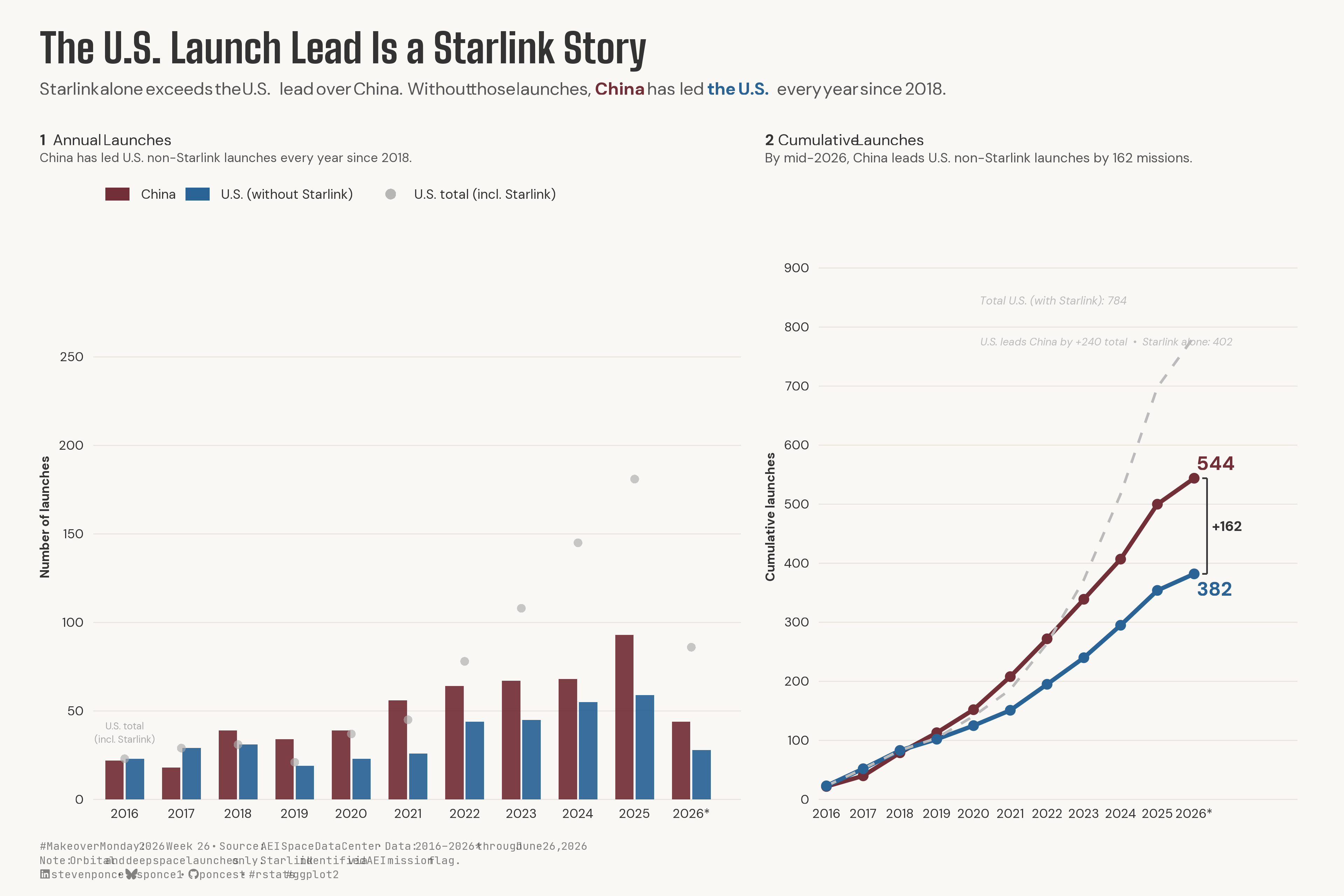
Starlink alone exceeds the U.S. lead over China. Without those launches, China has led the U.S. every year since 2018.

MakeoverMonday
Data Visualization
R Programming
2026
Annual and cumulative orbital launches (2016–2026 YTD) for the U.S. and China, comparing U.S. totals with and without Starlink missions. Decomposes the publisher’s aggregate launch count to reveal that China has led the U.S. in non-Starlink launches every year since 2018. Built in R with ggplot2 and patchwork.
Author

Steven Ponce

Published

June 30, 2026

Original

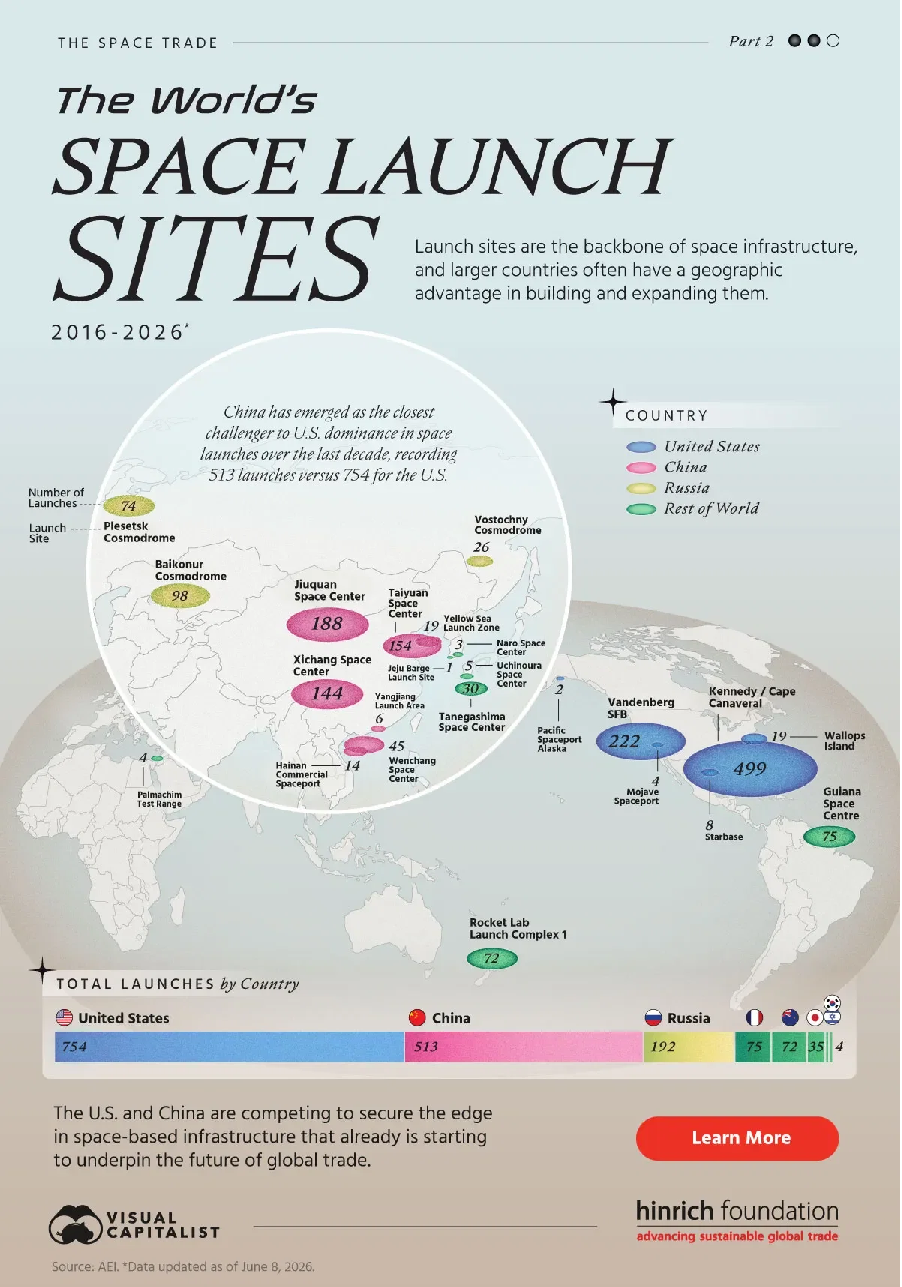
The original visualization comes from UFO Sightings

Original visualization

Makeover

Figure 1: Two-panel chart titled “The U.S. Launch Lead Is a Starlink Story.” Left panel: grouped bar chart of annual orbital launches, 2016–2026 YTD, comparing China (burgundy) to U.S. launches excluding Starlink (blue), with gray dots showing U.S. totals including Starlink. China’s bars exceed the U.S. non-Starlink bars every year from 2018 onward; the gray dots rise sharply after 2022, showing Starlink’s growing share of the U.S. total. Right panel: cumulative line chart showing China reaching 544 total launches by 2026 versus 382 for the U.S., excluding Starlink, a gap of 162 missions, while total U.S. launches, including Starlink, reach 784. Annotation notes Starlink alone (402 launches) exceeds the U.S.’s 240-launch lead over China in total figures.

Steps to Create this Graphic

1. Load Packages & Setup

Show code
```{r}
#| label: load
#| warning: false
#| message: false      
#| results: "hide"     

## 1. LOAD PACKAGES & SETUP ----
suppressPackageStartupMessages({
  if (!require("pacman")) install.packages("pacman")
  pacman::p_load(
    tidyverse, ggtext, showtext, scales, glue, 
    janitor, patchwork
)
})

### |- figure size ----
camcorder::gg_record(
  dir    = here::here("temp_plots"),
  device = "png",
  width  = 12,
  height = 8,
  units  = "in",
  dpi    = 320
)

# Source utility functions
suppressMessages(source(here::here("R/utils/fonts.R")))
source(here::here("R/utils/social_icons.R"))
source(here::here("R/utils/image_utils.R"))
source(here::here("R/themes/base_theme.R"))
```

2. Read in the Data

Show code
```{r}
#| label: read
#| include: true
#| eval: true
#| warning: false
#| 

df_raw <- read_csv(
  here::here("data/MakeoverMonday/2026/Launches (launches-launches-table-2026-06-29)_Launches.csv")) |>
  clean_names()
```

3. Examine the Data

Show code
```{r}
#| label: examine
#| include: true
#| eval: true
#| results: 'hide'
#| warning: false

glimpse(df_raw)
skimr::skim_without_charts(df_raw)
```

4. Tidy Data

Show code
```{r}
#| label: tidy
#| warning: false

df <- df_raw |>
  filter(
    year(launch_date) >= 2016,
    country_group %in% c("United States", "China")
  ) |>
  mutate(
    year = year(launch_date),
    group = case_when(
      country_group == "United States" & !is.na(starlink_mission) ~ "Starlink launches",
      country_group == "United States" & is.na(starlink_mission) ~ "U.S. (without Starlink)",
      country_group == "China" ~ "China"
    )
  )

### |- Panel 1: annual bars (China + US non-SL) and US total dots ----
annual_counts <- df |>
  count(year, group) |>
  complete(year, group, fill = list(n = 0L))

annual_us_total <- df |>
  filter(country_group == "United States") |>
  count(year, name = "us_total")

annual_bars <- annual_counts |>
  filter(group != "Starlink launches") |>
  mutate(group = factor(group, levels = c("China", "U.S. (without Starlink)")))

### |- Panel 2: cumulative — China, US non-Starlink, US Total (dashed reference only) ----
cumulative_lines <- df |>
  filter(group %in% c("China", "U.S. (without Starlink)")) |>
  count(year, group) |>
  complete(year, group, fill = list(n = 0L)) |>
  arrange(group, year) |>
  group_by(group) |>
  mutate(cumulative = cumsum(n)) |>
  ungroup()

us_total_line <- df |>
  filter(country_group == "United States") |>
  count(year) |>
  arrange(year) |>
  mutate(
    group      = "Total U.S. (with Starlink)",
    cumulative = cumsum(n)
  )

cumulative_all <- bind_rows(cumulative_lines, us_total_line)

### |- annotation coordinates (pre-extracted named scalars) ----
p2_china_end <- cumulative_all |> filter(year == 2026, group == "China") |> pull(cumulative)
p2_us_ns_end <- cumulative_all |> filter(year == 2026, group == "U.S. (without Starlink)") |> pull(cumulative)
p2_us_tot_end <- cumulative_all |> filter(year == 2026, group == "Total U.S. (with Starlink)") |> pull(cumulative)
p2_gap <- p2_china_end - p2_us_ns_end          
p2_us_lead <- p2_us_tot_end - p2_china_end         
p2_starlink_n  <- cumulative_all |>                    
  filter(year == 2026) |>
  summarise(sl = p2_us_tot_end - p2_us_ns_end) |>
  pull(sl)
p2_bracket_mid <- (p2_china_end + p2_us_ns_end) / 2
```

5. Visualization Parameters

Show code
```{r}
#| label: params
#| include: true
#| warning: false

### |-  plot aesthetics ----
col_china <- "#722F37"
col_us_ns <- "#2A6496"
col_starlink <- "#AAAAAA"
col_us_total <- "#BBBBBB"
col_annotation <- "#333333"
col_subtitle <- "#555555"
col_bg <- "#FAF8F4"
col_grid <- "#E8E4DE"

clrs <- get_theme_colors(palette = list(
  china      = col_china,
  us_ns      = col_us_ns,
  starlink   = col_starlink,
  annotation = col_annotation,
  background = col_bg
))

### |- titles and captions ----
title_text    <- "The U.S. Launch Lead Is a Starlink Story"

subtitle_text <- str_glue(
  "Starlink alone exceeds the U.S. lead over China. Without those launches, ",
  "<span style='color:{col_china}'>**China**</span> ",
  "has led <span style='color:{col_us_ns}'>**the U.S.**</span> ",
  "every year since 2018."
)

caption_text <- create_mm_caption(
  mm_year     = 2026,
  mm_week     = 26,
  source_text = "AEI Space Data Center · Data: 2016–2026* through June 26, 2026<br>
  Note: Orbital and deep space launches only. Starlink identified via AEI mission flag."
)

### |- fonts ----
setup_fonts()
fonts <- get_font_families()

### |- theme ----
base_theme   <- create_base_theme(clrs)
weekly_theme <- extend_weekly_theme(
  base_theme,
  theme(
    plot.background = element_rect(fill = col_bg, color = NA),
    panel.background = element_rect(fill = col_bg, color = NA),
    panel.grid.major.x = element_blank(),
    panel.grid.major.y = element_line(color = col_grid, linewidth = 0.3),
    panel.grid.minor = element_blank(),
    axis.ticks = element_blank(),
    axis.title.x = element_blank(),
    axis.title.y = element_text(
      size = 8, color = col_annotation,
      margin = margin(r = 6)
    ),
    axis.text = element_text(size = 8, color = col_annotation),
    legend.position = "top",
    legend.direction = "horizontal",
    legend.justification = "left",
    legend.background = element_rect(fill = col_bg, color = NA),
    legend.text = element_text(size = 8.5, color = col_annotation),
    legend.key.width = unit(1.2, "lines"),
    legend.key.height = unit(0.7, "lines"),
    legend.spacing.x = unit(0.5, "lines"),
    plot.margin = margin(t = 6, r = 10, b = 4, l = 6)
  )
)

theme_set(weekly_theme)
```

6. Plot

Show code
```{r}
#| label: plot
#| warning: false

### |- Panel 1: grouped bars + gray context dots ----

# First dot only gets a label — 2016
p1_dot_label <- annual_us_total |> filter(year == 2016)

p1 <- ggplot() +

  # Geoms
  geom_col(
    data = annual_bars,
    aes(x = year, y = n, fill = group),
    position = position_dodge(width = 0.72),
    width = 0.65, alpha = 0.92
  ) +
  geom_point(
    data = tibble(year = NA_real_, us_total = NA_real_, dot_label = "U.S. total (incl. Starlink)"),
    aes(x = year, y = us_total, color = dot_label),
    size = 2.2, shape = 16, alpha = 0.65
  ) +
  geom_point(
    data = annual_us_total,
    aes(x = year, y = us_total),
    color = col_starlink, size = 2.2, shape = 16, alpha = 0.65,
    show.legend = FALSE
  ) +
  geom_text(
    data = p1_dot_label,
    aes(
      x = year, y = us_total,
      label = "U.S. total\n(incl. Starlink)"
    ),
    nudge_y = 9, size = 2.2, color = col_starlink,
    lineheight = 1.15, hjust = 0.5, vjust = 0
  ) +
  # Scales
  scale_fill_manual(
    values = c(
      "China"                   = col_china,
      "U.S. (without Starlink)" = col_us_ns
    ),
    guide = guide_legend(
      nrow = 1, order = 1,
      override.aes = list(alpha = 1, shape = NA)
    )
  ) +
  scale_color_manual(
    values = c("U.S. total (incl. Starlink)" = col_starlink),
    guide = guide_legend(
      nrow = 1, order = 2,
      override.aes = list(
        shape = 16, size = 2.8, alpha = 0.85,
        linetype = 0, fill = NA
      )
    )
  ) +
  scale_x_continuous(
    breaks = 2016:2026,
    labels = c(as.character(2016:2025), "2026*"),
    expand = expansion(mult = c(0.02, 0.05))
  ) +
  scale_y_continuous(
    limits = c(0, 280),
    breaks = seq(0, 250, 50),
    expand = expansion(mult = c(0, 0.14))
  ) +
  coord_cartesian(clip = "off") +
  # Labs
  labs(
    title = "**1** &nbsp; Annual Launches",
    subtitle = "China has led U.S. non-Starlink launches every year since 2018.",
    y = "Number of launches",
    fill = NULL,
    color = NULL
  ) +
  # Theme
  theme(
    plot.title = element_markdown(
      size = 10, color = col_annotation,
      margin = margin(b = 3)
    ),
    plot.subtitle = element_text(
      size = 8, color = col_subtitle,
      lineheight = 1.3, margin = margin(b = 6)
    )
  )

### |- Panel 2: cumulative lines ----

p2 <- ggplot(
  cumulative_all |>
    mutate(group = factor(group, levels = c(
      "China", "U.S. (without Starlink)", "Total U.S. (with Starlink)"
    ))),
  aes(
    x = year, y = cumulative,
    color = group, linetype = group, linewidth = group
  )
) +
  # Geoms
  geom_line() +
  geom_point(
    data = cumulative_all |>
      filter(group %in% c("China", "U.S. (without Starlink)")),
    size = 2.4, show.legend = FALSE
  ) +

  # Annotate
  annotate("segment",
    x = 2026.35, xend = 2026.35,
    y = p2_us_ns_end, yend = p2_china_end,
    color = col_annotation, linewidth = 0.5
  ) +
  annotate("segment",
    x = 2026.22, xend = 2026.35,
    y = p2_china_end, yend = p2_china_end,
    color = col_annotation, linewidth = 0.5
  ) +
  annotate("segment",
    x = 2026.22, xend = 2026.35,
    y = p2_us_ns_end, yend = p2_us_ns_end,
    color = col_annotation, linewidth = 0.5
  ) +
  annotate("text",
    x = 2026.5, y = p2_bracket_mid,
    label = glue("+{p2_gap}"),
    hjust = 0, vjust = 0.5, size = 3.2,
    color = col_annotation, fontface = "bold"
  ) +
  annotate("text",
    x = 2020.2, y = 845,
    label = glue("Total U.S. (with Starlink): {p2_us_tot_end}"),
    hjust = 0, vjust = 0.5, size = 2.5,
    color = col_us_total, fontface = "italic"
  ) +
  annotate("text",
    x = 2020.2, y = 775,
    label = glue(
      "U.S. leads China by +{p2_us_lead} total  \u2022  Starlink alone: {p2_starlink_n}"
    ),
    hjust = 0, vjust = 0.5, size = 2.4,
    color = col_us_total, fontface = "italic"
  ) +
  annotate("text",
    x = 2026.1, y = p2_china_end + 14,
    label = as.character(p2_china_end),
    hjust = 0, vjust = 0, size = 4.4,
    color = col_china, fontface = "bold"
  ) +
  annotate("text",
    x = 2026.1, y = p2_us_ns_end - 14,
    label = as.character(p2_us_ns_end),
    hjust = 0, vjust = 1, size = 4.4,
    color = col_us_ns, fontface = "bold"
  ) +
  # Scales
  scale_color_manual(
    values = c(
      "China" = col_china,
      "U.S. (without Starlink)" = col_us_ns,
      "Total U.S. (with Starlink)" = col_us_total
    ),
    guide = "none"
  ) +
  scale_linetype_manual(
    values = c(
      "China" = "solid",
      "U.S. (without Starlink)" = "solid",
      "Total U.S. (with Starlink)" = "dashed"
    ),
    guide = "none"
  ) +
  scale_linewidth_manual(
    values = c(
      "China" = 1.3,
      "U.S. (without Starlink)" = 1.3,
      "Total U.S. (with Starlink)" = 0.8
    ),
    guide = "none"
  ) +
  scale_x_continuous(
    breaks = 2016:2026,
    labels = c(as.character(2016:2025), "2026*"),
    expand = expansion(mult = c(0.02, 0.22))
  ) +
  scale_y_continuous(
    limits = c(0, 920),
    breaks = seq(0, 900, 100),
    expand = expansion(mult = c(0, 0.04))
  ) +
  coord_cartesian(clip = "off") +
  # Labs
  labs(
    title = "**2** &nbsp; Cumulative Launches",
    subtitle = glue("By mid-2026, China leads U.S. non-Starlink launches by {p2_gap} missions."),
    y = "Cumulative launches"
  ) +
  # Theme
  theme(
    plot.title = element_markdown(
      size = 10, color = col_annotation,
      margin = margin(b = 3)
    ),
    plot.subtitle = element_text(
      size = 8.5, color = col_subtitle,
      lineheight = 1.3, margin = margin(b = 6)
    )
  )

### |- combine plots ----
p_combined <- (p1 | p2) +
  plot_layout(widths = c(1.15, 0.85)) +
  plot_annotation(
    title = title_text,
    subtitle = subtitle_text,
    caption = caption_text,
    theme = theme(
      plot.title = element_text(
        size = rel(1.85), face = "bold", family = fonts$title_1,
        color = col_annotation,
        margin = margin(b = 6)
      ),
      plot.subtitle = element_markdown(
        size = rel(0.8),
        color = col_subtitle, family = fonts$subtitle,
        lineheight = 1.35,
        margin = margin(b = 16)
      ),
      plot.caption = element_markdown(
        size = rel(0.5),
        color = alpha(col_annotation, 0.60),
        hjust = 0,
        lineheight = 1.3,
        margin = margin(t = 8), family = fonts$caption
      ),
      plot.margin = margin(t = 20, r = 20, b = 10, l = 20),
      plot.background = element_rect(fill = col_bg, color = NA)
    )
  )
```

7. Save

Show code
```{r}
#| label: save
#| warning: false

### |-  plot image ----  
save_plot_patchwork(
  plot = p_combined, 
  type = "makeovermonday", 
  year = current_year,
  week = current_week,
  width = 12, 
  height = 8
  )
```

8. Session Info

TipExpand for Session Info
R version 4.5.3 (2026-03-11 ucrt)
Platform: x86_64-w64-mingw32/x64
Running under: Windows 11 x64 (build 26100)

Matrix products: default
  LAPACK version 3.12.1

locale:
[1] LC_COLLATE=English_United States.utf8 
[2] LC_CTYPE=English_United States.utf8   
[3] LC_MONETARY=English_United States.utf8
[4] LC_NUMERIC=C                          
[5] LC_TIME=English_United States.utf8    

time zone: America/New_York
tzcode source: internal

attached base packages:
[1] stats     graphics  grDevices utils     datasets  methods   base     

other attached packages:
 [1] here_1.0.2      patchwork_1.3.2 janitor_2.2.1   glue_1.8.0     
 [5] scales_1.4.0    showtext_0.9-8  showtextdb_3.0  sysfonts_0.8.9 
 [9] ggtext_0.1.2    lubridate_1.9.5 forcats_1.0.1   stringr_1.6.0  
[13] dplyr_1.2.1     purrr_1.2.2     readr_2.2.0     tidyr_1.3.2    
[17] tibble_3.3.1    ggplot2_4.0.3   tidyverse_2.0.0 pacman_0.5.1   

loaded via a namespace (and not attached):
 [1] gtable_0.3.6       xfun_0.57          htmlwidgets_1.6.4  tzdb_0.5.0        
 [5] yulab.utils_0.2.4  vctrs_0.7.3        tools_4.5.3        generics_0.1.4    
 [9] curl_7.0.0         parallel_4.5.3     gifski_1.32.0-2    pkgconfig_2.0.3   
[13] ggplotify_0.1.3    skimr_2.2.2        RColorBrewer_1.1-3 S7_0.2.1          
[17] lifecycle_1.0.5    compiler_4.5.3     farver_2.1.2       textshaping_1.0.5 
[21] repr_1.1.7         codetools_0.2-20   snakecase_0.11.1   litedown_0.9      
[25] htmltools_0.5.9    yaml_2.3.12        crayon_1.5.3       pillar_1.11.1     
[29] camcorder_0.1.0    magick_2.9.1       commonmark_2.0.0   tidyselect_1.2.1  
[33] digest_0.6.39      stringi_1.8.7      rsvg_2.7.0         rprojroot_2.1.1   
[37] fastmap_1.2.0      grid_4.5.3         cli_3.6.6          magrittr_2.0.5    
[41] base64enc_0.1-6    withr_3.0.2        rappdirs_0.3.4     bit64_4.6.0-1     
[45] timechange_0.4.0   rmarkdown_2.31     bit_4.6.0          otel_0.2.0        
[49] hms_1.1.4          evaluate_1.0.5     knitr_1.51         markdown_2.0      
[53] gridGraphics_0.5-1 rlang_1.2.0        gridtext_0.1.6     Rcpp_1.1.1        
[57] xml2_1.5.2         svglite_2.2.2      rstudioapi_0.18.0  vroom_1.7.1       
[61] jsonlite_2.0.0     R6_2.6.1           fs_2.0.1           systemfonts_1.3.2 

9. GitHub Repository

TipExpand for GitHub Repo

The complete code for this analysis is available in mm_2026_26.qmd.

For the full repository, click here.

10. References

TipExpand for References

Primary Data (Makeover Monday):

  1. Makeover Monday 2026 Week 26: The World’s Space Launch Sites, 2016–2026
    • CSV: 7,335 rows × 18 columns (country, country_group, launch_category, launch_date, launch_outcome, launch_site, launch_site_name, launch_tag, launch_vehicle, lv_type, starlink_mission, variant, vehicle_size, actual_payload_metric_tons, latitude, longitude, leo_metric_tons, sso_metric_tons); one row per individual launch, full history back to 1957-10-04
    • The makeover filters to 2016–2026 YTD to match the original chart’s stated scope, and further filters to country_group = United States / China only — the two countries the analytical argument concerns
  2. Original Chart: Mapped: The World’s Space Launch Sites, 2016–2026 — Visual Capitalist / Hinrich Foundation, published via Voronoi
    • A proportional bubble map of launch sites by country, showing total launches 2016 through June 8, 2026. The original’s headline claim — U.S. dominance (754 launches vs. China’s 513) — motivated this makeover’s central question: does that lead hold once Starlink’s commercial megaconstellation missions are separated from sovereign/commercial launches?

Source Data:

  1. AEI Space Data Center
    • Ultimate source of the launch records; the American Enterprise Institute’s Space Data Center tracks orbital and deep-space launches globally, including mission-level flags (e.g., Starlink identification) not present in the original chart’s published aggregates

11. Custom Functions Documentation

Note📦 Custom Helper Functions

This analysis uses custom functions from my personal module library for efficiency and consistency across projects.

Functions Used:

  • fonts.R: setup_fonts(), get_font_families() - Font management with showtext
  • social_icons.R: create_social_caption() - Generates formatted social media captions
  • image_utils.R: save_plot() - Consistent plot saving with naming conventions
  • base_theme.R: create_base_theme(), extend_weekly_theme(), get_theme_colors() - Custom ggplot2 themes

Why custom functions?
These utilities standardize theming, fonts, and output across all my data visualizations. The core analysis (data tidying and visualization logic) uses only standard tidyverse packages.

Source Code:
View all custom functions → GitHub: R/utils

Back to top

Citation

BibTeX citation:
@online{ponce2026,
  author = {Ponce, Steven},
  title = {The {U.S.} {Launch} {Lead} {Is} a {Starlink} {Story}},
  date = {2026-06-30},
  url = {https://stevenponce.netlify.app/data_visualizations/MakeoverMonday/2026/mm_2026_26.html},
  langid = {en}
}
For attribution, please cite this work as:
Ponce, Steven. 2026. “The U.S. Launch Lead Is a Starlink Story.” June 30. https://stevenponce.netlify.app/data_visualizations/MakeoverMonday/2026/mm_2026_26.html.
Source Code
---
title: "The U.S. Launch Lead Is a Starlink Story"
subtitle: "Starlink alone exceeds the U.S. lead over China. Without those launches, China has led the U.S. every year since 2018."
description: "Annual and cumulative orbital launches (2016–2026 YTD) for the U.S. and China, comparing U.S. totals with and without Starlink missions. Decomposes the publisher's aggregate launch count to reveal that China has led the U.S. in non-Starlink launches every year since 2018. Built in R with ggplot2 and patchwork."
date: "2026-06-30"
author:
  - name: "Steven Ponce"
    url: "https://stevenponce.netlify.app"
citation:
  url: "https://stevenponce.netlify.app/data_visualizations/MakeoverMonday/2026/mm_2026_26.html"
categories: ["MakeoverMonday", "Data Visualization", "R Programming", "2026"]
tags: [
  "makeover-monday",
  "data-visualization",
  "ggplot2",
  "patchwork",
  "bar-chart",
  "line-chart",
  "space",
  "geopolitics",
  "China",
  "United States",
  "Starlink",
  "annotation",
  "decomposition",
  "2026"
]
image: "thumbnails/mm_2026_26.png"
format:
  html:
    toc: true
    toc-depth: 5
    code-link: true
    code-fold: true
    code-tools: true
    code-summary: "Show code"
    self-contained: true
    theme: 
      light: [flatly, assets/styling/custom_styles.scss]
      dark: [darkly, assets/styling/custom_styles_dark.scss]
editor_options: 
  chunk_output_type: inline
execute: 
  freeze: true
  cache: true
  error: false
  message: false
  warning: false
  eval: true
---

```{r}
#| label: setup-links
#| include: false

# CENTRALIZED LINK MANAGEMENT

## Project-specific info 
current_year <- 2026
current_week <- 26
project_file <- "mm_2026_26.qmd"
project_image <- "mm_2026_26.png"

## Data Sources
data_main <- "https://data.world/makeovermonday/2026wk26-the-worlds-space-launch-sites"
data_secondary <- "https://data.world/makeovermonday/2026wk26-the-worlds-space-launch-sites"

## Repository Links  
repo_main <- "https://github.com/poncest/personal-website/"
repo_file <- paste0("https://github.com/poncest/personal-website/blob/master/data_visualizations/MakeoverMonday/", current_year, "/", project_file)

## External Resources/Images
chart_original <- "https://raw.githubusercontent.com/poncest/MakeoverMonday/refs/heads/master/2026/Week_26/original_chart.png"

## Organization/Platform Links
org_primary <- "https://www.voronoiapp.com/geopolitics/Mapped-The-Worlds-Space-Launch-Sites-2016-2026-8434"
org_secondary <- "https://www.voronoiapp.com/geopolitics/Mapped-The-Worlds-Space-Launch-Sites-2016-2026-8434"

# Helper function to create markdown links
create_link <- function(text, url) {
  paste0("[", text, "](", url, ")")
}

# Helper function for citation-style links
create_citation_link <- function(text, url, title = NULL) {
  if (is.null(title)) {
    paste0("[", text, "](", url, ")")
  } else {
    paste0("[", text, "](", url, ' "', title, '")')
  }
}
```

### Original

The original visualization comes from `r create_link("UFO Sightings", data_secondary)`
![Original visualization](https://raw.githubusercontent.com/poncest/MakeoverMonday/refs/heads/master/2026/Week_26/original_chart.png)

### Makeover

![Two-panel chart titled "The U.S. Launch Lead Is a Starlink Story." Left panel: grouped bar chart of annual orbital launches, 2016–2026 YTD, comparing China (burgundy) to U.S. launches excluding Starlink (blue), with gray dots showing U.S. totals including Starlink. China's bars exceed the U.S. non-Starlink bars every year from 2018 onward; the gray dots rise sharply after 2022, showing Starlink's growing share of the U.S. total. Right panel: cumulative line chart showing China reaching 544 total launches by 2026 versus 382 for the U.S., excluding Starlink, a gap of 162 missions, while total U.S. launches, including Starlink, reach 784. Annotation notes Starlink alone (402 launches) exceeds the U.S.'s 240-launch lead over China in total figures.](mm_2026_26.png){#fig-1}

### [**Steps to Create this Graphic**]{.mark}

#### [1. Load Packages & Setup]{.smallcaps}

```{r}
#| label: load
#| warning: false
#| message: false      
#| results: "hide"     

## 1. LOAD PACKAGES & SETUP ----
suppressPackageStartupMessages({
  if (!require("pacman")) install.packages("pacman")
  pacman::p_load(
    tidyverse, ggtext, showtext, scales, glue, 
    janitor, patchwork
)
})

### |- figure size ----
camcorder::gg_record(
  dir    = here::here("temp_plots"),
  device = "png",
  width  = 12,
  height = 8,
  units  = "in",
  dpi    = 320
)

# Source utility functions
suppressMessages(source(here::here("R/utils/fonts.R")))
source(here::here("R/utils/social_icons.R"))
source(here::here("R/utils/image_utils.R"))
source(here::here("R/themes/base_theme.R"))
```

#### [2. Read in the Data]{.smallcaps}

```{r}
#| label: read
#| include: true
#| eval: true
#| warning: false
#| 

df_raw <- read_csv(
  here::here("data/MakeoverMonday/2026/Launches (launches-launches-table-2026-06-29)_Launches.csv")) |>
  clean_names()
```

#### [3. Examine the Data]{.smallcaps}

```{r}
#| label: examine
#| include: true
#| eval: true
#| results: 'hide'
#| warning: false

glimpse(df_raw)
skimr::skim_without_charts(df_raw)
```

#### [4. Tidy Data]{.smallcaps}

```{r}
#| label: tidy
#| warning: false

df <- df_raw |>
  filter(
    year(launch_date) >= 2016,
    country_group %in% c("United States", "China")
  ) |>
  mutate(
    year = year(launch_date),
    group = case_when(
      country_group == "United States" & !is.na(starlink_mission) ~ "Starlink launches",
      country_group == "United States" & is.na(starlink_mission) ~ "U.S. (without Starlink)",
      country_group == "China" ~ "China"
    )
  )

### |- Panel 1: annual bars (China + US non-SL) and US total dots ----
annual_counts <- df |>
  count(year, group) |>
  complete(year, group, fill = list(n = 0L))

annual_us_total <- df |>
  filter(country_group == "United States") |>
  count(year, name = "us_total")

annual_bars <- annual_counts |>
  filter(group != "Starlink launches") |>
  mutate(group = factor(group, levels = c("China", "U.S. (without Starlink)")))

### |- Panel 2: cumulative — China, US non-Starlink, US Total (dashed reference only) ----
cumulative_lines <- df |>
  filter(group %in% c("China", "U.S. (without Starlink)")) |>
  count(year, group) |>
  complete(year, group, fill = list(n = 0L)) |>
  arrange(group, year) |>
  group_by(group) |>
  mutate(cumulative = cumsum(n)) |>
  ungroup()

us_total_line <- df |>
  filter(country_group == "United States") |>
  count(year) |>
  arrange(year) |>
  mutate(
    group      = "Total U.S. (with Starlink)",
    cumulative = cumsum(n)
  )

cumulative_all <- bind_rows(cumulative_lines, us_total_line)

### |- annotation coordinates (pre-extracted named scalars) ----
p2_china_end <- cumulative_all |> filter(year == 2026, group == "China") |> pull(cumulative)
p2_us_ns_end <- cumulative_all |> filter(year == 2026, group == "U.S. (without Starlink)") |> pull(cumulative)
p2_us_tot_end <- cumulative_all |> filter(year == 2026, group == "Total U.S. (with Starlink)") |> pull(cumulative)
p2_gap <- p2_china_end - p2_us_ns_end          
p2_us_lead <- p2_us_tot_end - p2_china_end         
p2_starlink_n  <- cumulative_all |>                    
  filter(year == 2026) |>
  summarise(sl = p2_us_tot_end - p2_us_ns_end) |>
  pull(sl)
p2_bracket_mid <- (p2_china_end + p2_us_ns_end) / 2
```

#### [5. Visualization Parameters]{.smallcaps}

```{r}
#| label: params
#| include: true
#| warning: false

### |-  plot aesthetics ----
col_china <- "#722F37"
col_us_ns <- "#2A6496"
col_starlink <- "#AAAAAA"
col_us_total <- "#BBBBBB"
col_annotation <- "#333333"
col_subtitle <- "#555555"
col_bg <- "#FAF8F4"
col_grid <- "#E8E4DE"

clrs <- get_theme_colors(palette = list(
  china      = col_china,
  us_ns      = col_us_ns,
  starlink   = col_starlink,
  annotation = col_annotation,
  background = col_bg
))

### |- titles and captions ----
title_text    <- "The U.S. Launch Lead Is a Starlink Story"

subtitle_text <- str_glue(
  "Starlink alone exceeds the U.S. lead over China. Without those launches, ",
  "<span style='color:{col_china}'>**China**</span> ",
  "has led <span style='color:{col_us_ns}'>**the U.S.**</span> ",
  "every year since 2018."
)

caption_text <- create_mm_caption(
  mm_year     = 2026,
  mm_week     = 26,
  source_text = "AEI Space Data Center · Data: 2016–2026* through June 26, 2026<br>
  Note: Orbital and deep space launches only. Starlink identified via AEI mission flag."
)

### |- fonts ----
setup_fonts()
fonts <- get_font_families()

### |- theme ----
base_theme   <- create_base_theme(clrs)
weekly_theme <- extend_weekly_theme(
  base_theme,
  theme(
    plot.background = element_rect(fill = col_bg, color = NA),
    panel.background = element_rect(fill = col_bg, color = NA),
    panel.grid.major.x = element_blank(),
    panel.grid.major.y = element_line(color = col_grid, linewidth = 0.3),
    panel.grid.minor = element_blank(),
    axis.ticks = element_blank(),
    axis.title.x = element_blank(),
    axis.title.y = element_text(
      size = 8, color = col_annotation,
      margin = margin(r = 6)
    ),
    axis.text = element_text(size = 8, color = col_annotation),
    legend.position = "top",
    legend.direction = "horizontal",
    legend.justification = "left",
    legend.background = element_rect(fill = col_bg, color = NA),
    legend.text = element_text(size = 8.5, color = col_annotation),
    legend.key.width = unit(1.2, "lines"),
    legend.key.height = unit(0.7, "lines"),
    legend.spacing.x = unit(0.5, "lines"),
    plot.margin = margin(t = 6, r = 10, b = 4, l = 6)
  )
)

theme_set(weekly_theme)
```

#### [6. Plot]{.smallcaps}

```{r}
#| label: plot
#| warning: false

### |- Panel 1: grouped bars + gray context dots ----

# First dot only gets a label — 2016
p1_dot_label <- annual_us_total |> filter(year == 2016)

p1 <- ggplot() +

  # Geoms
  geom_col(
    data = annual_bars,
    aes(x = year, y = n, fill = group),
    position = position_dodge(width = 0.72),
    width = 0.65, alpha = 0.92
  ) +
  geom_point(
    data = tibble(year = NA_real_, us_total = NA_real_, dot_label = "U.S. total (incl. Starlink)"),
    aes(x = year, y = us_total, color = dot_label),
    size = 2.2, shape = 16, alpha = 0.65
  ) +
  geom_point(
    data = annual_us_total,
    aes(x = year, y = us_total),
    color = col_starlink, size = 2.2, shape = 16, alpha = 0.65,
    show.legend = FALSE
  ) +
  geom_text(
    data = p1_dot_label,
    aes(
      x = year, y = us_total,
      label = "U.S. total\n(incl. Starlink)"
    ),
    nudge_y = 9, size = 2.2, color = col_starlink,
    lineheight = 1.15, hjust = 0.5, vjust = 0
  ) +
  # Scales
  scale_fill_manual(
    values = c(
      "China"                   = col_china,
      "U.S. (without Starlink)" = col_us_ns
    ),
    guide = guide_legend(
      nrow = 1, order = 1,
      override.aes = list(alpha = 1, shape = NA)
    )
  ) +
  scale_color_manual(
    values = c("U.S. total (incl. Starlink)" = col_starlink),
    guide = guide_legend(
      nrow = 1, order = 2,
      override.aes = list(
        shape = 16, size = 2.8, alpha = 0.85,
        linetype = 0, fill = NA
      )
    )
  ) +
  scale_x_continuous(
    breaks = 2016:2026,
    labels = c(as.character(2016:2025), "2026*"),
    expand = expansion(mult = c(0.02, 0.05))
  ) +
  scale_y_continuous(
    limits = c(0, 280),
    breaks = seq(0, 250, 50),
    expand = expansion(mult = c(0, 0.14))
  ) +
  coord_cartesian(clip = "off") +
  # Labs
  labs(
    title = "**1** &nbsp; Annual Launches",
    subtitle = "China has led U.S. non-Starlink launches every year since 2018.",
    y = "Number of launches",
    fill = NULL,
    color = NULL
  ) +
  # Theme
  theme(
    plot.title = element_markdown(
      size = 10, color = col_annotation,
      margin = margin(b = 3)
    ),
    plot.subtitle = element_text(
      size = 8, color = col_subtitle,
      lineheight = 1.3, margin = margin(b = 6)
    )
  )

### |- Panel 2: cumulative lines ----

p2 <- ggplot(
  cumulative_all |>
    mutate(group = factor(group, levels = c(
      "China", "U.S. (without Starlink)", "Total U.S. (with Starlink)"
    ))),
  aes(
    x = year, y = cumulative,
    color = group, linetype = group, linewidth = group
  )
) +
  # Geoms
  geom_line() +
  geom_point(
    data = cumulative_all |>
      filter(group %in% c("China", "U.S. (without Starlink)")),
    size = 2.4, show.legend = FALSE
  ) +

  # Annotate
  annotate("segment",
    x = 2026.35, xend = 2026.35,
    y = p2_us_ns_end, yend = p2_china_end,
    color = col_annotation, linewidth = 0.5
  ) +
  annotate("segment",
    x = 2026.22, xend = 2026.35,
    y = p2_china_end, yend = p2_china_end,
    color = col_annotation, linewidth = 0.5
  ) +
  annotate("segment",
    x = 2026.22, xend = 2026.35,
    y = p2_us_ns_end, yend = p2_us_ns_end,
    color = col_annotation, linewidth = 0.5
  ) +
  annotate("text",
    x = 2026.5, y = p2_bracket_mid,
    label = glue("+{p2_gap}"),
    hjust = 0, vjust = 0.5, size = 3.2,
    color = col_annotation, fontface = "bold"
  ) +
  annotate("text",
    x = 2020.2, y = 845,
    label = glue("Total U.S. (with Starlink): {p2_us_tot_end}"),
    hjust = 0, vjust = 0.5, size = 2.5,
    color = col_us_total, fontface = "italic"
  ) +
  annotate("text",
    x = 2020.2, y = 775,
    label = glue(
      "U.S. leads China by +{p2_us_lead} total  \u2022  Starlink alone: {p2_starlink_n}"
    ),
    hjust = 0, vjust = 0.5, size = 2.4,
    color = col_us_total, fontface = "italic"
  ) +
  annotate("text",
    x = 2026.1, y = p2_china_end + 14,
    label = as.character(p2_china_end),
    hjust = 0, vjust = 0, size = 4.4,
    color = col_china, fontface = "bold"
  ) +
  annotate("text",
    x = 2026.1, y = p2_us_ns_end - 14,
    label = as.character(p2_us_ns_end),
    hjust = 0, vjust = 1, size = 4.4,
    color = col_us_ns, fontface = "bold"
  ) +
  # Scales
  scale_color_manual(
    values = c(
      "China" = col_china,
      "U.S. (without Starlink)" = col_us_ns,
      "Total U.S. (with Starlink)" = col_us_total
    ),
    guide = "none"
  ) +
  scale_linetype_manual(
    values = c(
      "China" = "solid",
      "U.S. (without Starlink)" = "solid",
      "Total U.S. (with Starlink)" = "dashed"
    ),
    guide = "none"
  ) +
  scale_linewidth_manual(
    values = c(
      "China" = 1.3,
      "U.S. (without Starlink)" = 1.3,
      "Total U.S. (with Starlink)" = 0.8
    ),
    guide = "none"
  ) +
  scale_x_continuous(
    breaks = 2016:2026,
    labels = c(as.character(2016:2025), "2026*"),
    expand = expansion(mult = c(0.02, 0.22))
  ) +
  scale_y_continuous(
    limits = c(0, 920),
    breaks = seq(0, 900, 100),
    expand = expansion(mult = c(0, 0.04))
  ) +
  coord_cartesian(clip = "off") +
  # Labs
  labs(
    title = "**2** &nbsp; Cumulative Launches",
    subtitle = glue("By mid-2026, China leads U.S. non-Starlink launches by {p2_gap} missions."),
    y = "Cumulative launches"
  ) +
  # Theme
  theme(
    plot.title = element_markdown(
      size = 10, color = col_annotation,
      margin = margin(b = 3)
    ),
    plot.subtitle = element_text(
      size = 8.5, color = col_subtitle,
      lineheight = 1.3, margin = margin(b = 6)
    )
  )

### |- combine plots ----
p_combined <- (p1 | p2) +
  plot_layout(widths = c(1.15, 0.85)) +
  plot_annotation(
    title = title_text,
    subtitle = subtitle_text,
    caption = caption_text,
    theme = theme(
      plot.title = element_text(
        size = rel(1.85), face = "bold", family = fonts$title_1,
        color = col_annotation,
        margin = margin(b = 6)
      ),
      plot.subtitle = element_markdown(
        size = rel(0.8),
        color = col_subtitle, family = fonts$subtitle,
        lineheight = 1.35,
        margin = margin(b = 16)
      ),
      plot.caption = element_markdown(
        size = rel(0.5),
        color = alpha(col_annotation, 0.60),
        hjust = 0,
        lineheight = 1.3,
        margin = margin(t = 8), family = fonts$caption
      ),
      plot.margin = margin(t = 20, r = 20, b = 10, l = 20),
      plot.background = element_rect(fill = col_bg, color = NA)
    )
  )

```

#### [7. Save]{.smallcaps}

```{r}
#| label: save
#| warning: false

### |-  plot image ----  
save_plot_patchwork(
  plot = p_combined, 
  type = "makeovermonday", 
  year = current_year,
  week = current_week,
  width = 12, 
  height = 8
  )
```

#### [8. Session Info]{.smallcaps}

::: {.callout-tip collapse="true"}
##### Expand for Session Info

```{r, echo = FALSE}
#| eval: true
#| warning: false

sessionInfo()
```
:::

#### [9. GitHub Repository]{.smallcaps}

::: {.callout-tip collapse="true"}
##### Expand for GitHub Repo

The complete code for this analysis is available in `r create_link(project_file, repo_file)`.

For the full repository, `r create_link("click here", repo_main)`.
:::

#### [10. References]{.smallcaps}

::: {.callout-tip collapse="true"}
##### Expand for References

**Primary Data (Makeover Monday):**

1. Makeover Monday `r current_year` Week `r current_week`: `r create_link("The World's Space Launch Sites, 2016–2026", "https://data.world/makeovermonday/2026wk26-the-worlds-space-launch-sites")`
   - CSV: 7,335 rows × 18 columns (`country`, `country_group`, `launch_category`, `launch_date`, `launch_outcome`, `launch_site`, `launch_site_name`, `launch_tag`, `launch_vehicle`, `lv_type`, `starlink_mission`, `variant`, `vehicle_size`, `actual_payload_metric_tons`, `latitude`, `longitude`, `leo_metric_tons`, `sso_metric_tons`); one row per individual launch, full history back to 1957-10-04
   - The makeover filters to 2016–2026 YTD to match the original chart's stated scope, and further filters to `country_group` = United States / China only — the two countries the analytical argument concerns

2. Original Chart: `r create_link("Mapped: The World's Space Launch Sites, 2016–2026", "https://www.voronoiapp.com/geopolitics/Mapped-The-Worlds-Space-Launch-Sites-2016-2026-8434")` — Visual Capitalist / Hinrich Foundation, published via Voronoi
   - A proportional bubble map of launch sites by country, showing total launches 2016 through June 8, 2026. The original's headline claim — U.S. dominance (754 launches vs. China's 513) — motivated this makeover's central question: does that lead hold once Starlink's commercial megaconstellation missions are separated from sovereign/commercial launches?

**Source Data:**

3. `r create_link("AEI Space Data Center", "https://spacedata.aei.org/space/launches/")`
   - Ultimate source of the launch records; the American Enterprise Institute's Space Data Center tracks orbital and deep-space launches globally, including mission-level flags (e.g., Starlink identification) not present in the original chart's published aggregates

:::


#### [11. Custom Functions Documentation]{.smallcaps}

::: {.callout-note collapse="true"}
##### 📦 Custom Helper Functions

This analysis uses custom functions from my personal module library for efficiency and consistency across projects.

**Functions Used:**

-   **`fonts.R`**: `setup_fonts()`, `get_font_families()` - Font management with showtext
-   **`social_icons.R`**: `create_social_caption()` - Generates formatted social media captions
-   **`image_utils.R`**: `save_plot()` - Consistent plot saving with naming conventions
-   **`base_theme.R`**: `create_base_theme()`, `extend_weekly_theme()`, `get_theme_colors()` - Custom ggplot2 themes

**Why custom functions?**\
These utilities standardize theming, fonts, and output across all my data visualizations. The core analysis (data tidying and visualization logic) uses only standard tidyverse packages.

**Source Code:**\
View all custom functions → [GitHub: R/utils](https://github.com/poncest/personal-website/tree/master/R)
:::

© 2024 Steven Ponce

Source Issues
