---
title: "The Böögg Cannot Predict Record Hot Summers"
subtitle: "The folklore: A faster Böögg explosion means a hotter summer. The reality: Record summers (>19°C) occurred whether the Böögg took 4 minutes or 60. Correlation: r = +0.19."
description: "Exploring whether Zurich's Sechseläuten festival tradition holds predictive power: does a faster Böögg explosion mean a hotter summer? This TidyTuesday visualization tests folklore against climate data, revealing a correlation of +0.19—the opposite direction from what tradition claims."
date: "2025-11-29"
categories: ["TidyTuesday", "2025"]
tags: [
"Sechseläuten",
"Böögg",
"Swiss Folklore",
"Climate Data",
"Weather Prediction",
"Scatter Plot",
"ggplot2",
"ggrepel",
"Correlation Analysis",
"MeteoSwiss",
"Zurich"
]
image: "thumbnails/tt_2025_48.png"
format:
html:
toc: true
toc-depth: 5
code-link: true
code-fold: true
code-tools: true
code-summary: "Show code"
editor_options:
chunk_output_type: inline
execute:
freeze: true
cache: true
error: false
message: false
warning: false
eval: true
---
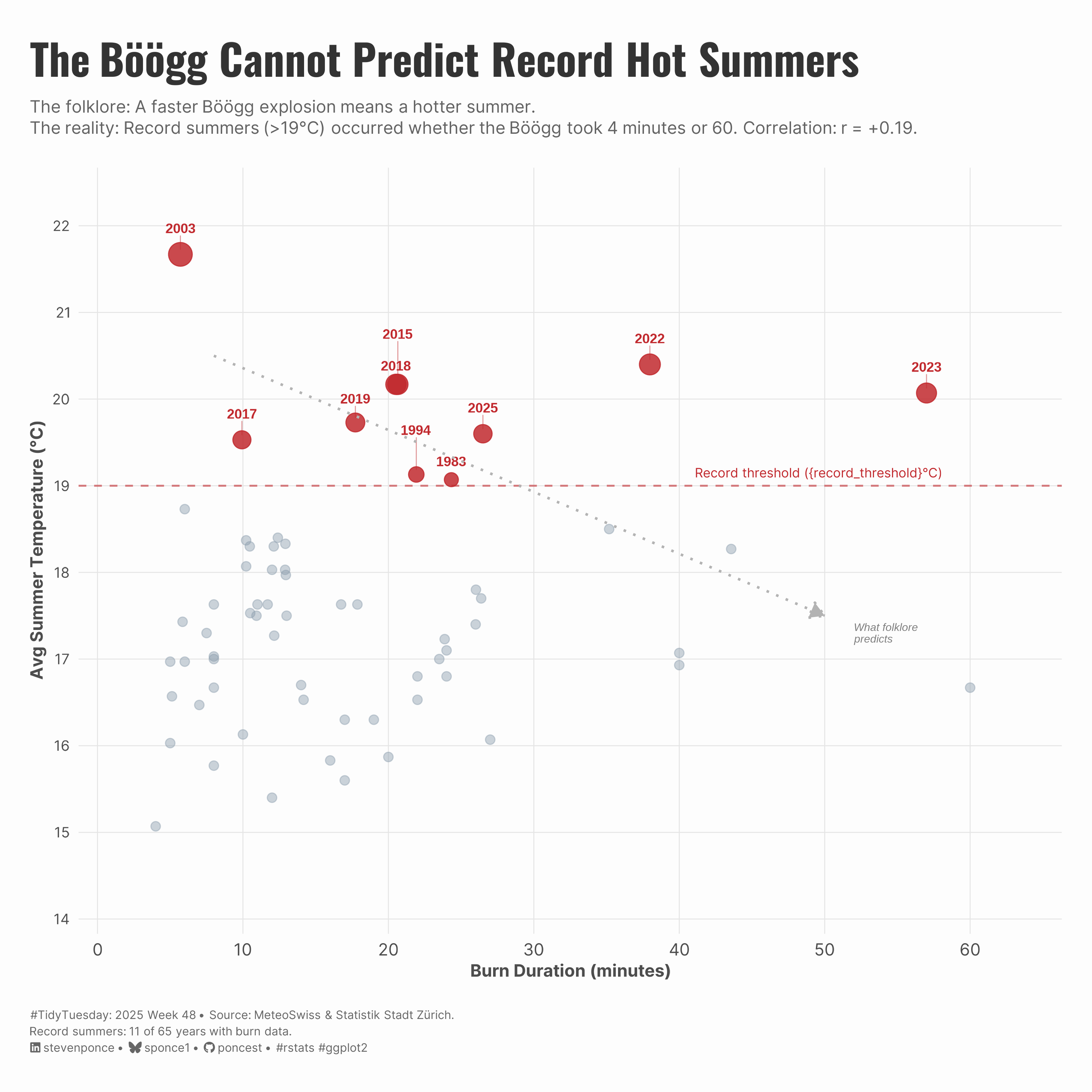{#fig-1}
### <mark> **Steps to Create this Graphic** </mark>
#### 1. Load Packages & Setup
```{r}
#| label: load
#| warning: false
#| message: false
#| results: "hide"

## 1. LOAD PACKAGES & SETUP ----
suppressPackageStartupMessages({
if (!require("pacman")) install.packages("pacman")
pacman::p_load(
    tidyverse,     # Easily Install and Load the 'Tidyverse'
    ggtext,        # Improved Text Rendering Support for 'ggplot2'
    showtext,      # Using Fonts More Easily in R Graphs
    janitor,       # Simple Tools for Examining and Cleaning Dirty Data
    scales,        # Scale Functions for Visualization
    glue,          # Interpreted String Literals
    ggrepel        # Automatically Position Non-Overlapping Text Labels
)
})

### |- figure size ----
camcorder::gg_record(
  dir    = here::here("temp_plots"),
  device = "png",
  width  = 10,
  height = 10,
  units  = "in",
  dpi    = 320
)

# Source utility functions
suppressMessages(source(here::here("R/utils/fonts.R")))
source(here::here("R/utils/social_icons.R"))
source(here::here("R/utils/image_utils.R"))
source(here::here("R/themes/base_theme.R"))
```
#### 2. Read in the Data
```{r}
#| label: read
#| include: true
#| eval: true
#| warning: false

tt <- tidytuesdayR::tt_load(2025, week = 48)

sechselaeuten <- tt$sechselaeuten |> clean_names()

tidytuesdayR::readme(tt)
rm(tt)
```
#### 3. Examine the Data
```{r}
#| label: examine
#| include: true
#| eval: true
#| results: 'hide'
#| warning: false

glimpse(sechselaeuten)
skimr::skim(sechselaeuten) |> summary()
```
#### 4. Tidy Data
```{r}
#| label: tidy-fixed
#| warning: false

### |- clean and prepare data ----
sechselaeuten_clean <- sechselaeuten |>
  mutate(
    # Flag years with missing duration
    duration_missing = is.na(duration),

    # Categorize burn duration
    burn_category = case_when(
      is.na(duration) ~ "No data",
      duration <= 10 ~ "Fast (≤10 min)",
      duration <= 20 ~ "Medium (11–20 min)",
      TRUE ~ "Slow (>20 min)"
    ),
    burn_category = factor(
      burn_category,
      levels = c("Fast (≤10 min)", "Medium (11–20 min)", "Slow (>20 min)", "No data")
    )
  )

### |- summary stats for reference ----
duration_median <- median(sechselaeuten_clean$duration, na.rm = TRUE)
temp_median <- median(sechselaeuten_clean$tre200m0, na.rm = TRUE)
record_threshold <- 19

# Correlation
cor_duration_temp <- cor(
  sechselaeuten_clean$duration,
  sechselaeuten_clean$tre200m0,
  use = "complete.obs"
)

# Record summers count
n_record <- sum(sechselaeuten_clean$record, na.rm = TRUE)
n_total <- sum(!sechselaeuten_clean$duration_missing)

### |- prepare data for plot ----
plot_data <- sechselaeuten_clean |>
  filter(!duration_missing)

# Separate record years for labeling
record_years <- plot_data |>
  filter(record == TRUE)

# Key stats for annotations
min_record_duration <- min(record_years$duration)
max_record_duration <- max(record_years$duration)
```
#### 5. Visualization Parameters
```{r}
#| label: params
#| include: true
#| warning: false

### |-  plot aesthetics ----
colors <- get_theme_colors(
    palette = c(
        "record"     = "#C1292E",
        "normal"     = "#8B9DAE",
        "threshold"  = "#C1292E",
        "annotation" = "#5C6B7A"
    )
)

### |- titles and caption ----
title_text <- "The Böögg Cannot Predict Record Hot Summers"

subtitle_text <- str_glue(
    "**The folklore:** A faster Böögg explosion means a hotter summer.<br>",
    "**The reality:** Record summers (>{record_threshold}°C) occurred whether the Böögg took ",
    "{min(plot_data$duration)} minutes or {max(plot_data$duration)}. Correlation: r = +0.19."
)

caption_text <- create_social_caption(
    tt_year  = 2025,
    tt_week  = 48,
    source_text = str_glue(
        "MeteoSwiss & Statistik Stadt Zürich.<br>",
        "Record summers: {n_record} of {n_total} years with burn data."
    )
)

### |-  fonts ----
setup_fonts()
fonts <- get_font_families()

### |-  plot theme ----
# Start with base theme
base_theme <- create_base_theme(colors)

# Add weekly-specific theme elements
weekly_theme <- extend_weekly_theme(
  base_theme,
  theme(
    # Text styling
    plot.title = element_markdown(
      face = "bold", family = fonts$title, size = rel(1.4),
      color = colors$title, margin = margin(b = 10), hjust = 0
    ),
    plot.subtitle = element_text(
      face = "italic", family = fonts$subtitle, lineheight = 1.2,
      color = colors$subtitle, size = rel(0.9), margin = margin(b = 20), hjust = 0
    ),

    # Grid
    panel.grid.minor = element_blank(),
    # panel.grid.major.x = element_blank(),
    panel.grid.major = element_line(color = "gray90", linewidth = 0.3),

    # Axes
    axis.title = element_text(size = rel(0.8), color = "gray30"),
    axis.text = element_text(color = "gray30"),
    axis.text.y = element_text(size = rel(0.85)),
    axis.ticks = element_blank(),

    # Facets
    strip.background = element_rect(fill = "gray95", color = NA),
    strip.text = element_text(
      face = "bold",
      color = "gray20",
      size = rel(0.9),
      margin = margin(t = 6, b = 4)
    ),
    panel.spacing = unit(1.5, "lines"),

    # Legend elements
    legend.position = "plot",
    legend.title = element_text(
      family = fonts$tsubtitle,
      color = colors$text, size = rel(0.8), face = "bold"
    ),
    legend.text = element_text(
      family = fonts$tsubtitle,
      color = colors$text, size = rel(0.7)
    ),
    legend.margin = margin(t = 15),

    # Plot margin
    plot.margin = margin(20, 20, 20, 20)
  )
)

# Set theme
theme_set(weekly_theme)
```
#### 6. Plot
```{r}
#| label: plot
#| warning: false

### |-  main plot ----
p <-
  plot_data |>
  ggplot(aes(x = duration, y = tre200m0)) +

  # Geoms
  geom_hline(
    yintercept = record_threshold,
    linetype = "dashed",
    linewidth = 0.6,
    color = colors$palette["threshold"],
    alpha = 0.6
  ) +
  geom_point(
    data = filter(plot_data, record == FALSE),
    size = 2.6,
    alpha = 0.45,
    color = colors$palette["normal"]
  ) +
  geom_point(
    data = record_years,
    aes(size = tre200m0),
    alpha = 0.85,
    color = colors$palette["record"]
  ) +
  # Labels for record years
  geom_text_repel(
    data = record_years,
    aes(label = year),
    size = 3.2,
    fontface = "bold",
    color = colors$palette["record"],
    nudge_y = 0.3,
    direction = "y",
    segment.size = 0.3,
    segment.color = colors$palette["record"],
    segment.alpha = 0.5,
    box.padding = 0.5,
    point.padding = 0.4,
    max.overlaps = 20,
    seed = 42
  ) +
  # Annotate
  annotate(
    "text",
    x = max(plot_data$duration) - 2,
    y = record_threshold + 0.15,
    label = ("Record threshold ({record_threshold}°C)"),
    hjust = 1,
    size = 3,
    fontface = "italic",
    color = colors$palette["threshold"],
    family = fonts$text
  ) +
  annotate(
    "segment",
    x = 8, xend = 50,
    y = 20.5, yend = 17.5,
    color = "gray70",
    linewidth = 0.8,
    linetype = "dotted",
    arrow = arrow(length = unit(0.15, "inches"), type = "closed")
  ) +
  annotate(
    "text",
    x = 52, y = 17.3,
    label = "What folklore\npredicts",
    size = 2.5,
    color = "gray50",
    hjust = 0,
    lineheight = 0.9,
    fontface = "italic"
  ) +
  # Scales
  scale_x_continuous(
    breaks = seq(0, 60, by = 10),
    limits = c(0, 65),
    expand = expansion(mult = c(0.02, 0.02))
  ) +
  scale_y_continuous(
    breaks = seq(14, 22, by = 1),
    limits = c(14, 22.5),
    expand = expansion(mult = c(0.02, 0.02))
  ) +
  scale_size_continuous(range = c(4, 7), guide = "none") +
  # Labs
  labs(
    title = title_text,
    subtitle = subtitle_text,
    caption = caption_text,
    x = "Burn Duration (minutes)",
    y = "Avg Summer Temperature (°C)"
  ) +
  # Theme
  theme(
    plot.title = element_markdown(
      size = rel(2),
      family = fonts$title,
      face = "bold",
      color = colors$title,
      lineheight = 1.15,
      margin = margin(t = 8, b = 5)
    ),
    plot.subtitle = element_markdown(
      size = rel(0.8),
      family = fonts$subtitle,
      color = alpha(colors$subtitle, 0.88),
      lineheight = 1.25,
      margin = margin(t = 5, b = 20)
    ),
    plot.caption = element_markdown(
      size = rel(0.55),
      family = fonts$subtitle,
      color = colors$caption,
      hjust = 0,
      lineheight = 1.4,
      margin = margin(t = 20, b = 5)
    )
  )
```
#### 7. Save
```{r}
#| label: save
#| warning: false

### |-  plot image ----
save_plot(
  plot = p,
  type = "tidytuesday",
  year = 2025,
  week = 48,
  width  = 10,
  height = 10,
  )
```
#### 8. Session Info
::: {.callout-tip collapse="true"}
##### Expand for Session Info
```{r, echo = FALSE}
#| eval: true
#| warning: false
sessionInfo()
```
:::
#### 9. GitHub Repository
::: {.callout-tip collapse="true"}
##### Expand for GitHub Repo
The complete code for this analysis is available in [`tt_2025_48.qmd`](https://github.com/poncest/personal-website/blob/master/data_visualizations/TidyTuesday/2025/tt_2025_48.qmd).
For the full repository, [click here](https://github.com/poncest/personal-website/).
:::
#### 10. References
::: {.callout-tip collapse="true"}
##### Expand for References
1. **Data Source:**
- TidyTuesday 2025 Week 48: [Can an exploding snowman predict the summer season?](https://github.com/rfordatascience/tidytuesday/blob/main/data/2025/2025-12-02/readme.md)
:::
#### 11. Custom Functions Documentation
::: {.callout-note collapse="true"}
##### 📦 Custom Helper Functions
This analysis uses custom functions from my personal module library for efficiency and consistency across projects.
**Functions Used:**
- **`fonts.R`**: `setup_fonts()`, `get_font_families()` - Font management with showtext
- **`social_icons.R`**: `create_social_caption()` - Generates formatted social media captions
- **`image_utils.R`**: `save_plot()` - Consistent plot saving with naming conventions
- **`base_theme.R`**: `create_base_theme()`, `extend_weekly_theme()`, `get_theme_colors()` - Custom ggplot2 themes
**Why custom functions?**\
These utilities standardize theming, fonts, and output across all my data visualizations. The core analysis (data tidying and visualization logic) uses only standard tidyverse packages.
**Source Code:**\
View all custom functions → [GitHub: R/utils](https://github.com/poncest/personal-website/tree/master/R)
:::
