• Steven Ponce
  • About
  • Data Visualizations
  • Projects
  • Resume
  • Email

On this page

  • Steps to Create this Graphic
    • 1. Load Packages & Setup
    • 2. Read in the Data
    • 3. Examine the Data
    • 4. Tidy Data
    • 5. Visualization Parameters
    • 6. Plot
    • 7. Save
    • 8. Session Info
    • 9. GitHub Repository
    • 10. References
    • 11. Custom Functions Documentation

Getting Electricity Is Just the First Step

  • Show All Code
  • Hide All Code

  • View Source

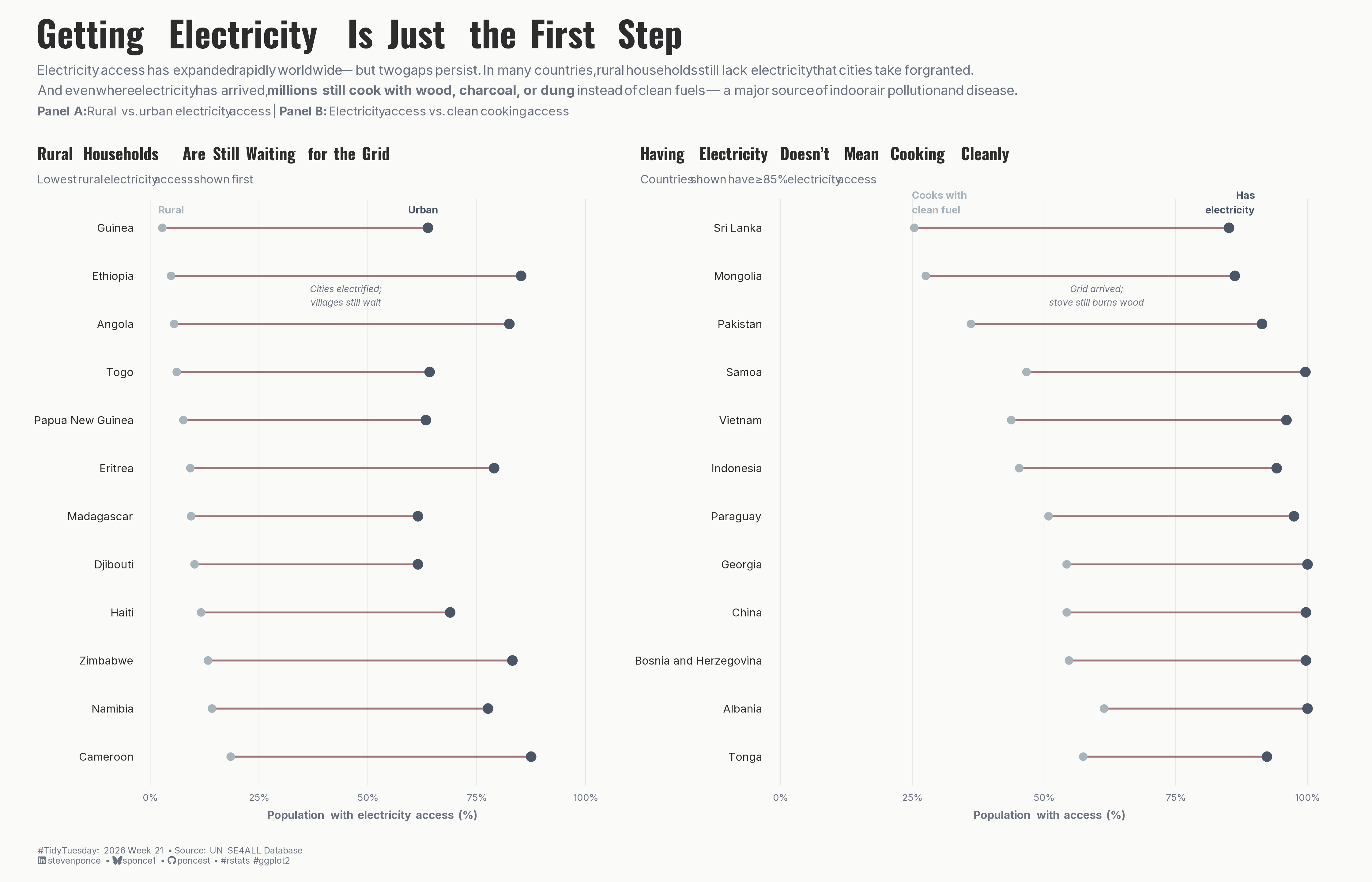
Electricity access has expanded rapidly worldwide — but two gaps persist. In many countries, rural households still lack electricity that cities take for granted. And even where electricity has arrived, millions still cook with wood, charcoal, or dung instead of clean fuels — a major source of indoor air pollution and disease.

TidyTuesday
Data Visualization
R Programming
2026
This two-panel dumbbell chart reveals two persistent gaps in global energy access: rural households still lag far behind cities in electricity access, and even highly electrified countries often have not completed the clean cooking transition. Panel A shows the 12 countries with the lowest rural electricity access (among those with meaningful urban access), while Panel B compares electricity vs. clean cooking access for countries with ≥85% electrification. Built with R/ggplot2, patchwork, and ggtext.
Author

Steven Ponce

Published

May 23, 2026

Figure 1: Two-panel dumbbell chart titled “Getting Electricity Is Just the First Step.” Panel A, “Rural Households Are Still Waiting for the Grid,” shows 12 countries where urban electricity access far exceeds rural access — gaps range from roughly 60 to 80 percentage points, with Guinea, Ethiopia, and Angola showing the largest divides. Panel B, “Having Electricity Doesn’t Mean Cooking Cleanly,” shows 12 countries with at least 85% electricity access, where clean cooking fuel access lags far behind — Sri Lanka, Mongolia, and Pakistan lead with gaps of nearly 60 percentage points. Both panels use burgundy segments to visualize the gap between a lighter dot (the lagging metric) and a darker dot (the achieved metric). The subtitle notes that millions still cook with wood, charcoal, or dung — a major source of indoor air pollution and disease.

Steps to Create this Graphic

1. Load Packages & Setup

Show code
```{r}
#| label: load
#| warning: false
#| message: false      
#| results: "hide"     

## 1. LOAD PACKAGES & SETUP ----
suppressPackageStartupMessages({
if (!require("pacman")) install.packages("pacman")
pacman::p_load(
    tidyverse, ggtext, showtext, janitor, ggrepel,      
    scales, glue, skimr, patchwork, ggrepel
    )
})

### |- figure size ----
camcorder::gg_record(
  dir    = here::here("temp_plots"),
  device = "png",
  width  = 14,
  height = 7,
  units  = "in",
  dpi    = 320
)

# Source utility functions
suppressMessages(source(here::here("R/utils/fonts.R")))
source(here::here("R/utils/social_icons.R"))
source(here::here("R/utils/image_utils.R"))
source(here::here("R/themes/base_theme.R"))
```

2. Read in the Data

Show code
```{r}
#| label: read
#| include: true
#| eval: true
#| warning: false

tt <- tidytuesdayR::tt_load(2026, week = 21)

energy_raw <- tt$energy_cleaned |> clean_names()

rm(tt)
```

3. Examine the Data

Show code
```{r}
#| label: examine
#| include: true
#| eval: true
#| results: 'hide'
#| warning: false

glimpse(energy_raw)
```

4. Tidy Data

Show code
```{r}
#| label: tidy
#| warning: false

energy_latest <- energy_raw |>
  filter(
    !is.na(access_electricity_urban_pop_pct),
    !is.na(access_electricity_rural_pop_pct),
    !is.na(access_electricity_total_pop_pct),
    !is.na(access_non_solid_fuel_total_pop_pct)
  ) |>
  slice_max(yr, by = country_name, with_ties = FALSE) |>
  select(
    country_name, country_code, yr,
    urban_elec = access_electricity_urban_pop_pct,
    rural_elec = access_electricity_rural_pop_pct,
    total_elec = access_electricity_total_pop_pct,
    non_solid = access_non_solid_fuel_total_pop_pct
  ) |>
  mutate(
    gap_rural   = urban_elec - rural_elec,
    gap_cooking = total_elec - non_solid
  )

regional_aggregates <- c(
  "Oceania", "Southern Asia", "Eastern Asia", "South East Asia",
  "Eastern Asia (not including Japan)", "Eastern Asia (including Japan)",
  "South Eastern Asia", "Western Asia", "Central Asia",
  "Caucasus and Central Asia",
  "Sub-Saharan Africa", "Northern Africa", "Latin America and the Caribbean",
  "Caribbean", "Central America", "South America",
  "Oceania (not including Australia and New Zealand)",
  "World", "Developed regions", "Developing regions",
  "Landlocked developing countries", "Small island developing States",
  "Least developed countries", "Low income", "Lower middle income",
  "Upper middle income", "High income",
  "Macedonia, FYR"
)

## Panel A: lowest rural access among countries where cities have meaningful access
panel_a_data <- energy_latest |>
  filter(
    !country_name %in% regional_aggregates,
    urban_elec >= 60
  ) |>
  slice_min(rural_elec, n = 12, with_ties = FALSE) |>
  arrange(desc(rural_elec)) |>
  mutate(
    country_name = fct_inorder(country_name)
  )

## Panel B: largest clean-cooking gaps among highly electrified countries
panel_b_data <- energy_latest |>
  filter(
    !country_name %in% regional_aggregates,
    total_elec >= 85
  ) |>
  slice_max(gap_cooking, n = 12, with_ties = FALSE) |>
  arrange(gap_cooking) |>
  mutate(
    country_name = fct_inorder(country_name)
  )
```

5. Visualization Parameters

Show code
```{r}
#| label: params
#| include: true
#| warning: false

### |- plot aesthetics ----
clrs <- get_theme_colors(
  palette = list(
    accent    = "#722F37",
    light_dot = "#A8B4BC",
    dark_dot  = "#4A5568",
    bg        = "#FAFAF8",
    text      = "#2D2D2D",
    sub       = "#6B7280"
  )
)

### |- titles and caption ----
title_text <- "Getting Electricity Is Just the First Step"

subtitle_text <- str_glue(
    "Electricity access has expanded rapidly worldwide — but two gaps persist. ",
    "In many countries, rural households still lack electricity that cities take for granted.<br> ",
    "And even where electricity has arrived, **millions still cook with wood, charcoal, or dung** ",
    "instead of clean fuels — a major source of indoor air pollution and disease.<br>",
    "<span style='font-size:9pt;'>",
    "**Panel A:** Rural vs. urban electricity access &nbsp;|&nbsp; ",
    "**Panel B:** Electricity access vs. clean cooking access",
    "</span>"
)

caption_text <- create_social_caption(
    tt_year = 2026,
    tt_week = 21,
    source_text = "UN SE4ALL Database"
)

### |- fonts ----
setup_fonts()
fonts <- get_font_families()

### |- plot theme ----
base_theme <- create_base_theme(clrs)

weekly_theme <- extend_weekly_theme(
  base_theme,
  theme(
    panel.background = element_rect(fill = clrs$palette$bg, color = NA),
    plot.background = element_rect(fill = clrs$palette$bg, color = NA),
    panel.grid.major.y = element_blank(),
    panel.grid.major.x = element_line(color = "gray90", linewidth = 0.25),
    panel.grid.minor = element_blank(),
    axis.ticks = element_blank(),
    axis.text.y = element_markdown(
      size   = 8,
      color  = clrs$palette$text,
      family = fonts$text
    ),
    axis.text.x = element_markdown(
      size = 7,
      color = clrs$palette$sub,
      family = fonts$text
    ),
    axis.title.x = element_markdown(
      size = 8,
      color = clrs$palette$sub,
      family = fonts$text,
      margin = margin(t = 4)
    ),
    axis.title.y = element_blank(),
    plot.title = element_markdown(
      size = 12,
      face = "bold",
      family = fonts$title,
      color = clrs$palette$text,
      margin = margin(b = 8)
    ),
    plot.subtitle = element_markdown(
      size = 8.5,
      family = fonts$text,
      color = clrs$palette$sub,
      lineheight = 1.4,
      margin = margin(b = 10)
    ),
    plot.caption = element_markdown(
      size = 6.5,
      family = fonts$text,
      color = clrs$palette$sub,
      hjust = 0,
      margin = margin(t = 4)
    ),
    plot.caption.position = "plot",
    plot.margin = margin(12, 16, 8, 12)
  )
)

theme_set(weekly_theme)
```

6. Plot

Show code
```{r}
#| label: plot
#| warning: false

### |- Panel A ----
p_a <- ggplot(panel_a_data) +
  # Geoms
  geom_segment(
    aes(
      x = rural_elec,
      xend = urban_elec,
      y = country_name,
      yend = country_name
    ),
    color = clrs$palette$accent,
    linewidth = 0.65,
    alpha = 0.65
  ) +
  geom_point(
    aes(x = rural_elec, y = country_name),
    color = clrs$palette$light_dot,
    size = 2.1
  ) +
  geom_point(
    aes(x = urban_elec, y = country_name),
    color = clrs$palette$dark_dot,
    size  = 2.8
  ) +
  # Annotate
  annotate("text",
    x = 2, y = 12.3,
    label = "Rural",
    hjust = 0, vjust = 0,
    size = 2.6, color = clrs$palette$light_dot,
    family = fonts$text, fontface = "bold"
  ) +
  annotate("text",
    x = 66, y = 12.3,
    label = "Urban",
    hjust = 1, vjust = 0,
    size = 2.6, color = clrs$palette$dark_dot,
    family = fonts$text, fontface = "bold"
  ) +
  annotate("text",
    x = 45,
    y = 10.8,
    label = "Cities electrified;\nvillages still wait",
    hjust = 0.5, vjust = 1,
    size = 2.4,
    color = clrs$palette$sub,
    family = fonts$text,
    fontface = "italic",
    lineheight = 1.2
  ) +
  # Scales
  scale_x_continuous(
    labels = label_percent(scale = 1, accuracy = 1),
    breaks = c(0, 25, 50, 75, 100),
    limits = c(0, 100),
    expand = expansion(mult = c(0.02, 0.04))
  ) +
  coord_cartesian(clip = "off") +
  # Labs
  labs(
    title = "**Rural Households Are Still Waiting for the Grid**",
    x = "Population with electricity access (%)",
    subtitle = "Lowest rural electricity access shown first"
  )

### |- Panel B ----
p_b <- ggplot(panel_b_data) +
  # Geoms
  geom_segment(
    aes(
      x = non_solid,
      xend = total_elec,
      y = country_name,
      yend = country_name
    ),
    color = clrs$palette$accent,
    linewidth = 0.65,
    alpha = 0.65
  ) +
  geom_point(
    aes(x = non_solid, y = country_name),
    color = clrs$palette$light_dot,
    size = 2.1
  ) +
  geom_point(
    aes(x = total_elec, y = country_name),
    color = clrs$palette$dark_dot,
    size  = 2.8
  ) +
  # Annotate
  annotate("text",
    x = 25, y = 12.3,
    label = "Cooks with\nclean fuel",
    hjust = 0, vjust = 0,
    size = 2.6, color = clrs$palette$light_dot,
    family = fonts$text, fontface = "bold"
  ) +
  annotate("text",
    x = 90, y = 12.3,
    label = "Has\nelectricity",
    hjust = 1, vjust = 0,
    size = 2.6, color = clrs$palette$dark_dot,
    family = fonts$text, fontface = "bold"
  ) +
  annotate("text",
    x = 60,
    y = 10.8,
    label = "Grid arrived;\nstove still burns wood",
    hjust = 0.5, vjust = 1,
    size = 2.4,
    color = clrs$palette$sub,
    family = fonts$text,
    fontface = "italic",
    lineheight = 1.2
  ) +
  # Scales
  scale_x_continuous(
    labels = label_percent(scale = 1, accuracy = 1),
    breaks = c(0, 25, 50, 75, 100),
    limits = c(0, 100),
    expand = expansion(mult = c(0.02, 0.04))
  ) +
  coord_cartesian(clip = "off") +
  # Labs
  labs(
    title = "**Having Electricity Doesn't Mean Cooking Cleanly**",
    x = "Population with access (%)",
    subtitle = "Countries shown have ≥85% electricity access"
  )

### |- Patchwork assembly ----
p_combined <- p_a + p_b +
  plot_layout(widths = c(0.95, 1.15)) +
  plot_annotation(
    title = title_text,
    subtitle = subtitle_text,
    caption = caption_text,
    theme = theme(
      plot.title = element_markdown(
        size = 26,
        face = "bold",
        family = fonts$title,
        color = clrs$palette$text,
        margin = margin(b = 6),
        lineheight = 1.2
      ),
      plot.subtitle = element_markdown(
        size = 10,
        family = fonts$text,
        color = clrs$palette$sub,
        lineheight = 1.5,
        margin = margin(b = 9)
      ),
      plot.caption = element_markdown(
        size = 6.5,
        family = fonts$text,
        color = clrs$palette$sub,
        hjust = 0,
        margin = margin(t = 10)
      ),
      plot.background = element_rect(fill = clrs$palette$bg, color = NA),
      plot.margin = margin(16, 16, 12, 16)
    )
  )
```

7. Save

Show code
```{r}
#| label: save
#| warning: false

### |-  plot image ----  
save_plot_patchwork(
  plot = p_combined, 
  type = "tidytuesday", 
  year = 2026, 
  week = 21, 
  width  = 14,
  height = 9
  )
```

8. Session Info

TipExpand for Session Info
R version 4.5.3 (2026-03-11 ucrt)
Platform: x86_64-w64-mingw32/x64
Running under: Windows 11 x64 (build 26100)

Matrix products: default
  LAPACK version 3.12.1

locale:
[1] LC_COLLATE=English_United States.utf8 
[2] LC_CTYPE=English_United States.utf8   
[3] LC_MONETARY=English_United States.utf8
[4] LC_NUMERIC=C                          
[5] LC_TIME=English_United States.utf8    

time zone: America/New_York
tzcode source: internal

attached base packages:
[1] stats     graphics  grDevices utils     datasets  methods   base     

other attached packages:
 [1] here_1.0.2      patchwork_1.3.2 skimr_2.2.2     glue_1.8.0     
 [5] scales_1.4.0    ggrepel_0.9.8   janitor_2.2.1   showtext_0.9-8 
 [9] showtextdb_3.0  sysfonts_0.8.9  ggtext_0.1.2    lubridate_1.9.5
[13] forcats_1.0.1   stringr_1.6.0   dplyr_1.2.1     purrr_1.2.2    
[17] readr_2.2.0     tidyr_1.3.2     tibble_3.3.1    ggplot2_4.0.3  
[21] tidyverse_2.0.0 pacman_0.5.1   

loaded via a namespace (and not attached):
 [1] tidyselect_1.2.1   farver_2.1.2       S7_0.2.1           fastmap_1.2.0     
 [5] gh_1.5.0           digest_0.6.39      timechange_0.4.0   lifecycle_1.0.5   
 [9] rsvg_2.7.0         magrittr_2.0.5     compiler_4.5.3     rlang_1.2.0       
[13] tools_4.5.3        yaml_2.3.12        knitr_1.51         htmlwidgets_1.6.4 
[17] bit_4.6.0          curl_7.0.0         xml2_1.5.2         camcorder_0.1.0   
[21] repr_1.1.7         RColorBrewer_1.1-3 tidytuesdayR_1.3.2 withr_3.0.2       
[25] grid_4.5.3         gitcreds_0.1.2     cli_3.6.6          rmarkdown_2.31    
[29] crayon_1.5.3       generics_0.1.4     otel_0.2.0         rstudioapi_0.18.0 
[33] tzdb_0.5.0         commonmark_2.0.0   parallel_4.5.3     ggplotify_0.1.3   
[37] base64enc_0.1-6    vctrs_0.7.3        yulab.utils_0.2.4  jsonlite_2.0.0    
[41] litedown_0.9       gridGraphics_0.5-1 hms_1.1.4          bit64_4.6.0-1     
[45] systemfonts_1.3.2  magick_2.9.1       gifski_1.32.0-2    codetools_0.2-20  
[49] stringi_1.8.7      gtable_0.3.6       pillar_1.11.1      rappdirs_0.3.4    
[53] htmltools_0.5.9    R6_2.6.1           httr2_1.2.2        textshaping_1.0.5 
[57] rprojroot_2.1.1    vroom_1.7.1        evaluate_1.0.5     markdown_2.0      
[61] gridtext_0.1.6     snakecase_0.11.1   Rcpp_1.1.1         svglite_2.2.2     
[65] xfun_0.57          fs_2.0.1           pkgconfig_2.0.3   

9. GitHub Repository

TipExpand for GitHub Repo

The complete code for this analysis is available in tt_2026_21.qmd.

For the full repository, click here.

10. References

TipExpand for References
  1. Data Source:
    • TidyTuesday 2026 Week 20: Sustainable Energy for All

11. Custom Functions Documentation

Note📦 Custom Helper Functions

This analysis uses custom functions from my personal module library for efficiency and consistency across projects.

Functions Used:

  • fonts.R: setup_fonts(), get_font_families() - Font management with showtext
  • social_icons.R: create_social_caption() - Generates formatted social media captions
  • image_utils.R: save_plot() - Consistent plot saving with naming conventions
  • base_theme.R: create_base_theme(), extend_weekly_theme(), get_theme_colors() - Custom ggplot2 themes

Why custom functions?
These utilities standardize theming, fonts, and output across all my data visualizations. The core analysis (data tidying and visualization logic) uses only standard tidyverse packages.

Source Code:
View all custom functions → GitHub: R/utils

Back to top

Citation

BibTeX citation:
@online{ponce2026,
  author = {Ponce, Steven},
  title = {Getting {Electricity} {Is} {Just} the {First} {Step}},
  date = {2026-05-23},
  url = {https://stevenponce.netlify.app/data_visualizations/TidyTuesday/2026/tt_2026_W21.html},
  langid = {en}
}
For attribution, please cite this work as:
Ponce, Steven. 2026. “Getting Electricity Is Just the First Step.” May 23. https://stevenponce.netlify.app/data_visualizations/TidyTuesday/2026/tt_2026_W21.html.
Source Code
---
title: "Getting Electricity Is Just the First Step"
subtitle: "Electricity access has expanded rapidly worldwide — but two gaps persist. In many countries, rural households still lack electricity that cities take for granted. And even where electricity has arrived, millions still cook with wood, charcoal, or dung instead of clean fuels — a major source of indoor air pollution and disease."
description: "This two-panel dumbbell chart reveals two persistent gaps in global energy access: rural households still lag far behind cities in electricity access, and even highly electrified countries often have not completed the clean cooking transition. Panel A shows the 12 countries with the lowest rural electricity access (among those with meaningful urban access), while Panel B compares electricity vs. clean cooking access for countries with ≥85% electrification. Built with R/ggplot2, patchwork, and ggtext."
date: "2026-05-23"
author:
  - name: "Steven Ponce"
    url: "https://stevenponce.netlify.app"
citation:
  url: "https://stevenponce.netlify.app/data_visualizations/TidyTuesday/2026/tt_2026_W21.html"
categories: ["TidyTuesday", "Data Visualization", "R Programming", "2026"]
tags: [
  "TidyTuesday",
  "Dumbbell Chart",
  "Energy Access",
  "Clean Cooking",
  "Rural Electrification",
  "Sustainable Energy",
  "SE4ALL",
  "Inequality",
  "Patchwork",
  "Annotation",
  "Multi-Panel",
  "2026"
]
image: "thumbnails/tt_2026_21.png"
format:
  html:
    toc: true
    toc-depth: 5
    code-link: true
    code-fold: true
    code-tools: true
    code-summary: "Show code"
    self-contained: true
    theme: 
      light: [flatly, assets/styling/custom_styles.scss]
      dark: [darkly, assets/styling/custom_styles_dark.scss]
editor_options: 
  chunk_output_type: inline
execute: 
  freeze: true
  cache: true
  error: false
  message: false
  warning: false
  eval: true
---
![Two-panel dumbbell chart titled "Getting Electricity Is Just the First Step." Panel A, "Rural Households Are Still Waiting for the Grid," shows 12 countries where urban electricity access far exceeds rural access — gaps range from roughly 60 to 80 percentage points, with Guinea, Ethiopia, and Angola showing the largest divides. Panel B, "Having Electricity Doesn't Mean Cooking Cleanly," shows 12 countries with at least 85% electricity access, where clean cooking fuel access lags far behind — Sri Lanka, Mongolia, and Pakistan lead with gaps of nearly 60 percentage points. Both panels use burgundy segments to visualize the gap between a lighter dot (the lagging metric) and a darker dot (the achieved metric). The subtitle notes that millions still cook with wood, charcoal, or dung — a major source of indoor air pollution and disease.](tt_2026_21.png){#fig-1}

### [**Steps to Create this Graphic**]{.mark}

#### [1. Load Packages & Setup]{.smallcaps}

```{r}
#| label: load
#| warning: false
#| message: false      
#| results: "hide"     

## 1. LOAD PACKAGES & SETUP ----
suppressPackageStartupMessages({
if (!require("pacman")) install.packages("pacman")
pacman::p_load(
    tidyverse, ggtext, showtext, janitor, ggrepel,      
    scales, glue, skimr, patchwork, ggrepel
    )
})

### |- figure size ----
camcorder::gg_record(
  dir    = here::here("temp_plots"),
  device = "png",
  width  = 14,
  height = 7,
  units  = "in",
  dpi    = 320
)

# Source utility functions
suppressMessages(source(here::here("R/utils/fonts.R")))
source(here::here("R/utils/social_icons.R"))
source(here::here("R/utils/image_utils.R"))
source(here::here("R/themes/base_theme.R"))
```

#### [2. Read in the Data]{.smallcaps}

```{r}
#| label: read
#| include: true
#| eval: true
#| warning: false

tt <- tidytuesdayR::tt_load(2026, week = 21)

energy_raw <- tt$energy_cleaned |> clean_names()

rm(tt)
```

#### [3. Examine the Data]{.smallcaps}

```{r}
#| label: examine
#| include: true
#| eval: true
#| results: 'hide'
#| warning: false

glimpse(energy_raw)
```

#### [4. Tidy Data]{.smallcaps}

```{r}
#| label: tidy
#| warning: false

energy_latest <- energy_raw |>
  filter(
    !is.na(access_electricity_urban_pop_pct),
    !is.na(access_electricity_rural_pop_pct),
    !is.na(access_electricity_total_pop_pct),
    !is.na(access_non_solid_fuel_total_pop_pct)
  ) |>
  slice_max(yr, by = country_name, with_ties = FALSE) |>
  select(
    country_name, country_code, yr,
    urban_elec = access_electricity_urban_pop_pct,
    rural_elec = access_electricity_rural_pop_pct,
    total_elec = access_electricity_total_pop_pct,
    non_solid = access_non_solid_fuel_total_pop_pct
  ) |>
  mutate(
    gap_rural   = urban_elec - rural_elec,
    gap_cooking = total_elec - non_solid
  )

regional_aggregates <- c(
  "Oceania", "Southern Asia", "Eastern Asia", "South East Asia",
  "Eastern Asia (not including Japan)", "Eastern Asia (including Japan)",
  "South Eastern Asia", "Western Asia", "Central Asia",
  "Caucasus and Central Asia",
  "Sub-Saharan Africa", "Northern Africa", "Latin America and the Caribbean",
  "Caribbean", "Central America", "South America",
  "Oceania (not including Australia and New Zealand)",
  "World", "Developed regions", "Developing regions",
  "Landlocked developing countries", "Small island developing States",
  "Least developed countries", "Low income", "Lower middle income",
  "Upper middle income", "High income",
  "Macedonia, FYR"
)

## Panel A: lowest rural access among countries where cities have meaningful access
panel_a_data <- energy_latest |>
  filter(
    !country_name %in% regional_aggregates,
    urban_elec >= 60
  ) |>
  slice_min(rural_elec, n = 12, with_ties = FALSE) |>
  arrange(desc(rural_elec)) |>
  mutate(
    country_name = fct_inorder(country_name)
  )

## Panel B: largest clean-cooking gaps among highly electrified countries
panel_b_data <- energy_latest |>
  filter(
    !country_name %in% regional_aggregates,
    total_elec >= 85
  ) |>
  slice_max(gap_cooking, n = 12, with_ties = FALSE) |>
  arrange(gap_cooking) |>
  mutate(
    country_name = fct_inorder(country_name)
  )
```

#### [5. Visualization Parameters]{.smallcaps}

```{r}
#| label: params
#| include: true
#| warning: false

### |- plot aesthetics ----
clrs <- get_theme_colors(
  palette = list(
    accent    = "#722F37",
    light_dot = "#A8B4BC",
    dark_dot  = "#4A5568",
    bg        = "#FAFAF8",
    text      = "#2D2D2D",
    sub       = "#6B7280"
  )
)

### |- titles and caption ----
title_text <- "Getting Electricity Is Just the First Step"

subtitle_text <- str_glue(
    "Electricity access has expanded rapidly worldwide — but two gaps persist. ",
    "In many countries, rural households still lack electricity that cities take for granted.<br> ",
    "And even where electricity has arrived, **millions still cook with wood, charcoal, or dung** ",
    "instead of clean fuels — a major source of indoor air pollution and disease.<br>",
    "<span style='font-size:9pt;'>",
    "**Panel A:** Rural vs. urban electricity access &nbsp;|&nbsp; ",
    "**Panel B:** Electricity access vs. clean cooking access",
    "</span>"
)

caption_text <- create_social_caption(
    tt_year = 2026,
    tt_week = 21,
    source_text = "UN SE4ALL Database"
)

### |- fonts ----
setup_fonts()
fonts <- get_font_families()

### |- plot theme ----
base_theme <- create_base_theme(clrs)

weekly_theme <- extend_weekly_theme(
  base_theme,
  theme(
    panel.background = element_rect(fill = clrs$palette$bg, color = NA),
    plot.background = element_rect(fill = clrs$palette$bg, color = NA),
    panel.grid.major.y = element_blank(),
    panel.grid.major.x = element_line(color = "gray90", linewidth = 0.25),
    panel.grid.minor = element_blank(),
    axis.ticks = element_blank(),
    axis.text.y = element_markdown(
      size   = 8,
      color  = clrs$palette$text,
      family = fonts$text
    ),
    axis.text.x = element_markdown(
      size = 7,
      color = clrs$palette$sub,
      family = fonts$text
    ),
    axis.title.x = element_markdown(
      size = 8,
      color = clrs$palette$sub,
      family = fonts$text,
      margin = margin(t = 4)
    ),
    axis.title.y = element_blank(),
    plot.title = element_markdown(
      size = 12,
      face = "bold",
      family = fonts$title,
      color = clrs$palette$text,
      margin = margin(b = 8)
    ),
    plot.subtitle = element_markdown(
      size = 8.5,
      family = fonts$text,
      color = clrs$palette$sub,
      lineheight = 1.4,
      margin = margin(b = 10)
    ),
    plot.caption = element_markdown(
      size = 6.5,
      family = fonts$text,
      color = clrs$palette$sub,
      hjust = 0,
      margin = margin(t = 4)
    ),
    plot.caption.position = "plot",
    plot.margin = margin(12, 16, 8, 12)
  )
)

theme_set(weekly_theme)
```

#### [6. Plot]{.smallcaps}

```{r}
#| label: plot
#| warning: false

### |- Panel A ----
p_a <- ggplot(panel_a_data) +
  # Geoms
  geom_segment(
    aes(
      x = rural_elec,
      xend = urban_elec,
      y = country_name,
      yend = country_name
    ),
    color = clrs$palette$accent,
    linewidth = 0.65,
    alpha = 0.65
  ) +
  geom_point(
    aes(x = rural_elec, y = country_name),
    color = clrs$palette$light_dot,
    size = 2.1
  ) +
  geom_point(
    aes(x = urban_elec, y = country_name),
    color = clrs$palette$dark_dot,
    size  = 2.8
  ) +
  # Annotate
  annotate("text",
    x = 2, y = 12.3,
    label = "Rural",
    hjust = 0, vjust = 0,
    size = 2.6, color = clrs$palette$light_dot,
    family = fonts$text, fontface = "bold"
  ) +
  annotate("text",
    x = 66, y = 12.3,
    label = "Urban",
    hjust = 1, vjust = 0,
    size = 2.6, color = clrs$palette$dark_dot,
    family = fonts$text, fontface = "bold"
  ) +
  annotate("text",
    x = 45,
    y = 10.8,
    label = "Cities electrified;\nvillages still wait",
    hjust = 0.5, vjust = 1,
    size = 2.4,
    color = clrs$palette$sub,
    family = fonts$text,
    fontface = "italic",
    lineheight = 1.2
  ) +
  # Scales
  scale_x_continuous(
    labels = label_percent(scale = 1, accuracy = 1),
    breaks = c(0, 25, 50, 75, 100),
    limits = c(0, 100),
    expand = expansion(mult = c(0.02, 0.04))
  ) +
  coord_cartesian(clip = "off") +
  # Labs
  labs(
    title = "**Rural Households Are Still Waiting for the Grid**",
    x = "Population with electricity access (%)",
    subtitle = "Lowest rural electricity access shown first"
  )

### |- Panel B ----
p_b <- ggplot(panel_b_data) +
  # Geoms
  geom_segment(
    aes(
      x = non_solid,
      xend = total_elec,
      y = country_name,
      yend = country_name
    ),
    color = clrs$palette$accent,
    linewidth = 0.65,
    alpha = 0.65
  ) +
  geom_point(
    aes(x = non_solid, y = country_name),
    color = clrs$palette$light_dot,
    size = 2.1
  ) +
  geom_point(
    aes(x = total_elec, y = country_name),
    color = clrs$palette$dark_dot,
    size  = 2.8
  ) +
  # Annotate
  annotate("text",
    x = 25, y = 12.3,
    label = "Cooks with\nclean fuel",
    hjust = 0, vjust = 0,
    size = 2.6, color = clrs$palette$light_dot,
    family = fonts$text, fontface = "bold"
  ) +
  annotate("text",
    x = 90, y = 12.3,
    label = "Has\nelectricity",
    hjust = 1, vjust = 0,
    size = 2.6, color = clrs$palette$dark_dot,
    family = fonts$text, fontface = "bold"
  ) +
  annotate("text",
    x = 60,
    y = 10.8,
    label = "Grid arrived;\nstove still burns wood",
    hjust = 0.5, vjust = 1,
    size = 2.4,
    color = clrs$palette$sub,
    family = fonts$text,
    fontface = "italic",
    lineheight = 1.2
  ) +
  # Scales
  scale_x_continuous(
    labels = label_percent(scale = 1, accuracy = 1),
    breaks = c(0, 25, 50, 75, 100),
    limits = c(0, 100),
    expand = expansion(mult = c(0.02, 0.04))
  ) +
  coord_cartesian(clip = "off") +
  # Labs
  labs(
    title = "**Having Electricity Doesn't Mean Cooking Cleanly**",
    x = "Population with access (%)",
    subtitle = "Countries shown have ≥85% electricity access"
  )

### |- Patchwork assembly ----
p_combined <- p_a + p_b +
  plot_layout(widths = c(0.95, 1.15)) +
  plot_annotation(
    title = title_text,
    subtitle = subtitle_text,
    caption = caption_text,
    theme = theme(
      plot.title = element_markdown(
        size = 26,
        face = "bold",
        family = fonts$title,
        color = clrs$palette$text,
        margin = margin(b = 6),
        lineheight = 1.2
      ),
      plot.subtitle = element_markdown(
        size = 10,
        family = fonts$text,
        color = clrs$palette$sub,
        lineheight = 1.5,
        margin = margin(b = 9)
      ),
      plot.caption = element_markdown(
        size = 6.5,
        family = fonts$text,
        color = clrs$palette$sub,
        hjust = 0,
        margin = margin(t = 10)
      ),
      plot.background = element_rect(fill = clrs$palette$bg, color = NA),
      plot.margin = margin(16, 16, 12, 16)
    )
  )
```

#### [7. Save]{.smallcaps}

```{r}
#| label: save
#| warning: false

### |-  plot image ----  
save_plot_patchwork(
  plot = p_combined, 
  type = "tidytuesday", 
  year = 2026, 
  week = 21, 
  width  = 14,
  height = 9
  )
```

#### [8. Session Info]{.smallcaps}

::: {.callout-tip collapse="true"}
##### Expand for Session Info

```{r, echo = FALSE}
#| eval: true
#| warning: false

sessionInfo()
```
:::

#### [9. GitHub Repository]{.smallcaps}

::: {.callout-tip collapse="true"}
##### Expand for GitHub Repo

The complete code for this analysis is available in [`tt_2026_21.qmd`](https://github.com/poncest/personal-website/blob/master/data_visualizations/TidyTuesday/2026/tt_2026_21.qmd).

For the full repository, [click here](https://github.com/poncest/personal-website/).
:::

#### [10. References]{.smallcaps}

::: {.callout-tip collapse="true"}
##### Expand for References
1.  **Data Source:**
    -   TidyTuesday 2026 Week 20: [Sustainable Energy for All](https://github.com/rfordatascience/tidytuesday/blob/main/data/2026/2026-05-26/readme.md)

:::


#### [11. Custom Functions Documentation]{.smallcaps}

::: {.callout-note collapse="true"}
##### 📦 Custom Helper Functions

This analysis uses custom functions from my personal module library for efficiency and consistency across projects.

**Functions Used:**

-   **`fonts.R`**: `setup_fonts()`, `get_font_families()` - Font management with showtext
-   **`social_icons.R`**: `create_social_caption()` - Generates formatted social media captions
-   **`image_utils.R`**: `save_plot()` - Consistent plot saving with naming conventions
-   **`base_theme.R`**: `create_base_theme()`, `extend_weekly_theme()`, `get_theme_colors()` - Custom ggplot2 themes

**Why custom functions?**\
These utilities standardize theming, fonts, and output across all my data visualizations. The core analysis (data tidying and visualization logic) uses only standard tidyverse packages.

**Source Code:**\
View all custom functions → [GitHub: R/utils](https://github.com/poncest/personal-website/tree/master/R)
:::

© 2024 Steven Ponce

Source Issues