• Steven Ponce
  • About
  • Data Visualizations
  • Projects
  • Resume
  • Email

On this page

  • Steps to Create this Graphic
    • 1. Load Packages & Setup
    • 2. Read in the Data
    • 3. Examine the Data
    • 4. Tidy Data
    • 5. Visualization Parameters
    • 6. Plot
    • 7. Save
    • 8. Session Info
    • 9. GitHub Repository
    • 10. References
    • 11. Custom Functions Documentation

Good Video Game Movies Used to Be Rare

  • Show All Code
  • Hide All Code

  • View Source

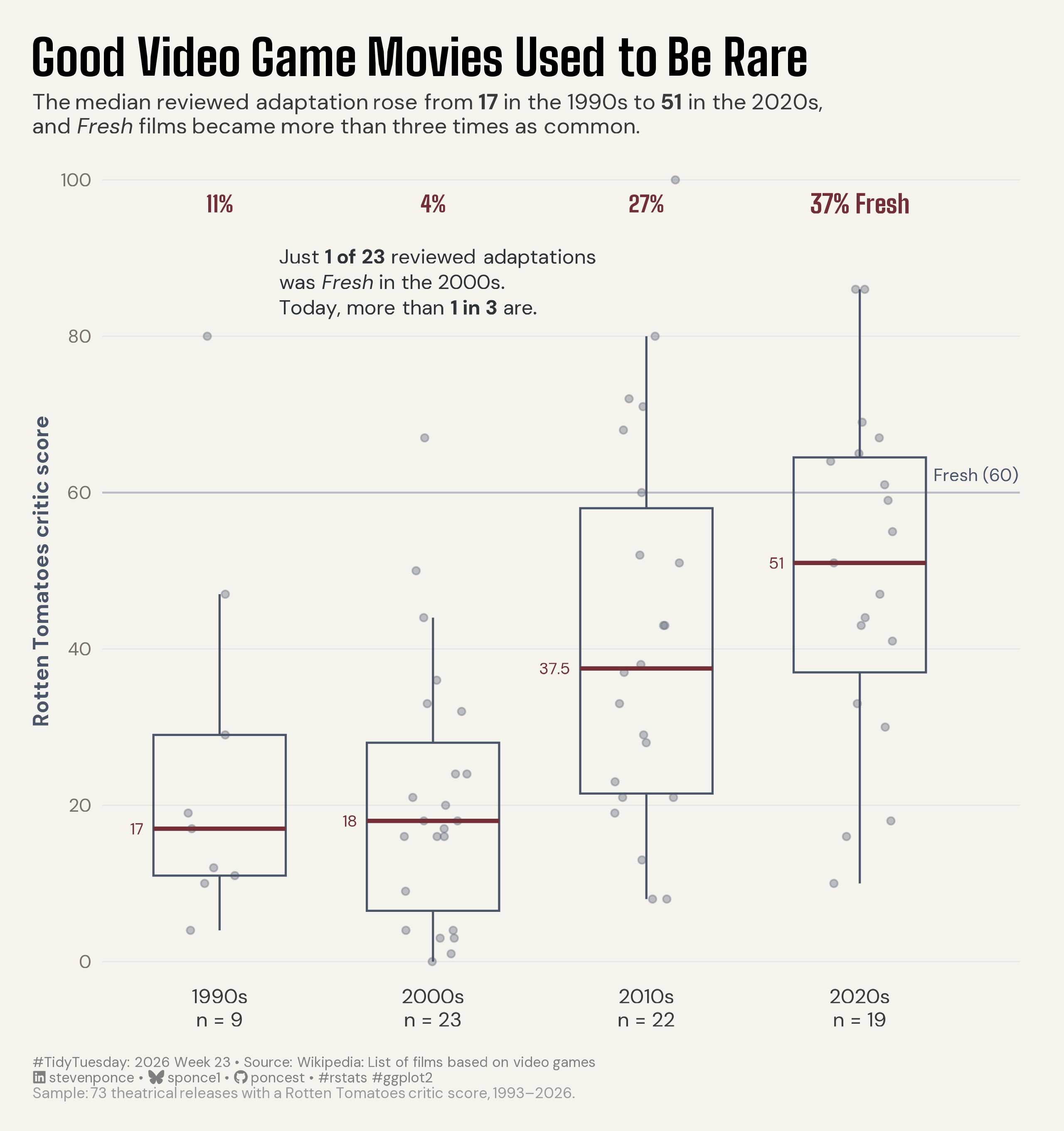
The median reviewed adaptation rose from 17 in the 1990s to 51 in the 2020s, and Fresh films became more than three times as common.

TidyTuesday
Data Visualization
R Programming
2026
A distribution view of Rotten Tomatoes critic scores for 73 video game film adaptations by release decade, showing that scores rose across the entire genre — not just among a few breakout hits — with the Fresh rate climbing from 4% in the 2000s to 37% in the 2020s. Built in R with ggplot2, ggtext, and showtext.
Author

Steven Ponce

Published

June 6, 2026

Figure 1: Boxplot of Rotten Tomatoes critic scores for 73 video game film adaptations, grouped by release decade from the 1990s to the 2020s. Scores climb steadily: median scores are 17 (1990s), 18 (2000s), 37.5 (2010s), and 51 (2020s), and the entire distribution shifts upward, not just the top films. A horizontal line marks the “Fresh” threshold of 60. The share of films scoring Fresh rises from 11% in the 1990s and just 4% in the 2000s to 27% in the 2010s and 37% in the 2020s, with the sharpest jump between the 2000s and 2010s. The typical adaptation is still rated below Fresh, but good video game movies have gone from rare to fairly common.

Steps to Create this Graphic

1. Load Packages & Setup

Show code
```{r}
#| label: load
#| warning: false
#| message: false      
#| results: "hide"     

## 1. LOAD PACKAGES & SETUP ----
suppressPackageStartupMessages({
if (!require("pacman")) install.packages("pacman")
pacman::p_load(
    tidyverse, ggtext, showtext, janitor, ggrepel,      
    scales, glue, skimr
    )
})

### |- figure size ----          TODO I am HERE !@#$%^&*(!@#$%^&*())
camcorder::gg_record(
  dir    = here::here("temp_plots"),
    device = "png",
    width  = 8,
    height = 8.5,
    units  = "in",
    dpi    = 320
)

# Source utility functions
suppressMessages(source(here::here("R/utils/fonts.R")))
source(here::here("R/utils/social_icons.R"))
source(here::here("R/utils/image_utils.R"))
source(here::here("R/themes/base_theme.R"))
```

2. Read in the Data

Show code
```{r}
#| label: read
#| include: true
#| eval: true
#| warning: false

tt <- tidytuesdayR::tt_load(2026, week = 23)
game_films <- tt$game_films |> clean_names()
rm(tt)
```

3. Examine the Data

Show code
```{r}
#| label: examine
#| include: true
#| eval: true
#| results: 'hide'
#| warning: false

glimpse(game_films)
```

4. Tidy Data

Show code
```{r}
#| label: tidy
#| warning: false

### |- analysis frame: theatrical releases with an RT score ----
df_rt <- game_films |>
  filter(
    category == "Theatrical releases",
    !is.na(rotten_tomatoes)
  ) |>
  mutate(
    year = year(release_date),
    decade = case_when(
      year < 2000 ~ "1990s",
      year < 2010 ~ "2000s",
      year < 2020 ~ "2010s",
      TRUE ~ "2020s"
    ),
    decade = factor(decade, levels = c("1990s", "2000s", "2010s", "2020s"))
  )

### |- per-decade summary ----
decade_stats <- df_rt |>
  summarise(
    n = n(),
    median_rt = median(rotten_tomatoes),
    fresh_pct = mean(rotten_tomatoes >= 60),
    .by = decade
  ) |>
  arrange(decade) |>
  mutate(
    x = as.integer(decade),
    fresh_lab = percent(fresh_pct, accuracy = 1),
    fresh_disp = if_else(decade == "2020s", paste0(fresh_lab, " Fresh"), fresh_lab),
    lab_size = if_else(decade == "2020s", 4.8, 4.3),
    median_lab = if_else(
      median_rt == floor(median_rt),
      as.character(as.integer(median_rt)),
      as.character(median_rt)
    ),
    axis_lab = paste0(decade, "\nn = ", n)
  )

# Named vector for the x-axis labels (decade + n)
axis_labels <- setNames(decade_stats$axis_lab, decade_stats$decade)
```

5. Visualization Parameters

Show code
```{r}
#| label: params
#| include: true
#| warning: false

### |- plot aesthetics ----
clrs <- get_theme_colors(
  palette = list(
    accent = "#722F37",
    box    = "#4A5568",
    point  = "#6B7280",
    fresh  = "#B8BCC2",
    note   = "#2E3338"
  )
)
col_accent <- clrs$palette$accent
col_box <- clrs$palette$box
col_point <- clrs$palette$point
col_fresh <- clrs$palette$fresh
col_note <- clrs$palette$note

### |- titles and caption ----
title_text <- str_glue("Good Video Game Movies Used to Be Rare")

subtitle_text <- str_glue(
  "The median reviewed adaptation rose from **17** in the 1990s to **51** ",
  "in the 2020s,<br>and *Fresh* films became more than three times as common."
)

base_caption <- create_social_caption(
  tt_year     = 2026,
  tt_week     = 23,
  source_text = "Wikipedia: List of films based on video games"
)

caption_text <- str_glue(
  "{base_caption}<br>",
  "<span style='font-size:8pt;color:#9A9A9A'>Sample: 73 theatrical releases ",
  "with a Rotten Tomatoes critic score, 1993\u20132026.</span>"
)

### |- annotation text  ----
ann_text <- str_glue(
  "Just **1 of 23** reviewed adaptations<br>",
  "was *Fresh* in the 2000s.<br>",
  "Today, more than **1 in 3** are."
)

### |- fonts ----
setup_fonts()
fonts <- get_font_families()

### |- plot theme ----
base_theme <- create_base_theme(clrs)

weekly_theme <- extend_weekly_theme(
  base_theme,
  theme(
    plot.title = element_markdown(
      face = "bold", family = fonts$title_1, size = rel(1.9),
      margin = margin(b = 4)
    ),
    plot.subtitle = element_textbox_simple(
      family = fonts$text, size = rel(0.85), color = "#3A3A3A",
      width = unit(1, "npc"), lineheight = 1.1, margin = margin(b = 14)
    ),
    plot.caption = element_markdown(
      family = fonts$text, size = rel(0.55), color = "#7F7F7F",
      hjust = 0, margin = margin(t = 14), lineheight = 1.1
    ),
    # plain text (with \n)
    axis.text.x = element_text(
      family = fonts$text, size = rel(1.0),
      lineheight = 0.95, color = "#3A3A3A"
    ),
    axis.text.y = element_text(family = fonts$text, size = rel(0.9)),
    axis.title.y = element_text(
      family = fonts$text, size = rel(0.9),
      color = "#4A5568"
    ),
    panel.grid.major.y = element_line(color = "gray90", linewidth = 0.3),
    panel.grid.major.x = element_blank(),
    panel.grid.minor = element_blank(),
    axis.ticks = element_blank(),
    plot.margin = margin(t = 20, r = 24, b = 16, l = 18)
  )
)

theme_set(weekly_theme)
```

6. Plot

Show code
```{r}
#| label: plot
#| warning: false

### |- plot ----
set.seed(1234)

p <- ggplot(df_rt, aes(x = decade, y = rotten_tomatoes)) +

  # Geoms
  geom_hline(
    yintercept = 60, color = col_fresh, linewidth = 0.5
  ) +
  geom_jitter(
    width = 0.16, height = 0, size = 1.5, alpha = 0.42, color = col_point
  ) +
  geom_boxplot(
    coef = 1.0, outlier.shape = NA, fill = NA,
    color = col_box, linewidth = 0.55, width = 0.62, fatten = 0
  ) +
  geom_segment(
    data = decade_stats,
    aes(x = x - 0.31, xend = x + 0.31, y = median_rt, yend = median_rt),
    inherit.aes = FALSE,
    color = col_accent, linewidth = 1.1
  ) +
  geom_text(
    data = decade_stats,
    aes(x = x - 0.36, y = median_rt, label = median_lab),
    inherit.aes = FALSE, hjust = 1, vjust = 0.5,
    family = fonts$text, size = 3.1, color = col_accent
  ) +
  geom_text(
    data = decade_stats,
    aes(x = x, y = 97, label = fresh_disp, size = lab_size),
    inherit.aes = FALSE,
    family = fonts$title_2, fontface = "bold", color = col_accent
  ) +
  # Annotate
  annotate(
    "richtext",
    x = 4.32, y = 62, label = "Fresh (60)",
    hjust = 0, family = fonts$text, size = 3.3, color = "#4A5568",
    fill = NA, label.color = NA
  ) +
  annotate(
    "richtext",
    x = 1.25, y = 92, label = ann_text,
    hjust = 0, vjust = 1, family = fonts$text, size = 3.9,
    color = col_note, fill = NA, label.color = NA, lineheight = 1.25
  ) +
  # Scales
  scale_size_identity() +
  scale_x_discrete(
    labels = axis_labels,
    expand = expansion(add = c(0.55, 0.75))
  ) +
  scale_y_continuous(
    breaks = seq(0, 100, 20),
    expand = expansion(mult = c(0.02, 0.02))
  ) +
  coord_cartesian(ylim = c(0, 100), clip = "off") +
  # Labs
  labs(
    title = title_text,
    subtitle = subtitle_text,
    caption = caption_text,
    x = NULL,
    y = "Rotten Tomatoes critic score"
  )
```

7. Save

Show code
```{r}
#| label: save
#| warning: false

### |-  plot image ----  
save_plot(
  plot = p, 
  type = "tidytuesday", 
  year = 2026, 
  week = 23, 
  width  = 8,
  height = 8.5,
  )
```

8. Session Info

TipExpand for Session Info
R version 4.5.3 (2026-03-11 ucrt)
Platform: x86_64-w64-mingw32/x64
Running under: Windows 11 x64 (build 26100)

Matrix products: default
  LAPACK version 3.12.1

locale:
[1] LC_COLLATE=English_United States.utf8 
[2] LC_CTYPE=English_United States.utf8   
[3] LC_MONETARY=English_United States.utf8
[4] LC_NUMERIC=C                          
[5] LC_TIME=English_United States.utf8    

time zone: America/New_York
tzcode source: internal

attached base packages:
[1] stats     graphics  grDevices utils     datasets  methods   base     

other attached packages:
 [1] here_1.0.2      skimr_2.2.2     glue_1.8.0      scales_1.4.0   
 [5] ggrepel_0.9.8   janitor_2.2.1   showtext_0.9-8  showtextdb_3.0 
 [9] sysfonts_0.8.9  ggtext_0.1.2    lubridate_1.9.5 forcats_1.0.1  
[13] stringr_1.6.0   dplyr_1.2.1     purrr_1.2.2     readr_2.2.0    
[17] tidyr_1.3.2     tibble_3.3.1    ggplot2_4.0.3   tidyverse_2.0.0
[21] pacman_0.5.1   

loaded via a namespace (and not attached):
 [1] gtable_0.3.6       httr2_1.2.2        xfun_0.57          htmlwidgets_1.6.4 
 [5] gh_1.5.0           tzdb_0.5.0         vctrs_0.7.3        tools_4.5.3       
 [9] generics_0.1.4     parallel_4.5.3     curl_7.0.0         gifski_1.32.0-2   
[13] pkgconfig_2.0.3    RColorBrewer_1.1-3 S7_0.2.1           lifecycle_1.0.5   
[17] compiler_4.5.3     farver_2.1.2       textshaping_1.0.5  repr_1.1.7        
[21] codetools_0.2-20   snakecase_0.11.1   litedown_0.9       htmltools_0.5.9   
[25] yaml_2.3.12        crayon_1.5.3       pillar_1.11.1      camcorder_0.1.0   
[29] magick_2.9.1       commonmark_2.0.0   tidyselect_1.2.1   digest_0.6.39     
[33] stringi_1.8.7      rsvg_2.7.0         rprojroot_2.1.1    fastmap_1.2.0     
[37] grid_4.5.3         cli_3.6.6          magrittr_2.0.5     base64enc_0.1-6   
[41] withr_3.0.2        rappdirs_0.3.4     bit64_4.6.0-1      timechange_0.4.0  
[45] rmarkdown_2.31     tidytuesdayR_1.3.2 gitcreds_0.1.2     bit_4.6.0         
[49] otel_0.2.0         ragg_1.5.2         hms_1.1.4          evaluate_1.0.5    
[53] knitr_1.51         markdown_2.0       rlang_1.2.0        gridtext_0.1.6    
[57] Rcpp_1.1.1         xml2_1.5.2         vroom_1.7.1        svglite_2.2.2     
[61] rstudioapi_0.18.0  jsonlite_2.0.0     R6_2.6.1           systemfonts_1.3.2 

9. GitHub Repository

TipExpand for GitHub Repo

The complete code for this analysis is available in tt_2026_23.qmd.

For the full repository, click here.

10. References

TipExpand for References
  1. Data Source:
    • TidyTuesday 2026 Week 23: Films Based on Video Games

11. Custom Functions Documentation

Note📦 Custom Helper Functions

This analysis uses custom functions from my personal module library for efficiency and consistency across projects.

Functions Used:

  • fonts.R: setup_fonts(), get_font_families() - Font management with showtext
  • social_icons.R: create_social_caption() - Generates formatted social media captions
  • image_utils.R: save_plot() - Consistent plot saving with naming conventions
  • base_theme.R: create_base_theme(), extend_weekly_theme(), get_theme_colors() - Custom ggplot2 themes

Why custom functions?
These utilities standardize theming, fonts, and output across all my data visualizations. The core analysis (data tidying and visualization logic) uses only standard tidyverse packages.

Source Code:
View all custom functions → GitHub: R/utils

Back to top

Citation

BibTeX citation:
@online{ponce2026,
  author = {Ponce, Steven},
  title = {Good {Video} {Game} {Movies} {Used} to {Be} {Rare}},
  date = {2026-06-06},
  url = {https://stevenponce.netlify.app/data_visualizations/TidyTuesday/2026/tt_2026_W23.html},
  langid = {en}
}
For attribution, please cite this work as:
Ponce, Steven. 2026. “Good Video Game Movies Used to Be Rare.” June 6. https://stevenponce.netlify.app/data_visualizations/TidyTuesday/2026/tt_2026_W23.html.
Source Code
---
title: "Good Video Game Movies Used to Be Rare"
subtitle: "The median reviewed adaptation rose from 17 in the 1990s to 51 in the 2020s, and Fresh films became more than three times as common."
description: "A distribution view of Rotten Tomatoes critic scores for 73 video game film adaptations by release decade, showing that scores rose across the entire genre — not just among a few breakout hits — with the Fresh rate climbing from 4% in the 2000s to 37% in the 2020s. Built in R with ggplot2, ggtext, and showtext."
date: "2026-06-06"
author:
  - name: "Steven Ponce"
    url: "https://stevenponce.netlify.app"
citation:
  url: "https://stevenponce.netlify.app/data_visualizations/TidyTuesday/2026/tt_2026_W23.html"
categories: ["TidyTuesday", "Data Visualization", "R Programming", "2026"]
tags: [
  "TidyTuesday",
  "Box Plot",
  "Distribution",
  "Film",
  "Video Games",
  "Movie Reviews",
  "Rotten Tomatoes",
  "Annotation",
  "ggtext",
  "showtext",
  "ggplot2",
  "2026"
]
image: "thumbnails/tt_2026_23.png"
format:
  html:
    toc: true
    toc-depth: 5
    code-link: true
    code-fold: true
    code-tools: true
    code-summary: "Show code"
    self-contained: true
    theme: 
      light: [flatly, assets/styling/custom_styles.scss]
      dark: [darkly, assets/styling/custom_styles_dark.scss]
editor_options: 
  chunk_output_type: inline
execute: 
  freeze: true
  cache: true
  error: false
  message: false
  warning: false
  eval: true
---
![Boxplot of Rotten Tomatoes critic scores for 73 video game film adaptations, grouped by release decade from the 1990s to the 2020s. Scores climb steadily: median scores are 17 (1990s), 18 (2000s), 37.5 (2010s), and 51 (2020s), and the entire distribution shifts upward, not just the top films. A horizontal line marks the "Fresh" threshold of 60. The share of films scoring Fresh rises from 11% in the 1990s and just 4% in the 2000s to 27% in the 2010s and 37% in the 2020s, with the sharpest jump between the 2000s and 2010s. The typical adaptation is still rated below Fresh, but good video game movies have gone from rare to fairly common.](tt_2026_23.png){#fig-1}

### [**Steps to Create this Graphic**]{.mark}

#### [1. Load Packages & Setup]{.smallcaps}

```{r}
#| label: load
#| warning: false
#| message: false      
#| results: "hide"     

## 1. LOAD PACKAGES & SETUP ----
suppressPackageStartupMessages({
if (!require("pacman")) install.packages("pacman")
pacman::p_load(
    tidyverse, ggtext, showtext, janitor, ggrepel,      
    scales, glue, skimr
    )
})

### |- figure size ----          TODO I am HERE !@#$%^&*(!@#$%^&*())
camcorder::gg_record(
  dir    = here::here("temp_plots"),
    device = "png",
    width  = 8,
    height = 8.5,
    units  = "in",
    dpi    = 320
)

# Source utility functions
suppressMessages(source(here::here("R/utils/fonts.R")))
source(here::here("R/utils/social_icons.R"))
source(here::here("R/utils/image_utils.R"))
source(here::here("R/themes/base_theme.R"))
```

#### [2. Read in the Data]{.smallcaps}

```{r}
#| label: read
#| include: true
#| eval: true
#| warning: false

tt <- tidytuesdayR::tt_load(2026, week = 23)
game_films <- tt$game_films |> clean_names()
rm(tt)
```

#### [3. Examine the Data]{.smallcaps}

```{r}
#| label: examine
#| include: true
#| eval: true
#| results: 'hide'
#| warning: false

glimpse(game_films)
```

#### [4. Tidy Data]{.smallcaps}

```{r}
#| label: tidy
#| warning: false

### |- analysis frame: theatrical releases with an RT score ----
df_rt <- game_films |>
  filter(
    category == "Theatrical releases",
    !is.na(rotten_tomatoes)
  ) |>
  mutate(
    year = year(release_date),
    decade = case_when(
      year < 2000 ~ "1990s",
      year < 2010 ~ "2000s",
      year < 2020 ~ "2010s",
      TRUE ~ "2020s"
    ),
    decade = factor(decade, levels = c("1990s", "2000s", "2010s", "2020s"))
  )

### |- per-decade summary ----
decade_stats <- df_rt |>
  summarise(
    n = n(),
    median_rt = median(rotten_tomatoes),
    fresh_pct = mean(rotten_tomatoes >= 60),
    .by = decade
  ) |>
  arrange(decade) |>
  mutate(
    x = as.integer(decade),
    fresh_lab = percent(fresh_pct, accuracy = 1),
    fresh_disp = if_else(decade == "2020s", paste0(fresh_lab, " Fresh"), fresh_lab),
    lab_size = if_else(decade == "2020s", 4.8, 4.3),
    median_lab = if_else(
      median_rt == floor(median_rt),
      as.character(as.integer(median_rt)),
      as.character(median_rt)
    ),
    axis_lab = paste0(decade, "\nn = ", n)
  )

# Named vector for the x-axis labels (decade + n)
axis_labels <- setNames(decade_stats$axis_lab, decade_stats$decade)
```

#### [5. Visualization Parameters]{.smallcaps}

```{r}
#| label: params
#| include: true
#| warning: false

### |- plot aesthetics ----
clrs <- get_theme_colors(
  palette = list(
    accent = "#722F37",
    box    = "#4A5568",
    point  = "#6B7280",
    fresh  = "#B8BCC2",
    note   = "#2E3338"
  )
)
col_accent <- clrs$palette$accent
col_box <- clrs$palette$box
col_point <- clrs$palette$point
col_fresh <- clrs$palette$fresh
col_note <- clrs$palette$note

### |- titles and caption ----
title_text <- str_glue("Good Video Game Movies Used to Be Rare")

subtitle_text <- str_glue(
  "The median reviewed adaptation rose from **17** in the 1990s to **51** ",
  "in the 2020s,<br>and *Fresh* films became more than three times as common."
)

base_caption <- create_social_caption(
  tt_year     = 2026,
  tt_week     = 23,
  source_text = "Wikipedia: List of films based on video games"
)

caption_text <- str_glue(
  "{base_caption}<br>",
  "<span style='font-size:8pt;color:#9A9A9A'>Sample: 73 theatrical releases ",
  "with a Rotten Tomatoes critic score, 1993\u20132026.</span>"
)

### |- annotation text  ----
ann_text <- str_glue(
  "Just **1 of 23** reviewed adaptations<br>",
  "was *Fresh* in the 2000s.<br>",
  "Today, more than **1 in 3** are."
)

### |- fonts ----
setup_fonts()
fonts <- get_font_families()

### |- plot theme ----
base_theme <- create_base_theme(clrs)

weekly_theme <- extend_weekly_theme(
  base_theme,
  theme(
    plot.title = element_markdown(
      face = "bold", family = fonts$title_1, size = rel(1.9),
      margin = margin(b = 4)
    ),
    plot.subtitle = element_textbox_simple(
      family = fonts$text, size = rel(0.85), color = "#3A3A3A",
      width = unit(1, "npc"), lineheight = 1.1, margin = margin(b = 14)
    ),
    plot.caption = element_markdown(
      family = fonts$text, size = rel(0.55), color = "#7F7F7F",
      hjust = 0, margin = margin(t = 14), lineheight = 1.1
    ),
    # plain text (with \n)
    axis.text.x = element_text(
      family = fonts$text, size = rel(1.0),
      lineheight = 0.95, color = "#3A3A3A"
    ),
    axis.text.y = element_text(family = fonts$text, size = rel(0.9)),
    axis.title.y = element_text(
      family = fonts$text, size = rel(0.9),
      color = "#4A5568"
    ),
    panel.grid.major.y = element_line(color = "gray90", linewidth = 0.3),
    panel.grid.major.x = element_blank(),
    panel.grid.minor = element_blank(),
    axis.ticks = element_blank(),
    plot.margin = margin(t = 20, r = 24, b = 16, l = 18)
  )
)

theme_set(weekly_theme)
```

#### [6. Plot]{.smallcaps}

```{r}
#| label: plot
#| warning: false

### |- plot ----
set.seed(1234)

p <- ggplot(df_rt, aes(x = decade, y = rotten_tomatoes)) +

  # Geoms
  geom_hline(
    yintercept = 60, color = col_fresh, linewidth = 0.5
  ) +
  geom_jitter(
    width = 0.16, height = 0, size = 1.5, alpha = 0.42, color = col_point
  ) +
  geom_boxplot(
    coef = 1.0, outlier.shape = NA, fill = NA,
    color = col_box, linewidth = 0.55, width = 0.62, fatten = 0
  ) +
  geom_segment(
    data = decade_stats,
    aes(x = x - 0.31, xend = x + 0.31, y = median_rt, yend = median_rt),
    inherit.aes = FALSE,
    color = col_accent, linewidth = 1.1
  ) +
  geom_text(
    data = decade_stats,
    aes(x = x - 0.36, y = median_rt, label = median_lab),
    inherit.aes = FALSE, hjust = 1, vjust = 0.5,
    family = fonts$text, size = 3.1, color = col_accent
  ) +
  geom_text(
    data = decade_stats,
    aes(x = x, y = 97, label = fresh_disp, size = lab_size),
    inherit.aes = FALSE,
    family = fonts$title_2, fontface = "bold", color = col_accent
  ) +
  # Annotate
  annotate(
    "richtext",
    x = 4.32, y = 62, label = "Fresh (60)",
    hjust = 0, family = fonts$text, size = 3.3, color = "#4A5568",
    fill = NA, label.color = NA
  ) +
  annotate(
    "richtext",
    x = 1.25, y = 92, label = ann_text,
    hjust = 0, vjust = 1, family = fonts$text, size = 3.9,
    color = col_note, fill = NA, label.color = NA, lineheight = 1.25
  ) +
  # Scales
  scale_size_identity() +
  scale_x_discrete(
    labels = axis_labels,
    expand = expansion(add = c(0.55, 0.75))
  ) +
  scale_y_continuous(
    breaks = seq(0, 100, 20),
    expand = expansion(mult = c(0.02, 0.02))
  ) +
  coord_cartesian(ylim = c(0, 100), clip = "off") +
  # Labs
  labs(
    title = title_text,
    subtitle = subtitle_text,
    caption = caption_text,
    x = NULL,
    y = "Rotten Tomatoes critic score"
  )
```

#### [7. Save]{.smallcaps}

```{r}
#| label: save
#| warning: false

### |-  plot image ----  
save_plot(
  plot = p, 
  type = "tidytuesday", 
  year = 2026, 
  week = 23, 
  width  = 8,
  height = 8.5,
  )
```

#### [8. Session Info]{.smallcaps}

::: {.callout-tip collapse="true"}
##### Expand for Session Info

```{r, echo = FALSE}
#| eval: true
#| warning: false

sessionInfo()
```
:::

#### [9. GitHub Repository]{.smallcaps}

::: {.callout-tip collapse="true"}
##### Expand for GitHub Repo

The complete code for this analysis is available in [`tt_2026_23.qmd`](https://github.com/poncest/personal-website/blob/master/data_visualizations/TidyTuesday/2026/tt_2026_23.qmd).

For the full repository, [click here](https://github.com/poncest/personal-website/).
:::

#### [10. References]{.smallcaps}

::: {.callout-tip collapse="true"}
##### Expand for References
1.  **Data Source:**
    -   TidyTuesday 2026 Week 23: [Films Based on Video Games](https://github.com/rfordatascience/tidytuesday/blob/main/data/2026/2026-06-09/readme.md)

:::


#### [11. Custom Functions Documentation]{.smallcaps}

::: {.callout-note collapse="true"}
##### 📦 Custom Helper Functions

This analysis uses custom functions from my personal module library for efficiency and consistency across projects.

**Functions Used:**

-   **`fonts.R`**: `setup_fonts()`, `get_font_families()` - Font management with showtext
-   **`social_icons.R`**: `create_social_caption()` - Generates formatted social media captions
-   **`image_utils.R`**: `save_plot()` - Consistent plot saving with naming conventions
-   **`base_theme.R`**: `create_base_theme()`, `extend_weekly_theme()`, `get_theme_colors()` - Custom ggplot2 themes

**Why custom functions?**\
These utilities standardize theming, fonts, and output across all my data visualizations. The core analysis (data tidying and visualization logic) uses only standard tidyverse packages.

**Source Code:**\
View all custom functions → [GitHub: R/utils](https://github.com/poncest/personal-website/tree/master/R)
:::

© 2024 Steven Ponce

Source Issues