• Steven Ponce
  • About
  • Data Visualizations
  • Projects
  • Resume
  • Email

On this page

  • Steps to Create this Graphic
    • 1. Load Packages & Setup
    • 2. Read in the Data
    • 3. Examine the Data
    • 4. Tidy Data
    • 5. Visualization Parameters
    • 6. Plot
    • 7. Save
    • 8. Session Info
    • 9. GitHub Repository
    • 10. References
    • 11. Custom Functions Documentation

Norway runs on water. India runs on coal. Electricity generation, shown in 10 icons.

  • Show All Code
  • Hide All Code

  • View Source

Each icon represents 10% of electricity generation (2023). Countries ordered from cleanest to most fossil-heavy.

30DayChartChallenge
Data Visualization
R Programming
2026
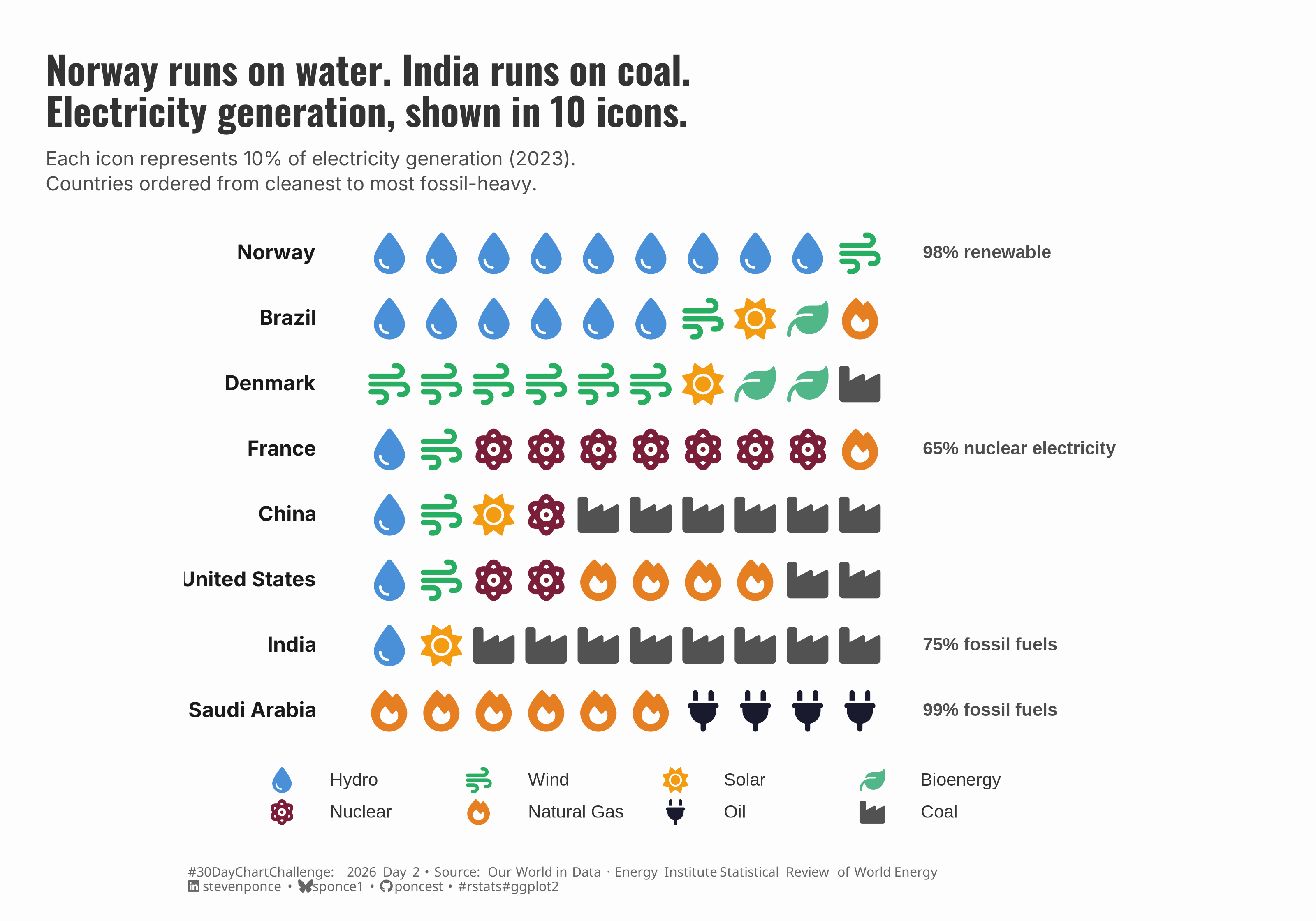
A pictogram chart showing the electricity generation mix for 8 countries in 2023. Each country gets exactly 10 icons — the icon type reveals the energy source. Countries range from Norway (98% renewable, nearly all hydro) to Saudi Arabia (99% fossil fuels). Built with R, ggplot2, FontAwesome icons, and patchwork.
Author

Steven Ponce

Published

April 2, 2026

Figure 1: Pictogram chart showing the electricity generation mix for 8 countries in 2023, with 10 icons per country, each representing 10% of generation. Icon type indicates the energy source — droplets for hydro, flames for gas, factory icons for coal, and others. Countries are ordered from cleanest to most fossil-heavy. Norway leads with 98% renewable energy (mostly hydro), while Saudi Arabia and India rely on 99% and 75% fossil fuels, respectively. France stands out mid-table with 65% nuclear electricity. Denmark shows a wind-dominant mix, and China and the United States display mixed fossil and clean profiles.

Steps to Create this Graphic

1. Load Packages & Setup

Show code
```{r}
#| label: load
#| warning: false
#| message: false      
#| results: "hide"     

## 1. LOAD PACKAGES & SETUP ----
suppressPackageStartupMessages({
pacman::p_load(
  tidyverse, ggtext, showtext, sysfonts, systemfonts,    
  janitor, scales, glue, patchwork   
  )
})

### |- figure size ----
camcorder::gg_record(
  dir    = here::here("temp_plots"),
  device = "png",
  width  = 10,
  height = 7,
  units  = "in",
  dpi    = 320
)

# Source utility functions
suppressMessages(source(here::here("R/utils/fonts.R")))
source(here::here("R/utils/social_icons.R"))
source(here::here("R/utils/image_utils.R"))
source(here::here("R/themes/base_theme.R"))

### |- load FontAwesome ----
font_add("FontAwesome6",
  regular = here::here("fonts/6.6.0/Font Awesome 6 Free-Solid-900.otf"))

showtext_auto()
showtext_opts(dpi = 320)
```

2. Read in the Data

Show code
```{r}
#| label: read
#| include: true
#| eval: true
#| warning: false

### |- OWID energy data ----
# Download: https://raw.githubusercontent.com/owid/energy-data/master/owid-energy-data.csv
energy_raw <- read_csv(
  here::here("data/30DayChartChallenge/2026/owid-energy-data.csv")
)
```

3. Examine the Data

Show code
```{r}
#| label: examine
#| include: true
#| eval: true
#| results: 'hide'
#| warning: false

glimpse(energy_raw)
```

4. Tidy Data

Show code
```{r}
#| label: tidy
#| warning: false

### |- target countries ----
target_countries <- c(
  "Norway", "Brazil", "Denmark", "France",
  "China", "United States", "India", "Saudi Arabia"
)

### |- column -> source lookup ----
col_source_map <- c(
  "coal_electricity"                        = "coal",
  "gas_electricity"                         = "gas",
  "oil_electricity"                         = "oil",
  "nuclear_electricity"                     = "nuclear",
  "hydro_electricity"                       = "hydro",
  "wind_electricity"                        = "wind",
  "solar_electricity"                       = "solar",
  "biofuel_electricity"                     = "bioenergy",
  "other_renewable_exc_biofuel_electricity" = "other_renewables"
  # NOTE: other_renewables retained for data completeness;
  # excluded from legend since none of the 8 countries use it in 2023
)

### |- sort orders (defined once, used throughout) ----
# Within-row display: renewables block | nuclear | fossil block
source_sort_order <- c(
  "hydro"            = 1,
  "wind"             = 2,
  "solar"            = 3,
  "bioenergy"        = 4,
  "other_renewables" = 5,
  "nuclear"          = 6,
  "gas"              = 7,
  "oil"              = 8,
  "coal"             = 9
)

# Legend order: same clean -> fossil sequence, other_renewables excluded
legend_order <- c(
  "hydro", "wind", "solar", "bioenergy",
  "nuclear", "gas", "oil", "coal"
)

### |- source group lookup ----
source_group_map <- c(
  "hydro"            = "renewable",
  "wind"             = "renewable",
  "solar"            = "renewable",
  "bioenergy"        = "renewable",
  "other_renewables" = "renewable",
  "nuclear"          = "nuclear",
  "gas"              = "fossil",
  "oil"              = "fossil",
  "coal"             = "fossil"
)

### |- icon unicode (FontAwesome 6 Solid) ----
icon_map <- c(
  "hydro"            = "\uf043", # fa-droplet
  "wind"             = "\uf72e", # fa-wind
  "solar"            = "\uf185", # fa-sun
  "bioenergy"        = "\uf06c", # fa-leaf
  "other_renewables" = "\uf0e7", # fa-bolt
  "nuclear"          = "\uf5d2", # fa-atom
  "gas"              = "\uf06d", # fa-fire
  "oil"              = "\uf1e6", # fa-plug
  "coal"             = "\uf275" # fa-industry
)

### |- display labels ----
source_labels <- c(
  "hydro"            = "Hydro",
  "wind"             = "Wind",
  "solar"            = "Solar",
  "bioenergy"        = "Bioenergy",
  "other_renewables" = "Other Renew.",
  "nuclear"          = "Nuclear",
  "gas"              = "Natural Gas",
  "oil"              = "Oil",
  "coal"             = "Coal"
)

### |- largest-remainder allocation: icons always sum to exactly 10 ----
allocate_icons <- function(shares, n_total = 10) {
  shares <- tidyr::replace_na(shares, 0)

  if (sum(shares) == 0) {
    return(rep(0L, length(shares)))
  }

  shares <- shares / sum(shares)

  floors <- floor(shares * n_total)
  remainder <- shares * n_total - floors
  n_remaining <- as.integer(n_total - sum(floors))

  if (n_remaining > 0) {
    top_idx <- order(remainder, decreasing = TRUE)[seq_len(n_remaining)]
    floors[top_idx] <- floors[top_idx] + 1L
  }

  floors
}

### |- filter, reshape, compute shares + icon counts ----
energy_clean <- energy_raw |>
  filter(country %in% target_countries, year == 2023) |>
  select(country, year, all_of(names(col_source_map))) |>
  pivot_longer(
    cols      = all_of(names(col_source_map)),
    names_to  = "col",
    values_to = "twh"
  ) |>
  mutate(
    source = col_source_map[col],
    twh    = replace_na(twh, 0)
  ) |>
  select(-col) |>
  group_by(country) |>
  mutate(
    total_twh = sum(twh, na.rm = TRUE),
    share     = if_else(total_twh > 0, twh / total_twh, 0),
    n_icons   = allocate_icons(share)
  ) |>
  ungroup() |>
  mutate(
    source = factor(source, levels = names(source_sort_order))
  ) |>
  # Keep only sources that receive at least one pictogram icon
  # after largest-remainder allocation
  filter(n_icons > 0)

### |- sanity check: every country must sum to exactly 10 icons ----
icon_check <- energy_clean |>
  group_by(country) |>
  summarise(total_icons = sum(n_icons), .groups = "drop")

stopifnot(all(icon_check$total_icons == 10))

### |- country order: cleanest -> most fossil-heavy ----
# left_join retains countries with zero fossil icons (e.g. Norway)
country_order <- energy_clean |>
  distinct(country) |>
  left_join(
    energy_clean |>
      filter(source %in% c("coal", "gas", "oil")) |>
      group_by(country) |>
      summarise(fossil_icons = sum(n_icons), .groups = "drop"),
    by = "country"
  ) |>
  mutate(fossil_icons = replace_na(fossil_icons, 0)) |>
  arrange(fossil_icons, country) |>
  pull(country)

### |- expand to one row per icon, sorted within each row ----
energy_expanded <- energy_clean |>
  uncount(n_icons) |>
  mutate(sort_key = source_sort_order[as.character(source)]) |>
  group_by(country) |>
  arrange(sort_key, .by_group = TRUE) |>
  mutate(
    icon_pos = row_number(),
    x        = icon_pos,
    y        = 0,
    icon     = icon_map[as.character(source)]
  ) |>
  ungroup() |>
  mutate(
    country = factor(country, levels = country_order),
    source  = factor(as.character(source), levels = legend_order)
  )

### |- right-side annotations (selected countries only) ----
annotation_df <- energy_clean |>
  mutate(group = source_group_map[as.character(source)]) |>
  group_by(country, group) |>
  summarise(pct = round(sum(share) * 100), .groups = "drop") |>
  pivot_wider(names_from = group, values_from = pct, values_fill = 0) |>
  mutate(
    annotation = case_when(
      country == "Norway" ~ glue("{renewable}% renewable"),
      country == "France" ~ glue("{nuclear}% nuclear electricity"),
      country %in% c("India", "Saudi Arabia") ~ glue("{fossil}% fossil fuels"),
      TRUE ~ NA_character_
    )
  ) |>
  filter(!is.na(annotation)) |>
  mutate(country = factor(country, levels = country_order))

### |- legend data ----
legend_df <- tibble(
  source = legend_order,
  label  = source_labels[legend_order],
  icon   = icon_map[legend_order]
) |>
  mutate(
    col = c(1, 2, 3, 4, 1, 2, 3, 4),
    row = c(2, 2, 2, 2, 1, 1, 1, 1)
  ) |>
  mutate(
    x_icon  = (col - 1) * 2.2 + 1,
    x_label = x_icon + 0.55,
    y       = row
  )
```

5. Visualization Parameters

Show code
```{r}
#| label: params
#| include: true
#| warning: false

### |- plot aesthetics ----
colors <- get_theme_colors(
  palette = c(
    "coal"             = "#525252",
    "gas"              = "#E67E22",
    "oil"              = "#1a1a2e",
    "nuclear"          = "#7A1E3A",
    "hydro"            = "#4A90D9",
    "wind"             = "#27AE60",
    "solar"            = "#F39C12",
    "bioenergy"        = "#52b788",
    "other_renewables" = "#1ABC9C"
  )
)

### |- titles and caption ----
title_text <- "Norway runs on water. India runs on coal.\nElectricity generation, shown in 10 icons."

subtitle_text <- str_glue(
  "Each icon represents 10% of electricity generation (2023).\n",
  "Countries ordered from cleanest to most fossil-heavy."
)

caption_text <- create_dcc_caption(
  dcc_year = 2026,
  dcc_day = 02,
  source_text = "Our World in Data · Energy Institute Statistical Review of World Energy"
)

### |- fonts ----
setup_fonts()
fonts <- get_font_families()

### |- plot theme ----
base_theme <- create_base_theme(colors)

weekly_theme <- extend_weekly_theme(
  base_theme,
  theme(
    strip.text.y.left = element_text(
      angle = 0, hjust = 1, vjust = 0.5,
      face = "bold", size = rel(1.0),
      margin = margin(r = 6, l = 0)
    ),
    plot.title = element_text(
      size = rel(1.5),
      family = fonts$title,
      face = "bold",
      color = colors$title,
      margin = margin(t = 5, b = 5)
    ),
    plot.subtitle = element_text(
      size = rel(0.75),
      family = fonts$subtitle,
      color = colors$subtitle,
      lineheight = 1.1,
      margin = margin(t = 5, b = 15)
    ),
    strip.background = element_blank(),
    axis.text = element_blank(),
    axis.title = element_blank(),
    axis.ticks = element_blank(),
    panel.grid = element_blank(),
    panel.spacing.y = unit(0.3, "lines"),
    legend.position = "none",
    plot.margin = margin(t = 10, r = 10, b = 10, l = 10)
  )
)

theme_set(weekly_theme)
```

6. Plot

Show code
```{r}
#| label: plot
#| warning: false

### |- main plot ----
p_main <- energy_expanded |>
  ggplot(aes(x = x, y = y, color = source, label = icon)) +
  geom_text(
    family      = "FontAwesome6",
    size        = 8,
    show.legend = FALSE
  ) +
  geom_text(
    data = annotation_df,
    aes(x = 11.2, y = 0, label = annotation),
    inherit.aes = FALSE,
    hjust = 0,
    vjust = 0.5,
    size = 3.5,
    color = "gray30",
    fontface = "bold",
    family = "sans"
  ) +
  scale_color_manual(values = colors$palette) +
  scale_x_continuous(limits = c(0.5, 14.5)) +
  scale_y_continuous(limits = c(-0.5, 0.5)) +
  coord_equal() +
  facet_wrap(
    ~country,
    ncol           = 1,
    strip.position = "left"
  ) +
  labs(
    title    = title_text,
    subtitle = subtitle_text
  )

### |- custom legend as its own ggplot ----
p_legend <- ggplot(legend_df) +
  geom_text(
    aes(x = x_icon, y = y, label = icon, color = source),
    family = "FontAwesome6",
    size = 5
  ) +
  geom_text(
    aes(x = x_label, y = y, label = label),
    hjust = 0,
    vjust = 0.5,
    size = 3.5,
    color = "gray20",
    family = "sans"
  ) +
  scale_color_manual(values = colors$palette) +
  scale_x_continuous(limits = c(0.5, 11.5)) +
  scale_y_continuous(limits = c(0.4, 2.6)) +
  theme_void() +
  theme(
    legend.position  = "none",
    plot.background  = element_rect(fill = colors$background, color = colors$background),
    panel.background = element_rect(fill = colors$background, color = colors$background),
    plot.margin      = margin(t = 0, r = 0, b = 0, l = 0)
  )

### |- caption panel ----
p_caption <- ggplot() +
  labs(caption = caption_text) +
  theme_void() +
  theme(
    plot.background = element_rect(fill = colors$background, color = colors$background),
    panel.background = element_rect(fill = colors$background, color = colors$background),
    plot.caption = element_markdown(
      size = rel(0.65),
      family = fonts$caption,
      color = colors$caption,
      lineheight = 1.1,
      hjust = 0,
      halign = 0,
      margin = margin(t = 5, b = 5)
    )
  )

### |- combine with patchwork ----
combined_plots <- p_main / p_legend / p_caption +
  plot_layout(heights = c(8, 1.2, 0.35)) +
  plot_annotation(
    theme = theme(
      plot.margin = margin(15, 15, 10, 15)
    )
  )
```

7. Save

Show code
```{r}
#| label: save
#| warning: false

### |-  plot image ----  
save_plot_patchwork(
  combined_plots, 
  type = "30daychartchallenge", 
  year = 2026, 
  day = 02, 
  width = 10, 
  height = 7
  )
```

8. Session Info

TipExpand for Session Info
R version 4.3.1 (2023-06-16 ucrt)
Platform: x86_64-w64-mingw32/x64 (64-bit)
Running under: Windows 11 x64 (build 26100)

Matrix products: default


locale:
[1] LC_COLLATE=English_United States.utf8 
[2] LC_CTYPE=English_United States.utf8   
[3] LC_MONETARY=English_United States.utf8
[4] LC_NUMERIC=C                          
[5] LC_TIME=English_United States.utf8    

time zone: America/New_York
tzcode source: internal

attached base packages:
[1] stats     graphics  grDevices utils     datasets  methods   base     

other attached packages:
 [1] here_1.0.2        patchwork_1.3.2   glue_1.8.0        scales_1.4.0     
 [5] janitor_2.2.1     systemfonts_1.3.2 showtext_0.9-7    showtextdb_3.0   
 [9] sysfonts_0.8.9    ggtext_0.1.2      lubridate_1.9.5   forcats_1.0.1    
[13] stringr_1.6.0     dplyr_1.2.0       purrr_1.2.1       readr_2.2.0      
[17] tidyr_1.3.2       tibble_3.2.1      ggplot2_4.0.2     tidyverse_2.0.0  

loaded via a namespace (and not attached):
 [1] gtable_0.3.6       xfun_0.56          htmlwidgets_1.6.4  tzdb_0.5.0        
 [5] yulab.utils_0.2.4  vctrs_0.7.1        tools_4.3.1        generics_0.1.4    
 [9] curl_7.0.0         parallel_4.3.1     gifski_1.32.0-2    pacman_0.5.1      
[13] pkgconfig_2.0.3    ggplotify_0.1.3    RColorBrewer_1.1-3 S7_0.2.0          
[17] lifecycle_1.0.5    compiler_4.3.1     farver_2.1.2       codetools_0.2-19  
[21] snakecase_0.11.1   litedown_0.9       htmltools_0.5.9    yaml_2.3.12       
[25] pillar_1.11.1      crayon_1.5.3       camcorder_0.1.0    magick_2.8.6      
[29] commonmark_2.0.0   tidyselect_1.2.1   digest_0.6.39      stringi_1.8.7     
[33] labeling_0.4.3     rsvg_2.6.2         rprojroot_2.1.1    fastmap_1.2.0     
[37] grid_4.3.1         cli_3.6.5          magrittr_2.0.3     withr_3.0.2       
[41] rappdirs_0.3.4     bit64_4.6.0-1      timechange_0.4.0   rmarkdown_2.30    
[45] bit_4.6.0          otel_0.2.0         hms_1.1.4          evaluate_1.0.5    
[49] knitr_1.51         markdown_2.0       gridGraphics_0.5-1 rlang_1.1.7       
[53] gridtext_0.1.6     Rcpp_1.1.1         xml2_1.5.2         svglite_2.1.3     
[57] rstudioapi_0.18.0  vroom_1.7.0        jsonlite_2.0.0     R6_2.6.1          
[61] fs_1.6.7          

9. GitHub Repository

TipExpand for GitHub Repo

The complete code for this analysis is available in 30dcc_2026_02.qmd.

For the full repository, click here.

10. References

TipExpand for References
  1. Data Sources:
    • Our World in Data. (2023). Electricity Mix. Based on data from Ember and the Energy Institute Statistical Review of World Energy. Retrieved from https://raw.githubusercontent.com/owid/energy-data/master/owid-energy-data.csv

    • Ember. (2023). Yearly Electricity Data. Retrieved from https://ember-energy.org

    • Energy Institute. (2023). Statistical Review of World Energy. Retrieved from https://www.energyinst.org/statistical-review

11. Custom Functions Documentation

Note📦 Custom Helper Functions

This analysis uses custom functions from my personal module library for efficiency and consistency across projects.

Functions Used:

  • fonts.R: setup_fonts(), get_font_families() - Font management with showtext
  • social_icons.R: create_social_caption() - Generates formatted social media captions
  • image_utils.R: save_plot() - Consistent plot saving with naming conventions
  • base_theme.R: create_base_theme(), extend_weekly_theme(), get_theme_colors() - Custom ggplot2 themes

Why custom functions?
These utilities standardize theming, fonts, and output across all my data visualizations. The core analysis (data tidying and visualization logic) uses only standard tidyverse packages.

Source Code:
View all custom functions → GitHub: R/utils

Back to top

Citation

BibTeX citation:
@online{ponce2026,
  author = {Ponce, Steven},
  title = {Norway Runs on Water. {India} Runs on Coal. {Electricity}
    Generation, Shown in 10 Icons.},
  date = {2026-04-02},
  url = {https://stevenponce.netlify.app/data_visualizations/30DayChartChallenge/2026/30dcc_2026_02.html},
  langid = {en}
}
For attribution, please cite this work as:
Ponce, Steven. 2026. “Norway Runs on Water. India Runs on Coal. Electricity Generation, Shown in 10 Icons.” April 2, 2026. https://stevenponce.netlify.app/data_visualizations/30DayChartChallenge/2026/30dcc_2026_02.html.
Source Code
---
title: "Norway runs on water. India runs on coal. Electricity generation, shown in 10 icons."
subtitle: "Each icon represents 10% of electricity generation (2023). Countries ordered from cleanest to most fossil-heavy."
description: "A pictogram chart showing the electricity generation mix for 8 countries in 2023. Each country gets exactly 10 icons — the icon type reveals the energy source. Countries range from Norway (98% renewable, nearly all hydro) to Saudi Arabia (99% fossil fuels). Built with R, ggplot2, FontAwesome icons, and patchwork."
date: "2026-04-02" 
author:
  - name: "Steven Ponce"
    url: "https://stevenponce.netlify.app"
citation:
  url: "https://stevenponce.netlify.app/data_visualizations/30DayChartChallenge/2026/30dcc_2026_02.html"
categories: ["30DayChartChallenge", "Data Visualization", "R Programming", "2026"]
tags: [
  "30DayChartChallenge",
  "Comparisons",
  "Pictogram",
  "Energy",
  "Electricity Mix",
  "FontAwesome",
  "Icon Chart",
  "Unit Chart",
  "Our World in Data",
  "Ember",
  "Climate",
  "ggplot2",
  "patchwork",
  "showtext",
  "geom_text"
]
image: "thumbnails/30dcc_2026_02.png"
format:
  html:
    toc: true
    toc-depth: 5
    code-link: true
    code-fold: true
    code-tools: true
    code-summary: "Show code"
    self-contained: true
    theme: 
      light: [flatly, assets/styling/custom_styles.scss]
      dark: [darkly, assets/styling/custom_styles_dark.scss]
editor_options: 
  chunk_output_type: inline
execute: 
  freeze: true                                                  
  cache: true                                                   
  error: false
  message: false
  warning: false
  eval: true
---
![Pictogram chart showing the electricity generation mix for 8 countries in 2023, with 10 icons per country, each representing 10% of generation. Icon type indicates the energy source — droplets for hydro, flames for gas, factory icons for coal, and others. Countries are ordered from cleanest to most fossil-heavy. Norway leads with 98% renewable energy (mostly hydro), while Saudi Arabia and India rely on 99% and 75% fossil fuels, respectively. France stands out mid-table with 65% nuclear electricity. Denmark shows a wind-dominant mix, and China and the United States display mixed fossil and clean profiles.](30dcc_2026_02.png){#fig-1}

### [**Steps to Create this Graphic**]{.mark}

#### [1. Load Packages & Setup]{.smallcaps}

```{r}
#| label: load
#| warning: false
#| message: false      
#| results: "hide"     

## 1. LOAD PACKAGES & SETUP ----
suppressPackageStartupMessages({
pacman::p_load(
  tidyverse, ggtext, showtext, sysfonts, systemfonts,    
  janitor, scales, glue, patchwork   
  )
})

### |- figure size ----
camcorder::gg_record(
  dir    = here::here("temp_plots"),
  device = "png",
  width  = 10,
  height = 7,
  units  = "in",
  dpi    = 320
)

# Source utility functions
suppressMessages(source(here::here("R/utils/fonts.R")))
source(here::here("R/utils/social_icons.R"))
source(here::here("R/utils/image_utils.R"))
source(here::here("R/themes/base_theme.R"))

### |- load FontAwesome ----
font_add("FontAwesome6",
  regular = here::here("fonts/6.6.0/Font Awesome 6 Free-Solid-900.otf"))

showtext_auto()
showtext_opts(dpi = 320)
```

#### [2. Read in the Data]{.smallcaps}

```{r}
#| label: read
#| include: true
#| eval: true
#| warning: false

### |- OWID energy data ----
# Download: https://raw.githubusercontent.com/owid/energy-data/master/owid-energy-data.csv
energy_raw <- read_csv(
  here::here("data/30DayChartChallenge/2026/owid-energy-data.csv")
)

```

#### [3. Examine the Data]{.smallcaps}

```{r}
#| label: examine
#| include: true
#| eval: true
#| results: 'hide'
#| warning: false

glimpse(energy_raw)
```

#### [4. Tidy Data]{.smallcaps}

```{r}
#| label: tidy
#| warning: false

### |- target countries ----
target_countries <- c(
  "Norway", "Brazil", "Denmark", "France",
  "China", "United States", "India", "Saudi Arabia"
)

### |- column -> source lookup ----
col_source_map <- c(
  "coal_electricity"                        = "coal",
  "gas_electricity"                         = "gas",
  "oil_electricity"                         = "oil",
  "nuclear_electricity"                     = "nuclear",
  "hydro_electricity"                       = "hydro",
  "wind_electricity"                        = "wind",
  "solar_electricity"                       = "solar",
  "biofuel_electricity"                     = "bioenergy",
  "other_renewable_exc_biofuel_electricity" = "other_renewables"
  # NOTE: other_renewables retained for data completeness;
  # excluded from legend since none of the 8 countries use it in 2023
)

### |- sort orders (defined once, used throughout) ----
# Within-row display: renewables block | nuclear | fossil block
source_sort_order <- c(
  "hydro"            = 1,
  "wind"             = 2,
  "solar"            = 3,
  "bioenergy"        = 4,
  "other_renewables" = 5,
  "nuclear"          = 6,
  "gas"              = 7,
  "oil"              = 8,
  "coal"             = 9
)

# Legend order: same clean -> fossil sequence, other_renewables excluded
legend_order <- c(
  "hydro", "wind", "solar", "bioenergy",
  "nuclear", "gas", "oil", "coal"
)

### |- source group lookup ----
source_group_map <- c(
  "hydro"            = "renewable",
  "wind"             = "renewable",
  "solar"            = "renewable",
  "bioenergy"        = "renewable",
  "other_renewables" = "renewable",
  "nuclear"          = "nuclear",
  "gas"              = "fossil",
  "oil"              = "fossil",
  "coal"             = "fossil"
)

### |- icon unicode (FontAwesome 6 Solid) ----
icon_map <- c(
  "hydro"            = "\uf043", # fa-droplet
  "wind"             = "\uf72e", # fa-wind
  "solar"            = "\uf185", # fa-sun
  "bioenergy"        = "\uf06c", # fa-leaf
  "other_renewables" = "\uf0e7", # fa-bolt
  "nuclear"          = "\uf5d2", # fa-atom
  "gas"              = "\uf06d", # fa-fire
  "oil"              = "\uf1e6", # fa-plug
  "coal"             = "\uf275" # fa-industry
)

### |- display labels ----
source_labels <- c(
  "hydro"            = "Hydro",
  "wind"             = "Wind",
  "solar"            = "Solar",
  "bioenergy"        = "Bioenergy",
  "other_renewables" = "Other Renew.",
  "nuclear"          = "Nuclear",
  "gas"              = "Natural Gas",
  "oil"              = "Oil",
  "coal"             = "Coal"
)

### |- largest-remainder allocation: icons always sum to exactly 10 ----
allocate_icons <- function(shares, n_total = 10) {
  shares <- tidyr::replace_na(shares, 0)

  if (sum(shares) == 0) {
    return(rep(0L, length(shares)))
  }

  shares <- shares / sum(shares)

  floors <- floor(shares * n_total)
  remainder <- shares * n_total - floors
  n_remaining <- as.integer(n_total - sum(floors))

  if (n_remaining > 0) {
    top_idx <- order(remainder, decreasing = TRUE)[seq_len(n_remaining)]
    floors[top_idx] <- floors[top_idx] + 1L
  }

  floors
}

### |- filter, reshape, compute shares + icon counts ----
energy_clean <- energy_raw |>
  filter(country %in% target_countries, year == 2023) |>
  select(country, year, all_of(names(col_source_map))) |>
  pivot_longer(
    cols      = all_of(names(col_source_map)),
    names_to  = "col",
    values_to = "twh"
  ) |>
  mutate(
    source = col_source_map[col],
    twh    = replace_na(twh, 0)
  ) |>
  select(-col) |>
  group_by(country) |>
  mutate(
    total_twh = sum(twh, na.rm = TRUE),
    share     = if_else(total_twh > 0, twh / total_twh, 0),
    n_icons   = allocate_icons(share)
  ) |>
  ungroup() |>
  mutate(
    source = factor(source, levels = names(source_sort_order))
  ) |>
  # Keep only sources that receive at least one pictogram icon
  # after largest-remainder allocation
  filter(n_icons > 0)

### |- sanity check: every country must sum to exactly 10 icons ----
icon_check <- energy_clean |>
  group_by(country) |>
  summarise(total_icons = sum(n_icons), .groups = "drop")

stopifnot(all(icon_check$total_icons == 10))

### |- country order: cleanest -> most fossil-heavy ----
# left_join retains countries with zero fossil icons (e.g. Norway)
country_order <- energy_clean |>
  distinct(country) |>
  left_join(
    energy_clean |>
      filter(source %in% c("coal", "gas", "oil")) |>
      group_by(country) |>
      summarise(fossil_icons = sum(n_icons), .groups = "drop"),
    by = "country"
  ) |>
  mutate(fossil_icons = replace_na(fossil_icons, 0)) |>
  arrange(fossil_icons, country) |>
  pull(country)

### |- expand to one row per icon, sorted within each row ----
energy_expanded <- energy_clean |>
  uncount(n_icons) |>
  mutate(sort_key = source_sort_order[as.character(source)]) |>
  group_by(country) |>
  arrange(sort_key, .by_group = TRUE) |>
  mutate(
    icon_pos = row_number(),
    x        = icon_pos,
    y        = 0,
    icon     = icon_map[as.character(source)]
  ) |>
  ungroup() |>
  mutate(
    country = factor(country, levels = country_order),
    source  = factor(as.character(source), levels = legend_order)
  )

### |- right-side annotations (selected countries only) ----
annotation_df <- energy_clean |>
  mutate(group = source_group_map[as.character(source)]) |>
  group_by(country, group) |>
  summarise(pct = round(sum(share) * 100), .groups = "drop") |>
  pivot_wider(names_from = group, values_from = pct, values_fill = 0) |>
  mutate(
    annotation = case_when(
      country == "Norway" ~ glue("{renewable}% renewable"),
      country == "France" ~ glue("{nuclear}% nuclear electricity"),
      country %in% c("India", "Saudi Arabia") ~ glue("{fossil}% fossil fuels"),
      TRUE ~ NA_character_
    )
  ) |>
  filter(!is.na(annotation)) |>
  mutate(country = factor(country, levels = country_order))

### |- legend data ----
legend_df <- tibble(
  source = legend_order,
  label  = source_labels[legend_order],
  icon   = icon_map[legend_order]
) |>
  mutate(
    col = c(1, 2, 3, 4, 1, 2, 3, 4),
    row = c(2, 2, 2, 2, 1, 1, 1, 1)
  ) |>
  mutate(
    x_icon  = (col - 1) * 2.2 + 1,
    x_label = x_icon + 0.55,
    y       = row
  )
```


#### [5. Visualization Parameters]{.smallcaps}

```{r}
#| label: params
#| include: true
#| warning: false

### |- plot aesthetics ----
colors <- get_theme_colors(
  palette = c(
    "coal"             = "#525252",
    "gas"              = "#E67E22",
    "oil"              = "#1a1a2e",
    "nuclear"          = "#7A1E3A",
    "hydro"            = "#4A90D9",
    "wind"             = "#27AE60",
    "solar"            = "#F39C12",
    "bioenergy"        = "#52b788",
    "other_renewables" = "#1ABC9C"
  )
)

### |- titles and caption ----
title_text <- "Norway runs on water. India runs on coal.\nElectricity generation, shown in 10 icons."

subtitle_text <- str_glue(
  "Each icon represents 10% of electricity generation (2023).\n",
  "Countries ordered from cleanest to most fossil-heavy."
)

caption_text <- create_dcc_caption(
  dcc_year = 2026,
  dcc_day = 02,
  source_text = "Our World in Data · Energy Institute Statistical Review of World Energy"
)

### |- fonts ----
setup_fonts()
fonts <- get_font_families()

### |- plot theme ----
base_theme <- create_base_theme(colors)

weekly_theme <- extend_weekly_theme(
  base_theme,
  theme(
    strip.text.y.left = element_text(
      angle = 0, hjust = 1, vjust = 0.5,
      face = "bold", size = rel(1.0),
      margin = margin(r = 6, l = 0)
    ),
    plot.title = element_text(
      size = rel(1.5),
      family = fonts$title,
      face = "bold",
      color = colors$title,
      margin = margin(t = 5, b = 5)
    ),
    plot.subtitle = element_text(
      size = rel(0.75),
      family = fonts$subtitle,
      color = colors$subtitle,
      lineheight = 1.1,
      margin = margin(t = 5, b = 15)
    ),
    strip.background = element_blank(),
    axis.text = element_blank(),
    axis.title = element_blank(),
    axis.ticks = element_blank(),
    panel.grid = element_blank(),
    panel.spacing.y = unit(0.3, "lines"),
    legend.position = "none",
    plot.margin = margin(t = 10, r = 10, b = 10, l = 10)
  )
)

theme_set(weekly_theme)

```

#### [6. Plot]{.smallcaps}

```{r}
#| label: plot
#| warning: false

### |- main plot ----
p_main <- energy_expanded |>
  ggplot(aes(x = x, y = y, color = source, label = icon)) +
  geom_text(
    family      = "FontAwesome6",
    size        = 8,
    show.legend = FALSE
  ) +
  geom_text(
    data = annotation_df,
    aes(x = 11.2, y = 0, label = annotation),
    inherit.aes = FALSE,
    hjust = 0,
    vjust = 0.5,
    size = 3.5,
    color = "gray30",
    fontface = "bold",
    family = "sans"
  ) +
  scale_color_manual(values = colors$palette) +
  scale_x_continuous(limits = c(0.5, 14.5)) +
  scale_y_continuous(limits = c(-0.5, 0.5)) +
  coord_equal() +
  facet_wrap(
    ~country,
    ncol           = 1,
    strip.position = "left"
  ) +
  labs(
    title    = title_text,
    subtitle = subtitle_text
  )

### |- custom legend as its own ggplot ----
p_legend <- ggplot(legend_df) +
  geom_text(
    aes(x = x_icon, y = y, label = icon, color = source),
    family = "FontAwesome6",
    size = 5
  ) +
  geom_text(
    aes(x = x_label, y = y, label = label),
    hjust = 0,
    vjust = 0.5,
    size = 3.5,
    color = "gray20",
    family = "sans"
  ) +
  scale_color_manual(values = colors$palette) +
  scale_x_continuous(limits = c(0.5, 11.5)) +
  scale_y_continuous(limits = c(0.4, 2.6)) +
  theme_void() +
  theme(
    legend.position  = "none",
    plot.background  = element_rect(fill = colors$background, color = colors$background),
    panel.background = element_rect(fill = colors$background, color = colors$background),
    plot.margin      = margin(t = 0, r = 0, b = 0, l = 0)
  )

### |- caption panel ----
p_caption <- ggplot() +
  labs(caption = caption_text) +
  theme_void() +
  theme(
    plot.background = element_rect(fill = colors$background, color = colors$background),
    panel.background = element_rect(fill = colors$background, color = colors$background),
    plot.caption = element_markdown(
      size = rel(0.65),
      family = fonts$caption,
      color = colors$caption,
      lineheight = 1.1,
      hjust = 0,
      halign = 0,
      margin = margin(t = 5, b = 5)
    )
  )

### |- combine with patchwork ----
combined_plots <- p_main / p_legend / p_caption +
  plot_layout(heights = c(8, 1.2, 0.35)) +
  plot_annotation(
    theme = theme(
      plot.margin = margin(15, 15, 10, 15)
    )
  )
```

#### [7. Save]{.smallcaps}

```{r}
#| label: save
#| warning: false

### |-  plot image ----  
save_plot_patchwork(
  combined_plots, 
  type = "30daychartchallenge", 
  year = 2026, 
  day = 02, 
  width = 10, 
  height = 7
  )
```

#### [8. Session Info]{.smallcaps}

::: {.callout-tip collapse="true"}
##### Expand for Session Info

```{r, echo = FALSE}
#| eval: true
#| warning: false

sessionInfo()
```
:::

#### [9. GitHub Repository]{.smallcaps} 

::: {.callout-tip collapse="true"}
##### Expand for GitHub Repo

The complete code for this analysis is available in [`30dcc_2026_02.qmd`](https://github.com/poncest/personal-website/blob/master/data_visualizations/TidyTuesday/2026/30dcc_2026_02.qmd).

For the full repository, [click here](https://github.com/poncest/personal-website/).
:::

#### [10. References]{.smallcaps}

::: {.callout-tip collapse="true"}
##### Expand for References
1. Data Sources:
   - Our World in Data. (2023). *Electricity Mix*. Based on data from Ember and the 
   Energy Institute Statistical Review of World Energy. 
   Retrieved from https://raw.githubusercontent.com/owid/energy-data/master/owid-energy-data.csv
   
   - Ember. (2023). *Yearly Electricity Data*. Retrieved from https://ember-energy.org
   
   - Energy Institute. (2023). *Statistical Review of World Energy*. 
   Retrieved from https://www.energyinst.org/statistical-review
:::

#### [11. Custom Functions Documentation]{.smallcaps}

::: {.callout-note collapse="true"}
##### 📦 Custom Helper Functions

This analysis uses custom functions from my personal module library for efficiency and consistency across projects.

**Functions Used:**

-   **`fonts.R`**: `setup_fonts()`, `get_font_families()` - Font management with showtext
-   **`social_icons.R`**: `create_social_caption()` - Generates formatted social media captions
-   **`image_utils.R`**: `save_plot()` - Consistent plot saving with naming conventions
-   **`base_theme.R`**: `create_base_theme()`, `extend_weekly_theme()`, `get_theme_colors()` - Custom ggplot2 themes

**Why custom functions?**\
These utilities standardize theming, fonts, and output across all my data visualizations. The core analysis (data tidying and visualization logic) uses only standard tidyverse packages.

**Source Code:**\
View all custom functions → [GitHub: R/utils](https://github.com/poncest/personal-website/tree/master/R)
:::

© 2024 Steven Ponce

Source Issues