• Steven Ponce
  • About
  • Data Visualizations
  • Projects
  • Resume
  • Email

On this page

  • Original
  • Makeover
  • Steps to Create this Graphic
    • 1. Load Packages & Setup
    • 2. Read in the Data
    • 3. Examine the Data
    • 4. Tidy Data
    • 5. Visualization Parameters
    • 6. Plot
    • 7. Save
    • 8. Session Info
    • 9. GitHub Repository
    • 10. References
    • 11. Custom Functions Documentation

AI Model Performance: Accuracy vs. Hallucination

  • Show All Code
  • Hide All Code

  • View Source

Top 6 models by combined accuracy–hallucination score, shown in context of 18 leading AI models

MakeoverMonday
Data Visualization
R Programming
2025
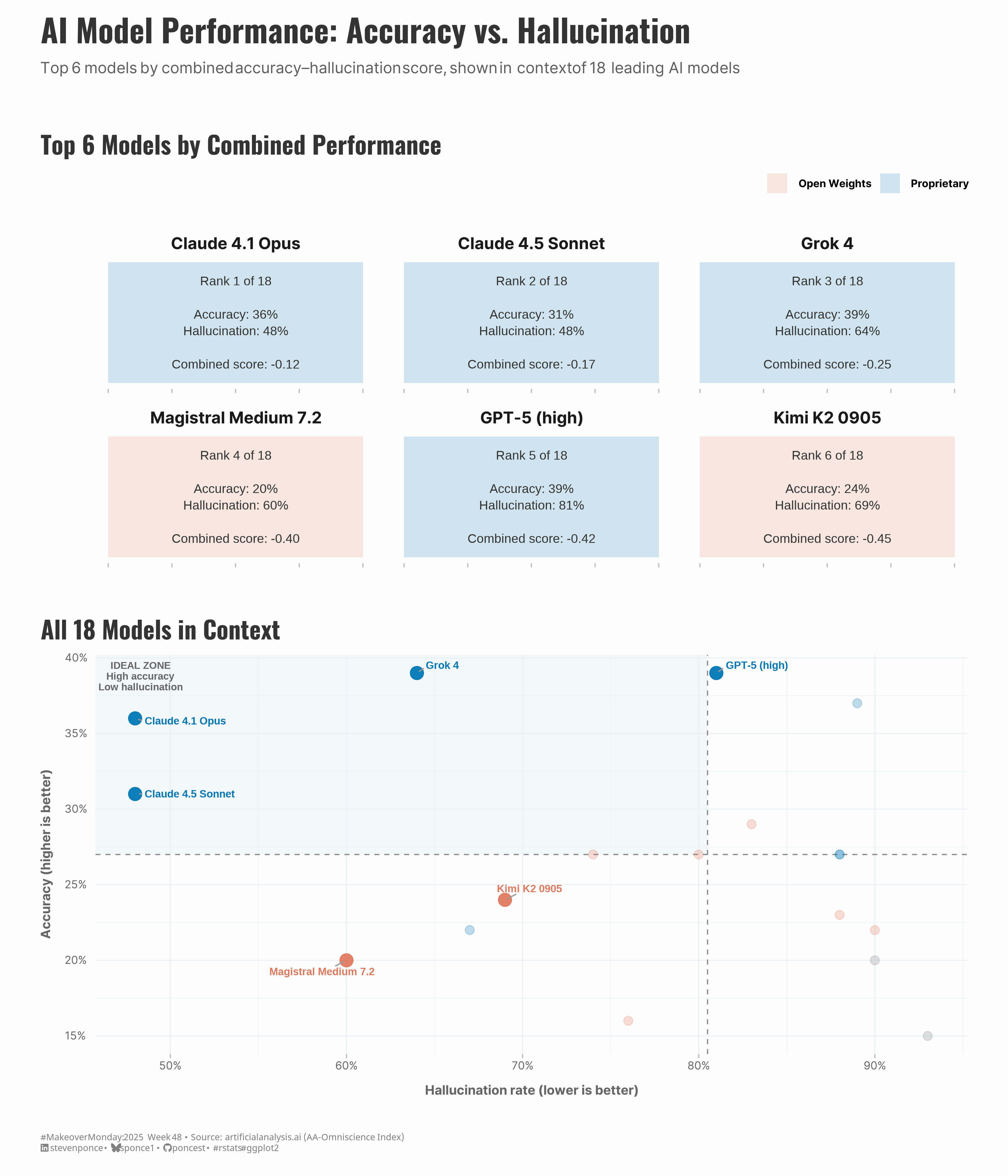
A two-panel visualization examining 18 leading AI models across accuracy and hallucination metrics. The top panel highlights the six best performers through detailed scorecards, while the bottom scatterplot reveals that proprietary models (Claude, Grok, GPT-5) cluster in the high-accuracy, low-hallucination zone, outperforming most open-weight alternatives.
Author

Steven Ponce

Published

December 8, 2025

Original

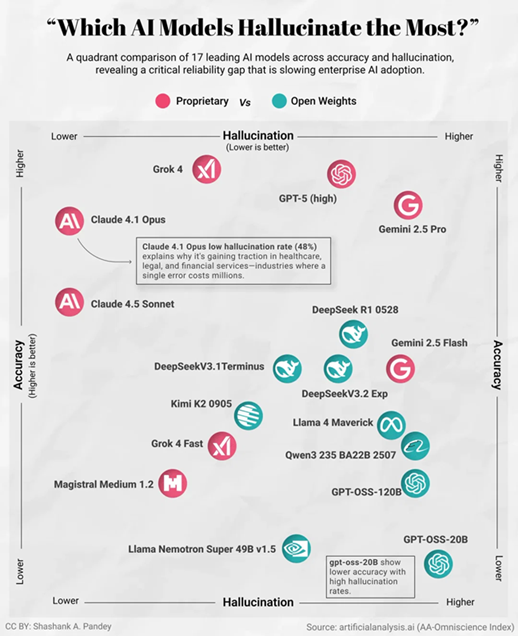
The original visualization comes from Which AI Models Hallucinate the Most?

Original visualization

Makeover

Figure 1: Two-panel chart showing AI model performance. The top panel displays performance cards for the six best models (Claude 4.1 Opus, Claude 4.5 Sonnet, Grok 4, Magistral Medium 7.2, GPT-5 high, and Kimi K2 0905) with their accuracy, hallucination rates, and combined scores. The bottom panel shows a scatterplot of all 18 models, plotting accuracy versus hallucination rate, with the top 6 models labeled and highlighted. Proprietary models (blue) cluster in the high accuracy, low hallucination zone, while open-weight models (coral) show more varied performance.

Steps to Create this Graphic

1. Load Packages & Setup

Show code
```{r}
#| label: load
#| warning: false
#| message: false
#| results: "hide"

## 1. LOAD PACKAGES & SETUP ----
suppressPackageStartupMessages({
  if (!require("pacman")) install.packages("pacman")
  pacman::p_load(
    tidyverse,     # Easily Install and Load the 'Tidyverse'
    janitor,       # Simple Tools for Examining and Cleaning Dirty Data
    skimr,         # Compact and Flexible Summaries of Data
    scales,        # Scale Functions for Visualization
    ggtext,        # Improved Text Rendering Support for 'ggplot2'
    showtext,      # Using Fonts More Easily in R Graphs
    glue,          # Interpreted String Literals
    patchwork,     # The Composer of Plots
    ggrepel        # Automatically Position Non-Overlapping Text Labels with ggplot2
)
})

### |- figure size ----
camcorder::gg_record(
    dir    = here::here("temp_plots"),
    device = "png",
    width  = 12,
    height = 14,
    units  = "in",
    dpi    = 320
)

# Source utility functions
suppressMessages(source(here::here("R/utils/fonts.R")))
source(here::here("R/utils/social_icons.R"))
source(here::here("R/utils/image_utils.R"))
source(here::here("R/themes/base_theme.R"))
```

2. Read in the Data

Show code
```{r}
#| label: read
#| include: true
#| eval: true
#| warning: false
#|

ai_models <- readxl::read_excel(
   here::here("data/MakeoverMonday/2025/AI Model Hallucination Scores.xlsx")) |>
  clean_names()
```

3. Examine the Data

Show code
```{r}
#| label: examine
#| include: true
#| eval: true
#| results: 'hide'
#| warning: false

glimpse(ai_models)
skim(ai_models) |> summary()
```

4. Tidy Data

Show code
```{r}
#| label: tidy
#| warning: false

### |-  data wrangling ----
ai_models_tidy <- ai_models |>
  mutate(
    model_type = case_when(
      str_detect(model, "Claude|GPT-5|Gemini|Grok") ~ "Proprietary",
      str_detect(model, "DeepSeek|Llama|Qwen|GPT-OSS|Kimi|Magistral") ~ "Open Weights",
      TRUE ~ "Unknown"
    ),
    model_family = case_when(
      str_detect(model, "Claude") ~ "Claude",
      str_detect(model, "GPT") ~ "GPT",
      str_detect(model, "Gemini") ~ "Gemini",
      str_detect(model, "Grok") ~ "Grok",
      str_detect(model, "DeepSeek") ~ "DeepSeek",
      str_detect(model, "Llama") ~ "Llama",
      str_detect(model, "Qwen") ~ "Qwen",
      str_detect(model, "Kimi") ~ "Kimi",
      str_detect(model, "Magistral") ~ "Magistral",
      TRUE ~ "Other"
    ),
    model_short = str_remove(model, " v\\d+\\.\\d+$") |>
      str_remove(" BA\\d+B \\d+$"),
    median_accuracy = median(accuracy_index_higher_is_better),
    median_hallucination = median(hallucination_index_lower_is_better),
    quadrant = case_when(
      accuracy_index_higher_is_better > median_accuracy &
        hallucination_index_lower_is_better < median_hallucination ~
        "High Accuracy, Low Hallucination",
      accuracy_index_higher_is_better > median_accuracy &
        hallucination_index_lower_is_better >= median_hallucination ~
        "High Accuracy, High Hallucination",
      accuracy_index_higher_is_better <= median_accuracy &
        hallucination_index_lower_is_better < median_hallucination ~
        "Low Accuracy, Low Hallucination",
      TRUE ~ "Low Accuracy, High Hallucination"
    ),
    combined_score = accuracy_index_higher_is_better - hallucination_index_lower_is_better,
    rank_combined = rank(-combined_score, ties.method = "min"),
    rank_label = glue("Rank {rank_combined} of {n()}")
  )

median_acc <- median(ai_models_tidy$accuracy_index_higher_is_better)
median_hall <- median(ai_models_tidy$hallucination_index_lower_is_better)

top_6_models <- ai_models_tidy |>
  arrange(desc(combined_score)) |>
  slice_head(n = 6)
```

5. Visualization Parameters

Show code
```{r}
#| label: params
#| include: true
#| warning: false

### |-  plot aesthetics ----
# Get base colors with custom palette
colors <- get_theme_colors(
  palette = list(
   proprietary   = "#0077B6",
    open_weights  = "#E07A5F",
    neutral_light = "#E8F4F8",
    neutral_mid   = "#90C9E8",
    success       = "#06A77D"    
  )
)

### |-  Main titles ----
title_text    <- "AI Model Performance: Accuracy vs. Hallucination"
subtitle_text <- "Top 6 models by combined accuracy–hallucination score, shown in context of 18 leading AI models"


### |-  Data source caption ----
caption_text <- create_mm_caption(
  mm_year = 2025,
  mm_week = 48,
  source_text = str_glue(
     "artificialanalysis.ai (AA-Omniscience Index)"
  )
)

### |-  fonts ----
setup_fonts()
fonts <- get_font_families()

### |-  plot theme ----

# Start with base theme
base_theme <- create_base_theme(colors)

# Add weekly-specific theme elements
weekly_theme <- extend_weekly_theme(
  base_theme,
  theme(
    # # Text styling
    plot.title = element_text(
      size = rel(1.5), family = fonts$title, face = "bold",
      color = colors$title, lineheight = 1.1, hjust = 0,
      margin = margin(t = 5, b = 10)
    ),
    plot.subtitle = element_markdown(
      size = rel(0.9), family = fonts$subtitle, face = "italic",
      color = alpha(colors$subtitle, 0.9), lineheight = 1.1,
      margin = margin(t = 0, b = 20)
    ),

    # Legend formatting
    legend.position = "plot",
    legend.justification = "right",
    legend.margin = margin(l = 12, b = 5),
    legend.key.size = unit(0.8, "cm"),
    legend.box.margin = margin(b = 10),
    # legend.title = element_text(face = "bold"),

    # Axis formatting
    axis.ticks.y = element_blank(),
    axis.ticks.x = element_line(color = "gray", linewidth = 0.5),
    
    axis.title.x = element_text(
      face = "bold", size = rel(0.85),
      margin = margin(t = 10), family = fonts$subtitle,
      color = "gray40" 
    ),
    axis.title.y = element_text(
      face = "bold", size = rel(0.85),
      margin = margin(r = 10), family = fonts$subtitle,
      color = "gray40" 
    ),
    axis.text.x = element_text(
      size = rel(0.85), family = fonts$subtitle,
      color = "gray40"  
    ),
    axis.text.y = element_markdown(
      size = rel(0.85), family = fonts$subtitle,
      color = "gray40"
    ),

    # Grid lines
    panel.grid.minor = element_line(color = "#ecf0f1", linewidth = 0.2),
    panel.grid.major = element_line(color = "#ecf0f1", linewidth = 0.4),

    # Margin
    plot.margin = margin(20, 20, 20, 20)
  )
)

# Set theme
theme_set(weekly_theme)
```

6. Plot

Show code
```{r}
#| label: plot
#| warning: false

### |- PANEL 1: SCORE CARDS ----
p1 <- top_6_models |>
  ggplot(aes(x = 1, y = 1)) +
  # Geoms
  geom_tile(
    aes(fill = model_type),
    alpha = 0.18,
    linewidth = 3
  ) +
  geom_text(
    aes(label = glue(
      "{rank_label}\n\n",
      "Accuracy: {percent(accuracy_index_higher_is_better, accuracy = 1)}\n",
      "Hallucination: {percent(hallucination_index_lower_is_better, accuracy = 1)}\n\n",
      "Combined score: {sprintf('%.2f', combined_score)}"
    )),
    size = 3.8,
    lineheight = 1.1,
    fontface = "plain",
    color = "gray20"
  ) +
  # Facets
  facet_wrap(
    ~ reorder(model_short, -combined_score),
    ncol   = 3,
    scales = "free"
  ) +
  # Scales
  scale_fill_manual(
    values = c(
      "Proprietary" = colors$palette$proprietary,
      "Open Weights" = colors$palette$open_weights
    ),
    name = NULL
  ) +
  # Labs
  labs(title = "Top 6 Models by Combined Performance") +
  # Theme
  theme(
    legend.position = "top",
    legend.direction = "horizontal",
    legend.text = element_text(size = 9, face = "bold"),
    strip.text = element_text(
      size = rel(1),
      face = "bold",
      hjust = 0.5,
      margin = margin(t = 4, b = 4)
    ),
    plot.margin = weekly_theme$plot.margin,
    panel.spacing = unit(10, "pt"),
    axis.title.x = element_blank(),
    axis.title.y = element_blank(),
    axis.text.x = element_blank(),
    axis.text.y = element_blank(),
    panel.grid.minor = element_blank(),
    panel.grid.major = element_blank()
  )

### |- PANEL 2: SCATTERPLOT ----
p2 <- ai_models_tidy |>
  ggplot(aes(
    x = hallucination_index_lower_is_better,
    y = accuracy_index_higher_is_better
  )) +
  # Annotate
  annotate(
    "rect",
    xmin = -Inf, xmax = median_hall,
    ymin = median_acc, ymax = Inf,
    fill = colors$palette$neutral_light, alpha = 0.5
  ) +
  annotate(
    "text",
    x = median_hall * 0.6,
    y = Inf,
    label = "IDEAL ZONE\nHigh accuracy\nLow hallucination",
    vjust = 1.25,
    size = 3,
    color = "gray40",
    fontface = "bold",
    lineheight = 0.9
  ) +
  # Geoms
  geom_vline(
    xintercept = median_hall,
    linetype   = "dashed",
    color      = "gray55",
    linewidth  = 0.5
  ) +
  geom_hline(
    yintercept = median_acc,
    linetype   = "dashed",
    color      = "gray55",
    linewidth  = 0.5
  ) +
  geom_point(
    data = ai_models_tidy |> filter(rank_combined > 6),
    aes(color = model_type),
    size = 3.3,
    alpha = 0.25
  ) +
  geom_point(
    data = top_6_models,
    aes(color = model_type),
    size = 5,
    alpha = 0.95
  ) +
  geom_text_repel(
    data = top_6_models,
    aes(label = model_short, color = model_type),
    size = 3.2,
    fontface = "bold",
    box.padding = 0.4,
    point.padding = 0.3,
    segment.color = "gray60",
    segment.size = 0.5,
    min.segment.length = 0,
    max.overlaps = 20,
    show.legend = FALSE,
    seed = 1234
  ) +
  # Scales
  scale_color_manual(
    values = c(
      "Proprietary" = colors$palette$proprietary,
      "Open Weights" = colors$palette$open_weights
    ),
    name = NULL
  ) +
  scale_x_continuous(
    labels = percent_format(accuracy = 1),
    expand = expansion(mult = 0.05)
  ) +
  scale_y_continuous(
    labels = percent_format(accuracy = 1),
    expand = expansion(mult = 0.05)
  ) +
  # Labs
  labs(
    title = "All 18 Models in Context",
    x = "Hallucination rate (lower is better)",
    y = "Accuracy (higher is better)"
  )

### |- COMBINED PLOTS ----
combined_plots <- p1 / p2 +
  plot_layout(heights = c(1, 1.3)) +
  plot_annotation(
    title = title_text,
    subtitle = subtitle_text,
    caption = caption_text,
    theme = theme(
      plot.title = element_text(
        size = rel(1.95),
        family = fonts$title,
        face = "bold",
        color = colors$title,
        lineheight = 1.1,
        margin = margin(t = 5, b = 5)
      ),
      plot.subtitle = element_markdown(
        size = rel(0.95),
        family = fonts$subtitle,
        color = alpha(colors$subtitle, 0.9),
        lineheight = 1.5,
        margin = margin(t = 5, b = 25)
      ),
      plot.caption = element_markdown(
        size = rel(0.55),
        family = fonts$caption,
        color = "gray50",
        hjust = 0,
        lineheight = 1.2,
        margin = margin(t = 10, b = 10)
      ),
      plot.margin = margin(10, 15, 10, 15)
    )
  )
```

7. Save

Show code
```{r}
#| label: save
#| warning: false

### |-  plot image ----  
save_plot_patchwork(
  plot = combined_plots, 
  type = "makeovermonday", 
  year = current_year,
  week = current_week,
  width = 12, 
  height = 14
  )
```

8. Session Info

Expand for Session Info
R version 4.4.1 (2024-06-14 ucrt)
Platform: x86_64-w64-mingw32/x64
Running under: Windows 11 x64 (build 26100)

Matrix products: default


locale:
[1] LC_COLLATE=English_United States.utf8 
[2] LC_CTYPE=English_United States.utf8   
[3] LC_MONETARY=English_United States.utf8
[4] LC_NUMERIC=C                          
[5] LC_TIME=English_United States.utf8    

time zone: America/New_York
tzcode source: internal

attached base packages:
[1] stats     graphics  grDevices datasets  utils     methods   base     

other attached packages:
 [1] here_1.0.1      ggrepel_0.9.6   patchwork_1.3.0 glue_1.8.0     
 [5] showtext_0.9-7  showtextdb_3.0  sysfonts_0.8.9  ggtext_0.1.2   
 [9] scales_1.3.0    skimr_2.1.5     janitor_2.2.0   lubridate_1.9.3
[13] forcats_1.0.0   stringr_1.5.1   dplyr_1.1.4     purrr_1.0.2    
[17] readr_2.1.5     tidyr_1.3.1     tibble_3.2.1    ggplot2_3.5.1  
[21] tidyverse_2.0.0 pacman_0.5.1   

loaded via a namespace (and not attached):
 [1] gtable_0.3.6       xfun_0.49          htmlwidgets_1.6.4  tzdb_0.5.0        
 [5] yulab.utils_0.1.8  vctrs_0.6.5        tools_4.4.0        generics_0.1.3    
 [9] curl_6.0.0         gifski_1.32.0-1    fansi_1.0.6        pkgconfig_2.0.3   
[13] ggplotify_0.1.2    readxl_1.4.3       lifecycle_1.0.4    compiler_4.4.0    
[17] farver_2.1.2       munsell_0.5.1      repr_1.1.7         codetools_0.2-20  
[21] snakecase_0.11.1   htmltools_0.5.8.1  yaml_2.3.10        pillar_1.9.0      
[25] camcorder_0.1.0    magick_2.8.5       commonmark_1.9.2   tidyselect_1.2.1  
[29] digest_0.6.37      stringi_1.8.4      labeling_0.4.3     rsvg_2.6.1        
[33] rprojroot_2.0.4    fastmap_1.2.0      grid_4.4.0         colorspace_2.1-1  
[37] cli_3.6.4          magrittr_2.0.3     base64enc_0.1-3    utf8_1.2.4        
[41] withr_3.0.2        timechange_0.3.0   rmarkdown_2.29     cellranger_1.1.0  
[45] hms_1.1.3          evaluate_1.0.1     knitr_1.49         markdown_1.13     
[49] gridGraphics_0.5-1 rlang_1.1.6        gridtext_0.1.5     Rcpp_1.0.13-1     
[53] xml2_1.3.6         renv_1.0.3         svglite_2.1.3      rstudioapi_0.17.1 
[57] jsonlite_1.8.9     R6_2.5.1           fs_1.6.5           systemfonts_1.1.0 

9. GitHub Repository

Expand for GitHub Repo

The complete code for this analysis is available in mm_2025_48.qmd.

For the full repository, click here.

10. References

Expand for References
  1. Data:

    • Makeover Monday 2025 Week 48: Which AI Models Hallucinate the Most?
  2. Article

    • Which AI Models Hallucinate the Most?

11. Custom Functions Documentation

📦 Custom Helper Functions

This analysis uses custom functions from my personal module library for efficiency and consistency across projects.

Functions Used:

  • fonts.R: setup_fonts(), get_font_families() - Font management with showtext
  • social_icons.R: create_social_caption() - Generates formatted social media captions
  • image_utils.R: save_plot() - Consistent plot saving with naming conventions
  • base_theme.R: create_base_theme(), extend_weekly_theme(), get_theme_colors() - Custom ggplot2 themes

Why custom functions?
These utilities standardize theming, fonts, and output across all my data visualizations. The core analysis (data tidying and visualization logic) uses only standard tidyverse packages.

Source Code:
View all custom functions → GitHub: R/utils

Back to top

Citation

BibTeX citation:
@online{ponce2025,
  author = {Ponce, Steven},
  title = {AI {Model} {Performance:} {Accuracy} Vs. {Hallucination}},
  date = {2025-12-08},
  url = {https://stevenponce.netlify.app/data_visualizations/MakeoverMonday/2025/mm_2025_48.html},
  langid = {en}
}
For attribution, please cite this work as:
Ponce, Steven. 2025. “AI Model Performance: Accuracy Vs. Hallucination.” December 8, 2025. https://stevenponce.netlify.app/data_visualizations/MakeoverMonday/2025/mm_2025_48.html.
Source Code
---
title: "AI Model Performance: Accuracy vs. Hallucination"
subtitle: "Top 6 models by combined accuracy–hallucination score, shown in context of 18 leading AI models"
description: "A two-panel visualization examining 18 leading AI models across accuracy and hallucination metrics. The top panel highlights the six best performers through detailed scorecards, while the bottom scatterplot reveals that proprietary models (Claude, Grok, GPT-5) cluster in the high-accuracy, low-hallucination zone, outperforming most open-weight alternatives."
date: "2025-12-08"
author:
  - name: "Steven Ponce"
    url: "https://stevenponce.netlify.app"
citation:
  url: "https://stevenponce.netlify.app/data_visualizations/MakeoverMonday/2025/mm_2025_48.html"
categories: ["MakeoverMonday", "Data Visualization", "R Programming", "2025"]   
tags: [
  "makeover-monday",
  "artificial-intelligence",
  "machine-learning",
  "model-evaluation",
  "accuracy",
  "hallucination",
  "scatterplot",
  "small-multiples",
  "patchwork",
  "ggplot2",
  "performance-metrics",
  "comparative-analysis",
  "Claude",
  "GPT",
  "LLM"
]
image: "thumbnails/mm_2025_48.png"
format:
  html:
    toc: true
    toc-depth: 5
    code-link: true
    code-fold: true
    code-tools: true
    code-summary: "Show code"
    self-contained: true
    theme: 
      light: [flatly, assets/styling/custom_styles.scss]
      dark: [darkly, assets/styling/custom_styles_dark.scss]
editor_options: 
  chunk_output_type: inline
execute: 
  freeze: true                                      
  cache: true                                       
  error: false
  message: false
  warning: false
  eval: true
---

```{r}
#| label: setup-links
#| include: false

# CENTRALIZED LINK MANAGEMENT

## Project-specific info 
current_year <- 2025
current_week <- 48
project_file <- "mm_2025_48.qmd"
project_image <- "mm_2025_48.png"

## Data Sources
data_main <- "https://data.world/makeovermonday/2025wk48-which-ai-models-hallucinate-the-most"
data_secondary <- "https://data.world/makeovermonday/2025wk48-which-ai-models-hallucinate-the-most"

## Repository Links  
repo_main <- "https://github.com/poncest/personal-website/"
repo_file <- paste0("https://github.com/poncest/personal-website/blob/master/data_visualizations/MakeoverMonday/", current_year, "/", project_file)

## External Resources/Images
chart_original <- "https://raw.githubusercontent.com/poncest/MakeoverMonday/refs/heads/master/2025/Week_48/original_chart.png"

## Organization/Platform Links
org_primary <- "https://www.voronoiapp.com/technology/Which-AI-Models-Hallucinate-the-Most-7211"
org_secondary <- "https://www.voronoiapp.com/technology/Which-AI-Models-Hallucinate-the-Most-7211"

# Helper function to create markdown links
create_link <- function(text, url) {
  paste0("[", text, "](", url, ")")
}

# Helper function for citation-style links
create_citation_link <- function(text, url, title = NULL) {
  if (is.null(title)) {
    paste0("[", text, "](", url, ")")
  } else {
    paste0("[", text, "](", url, ' "', title, '")')
  }
}
```

### Original

The original visualization comes from `r create_link("Which AI Models Hallucinate the Most?", data_secondary)`
![Original visualization](https://raw.githubusercontent.com/poncest/MakeoverMonday/refs/heads/master/2025/Week_48/original_chart.png)

### Makeover

![Two-panel chart showing AI model performance. The top panel displays performance cards for the six best models (Claude 4.1 Opus, Claude 4.5 Sonnet, Grok 4, Magistral Medium 7.2, GPT-5 high, and Kimi K2 0905) with their accuracy, hallucination rates, and combined scores. The bottom panel shows a scatterplot of all 18 models, plotting accuracy versus hallucination rate, with the top 6 models labeled and highlighted. Proprietary models (blue) cluster in the high accuracy, low hallucination zone, while open-weight models (coral) show more varied performance.](mm_2025_48.png){#fig-1}

### <mark> **Steps to Create this Graphic** </mark>

#### 1. Load Packages & Setup

```{r}
#| label: load
#| warning: false
#| message: false      
#| results: "hide"     

## 1. LOAD PACKAGES & SETUP ----
suppressPackageStartupMessages({
  if (!require("pacman")) install.packages("pacman")
  pacman::p_load(
    tidyverse,     # Easily Install and Load the 'Tidyverse'
    janitor,       # Simple Tools for Examining and Cleaning Dirty Data
    skimr,         # Compact and Flexible Summaries of Data
    scales,        # Scale Functions for Visualization
    ggtext,        # Improved Text Rendering Support for 'ggplot2'
    showtext,      # Using Fonts More Easily in R Graphs
    glue,          # Interpreted String Literals
    patchwork,     # The Composer of Plots
    ggrepel        # Automatically Position Non-Overlapping Text Labels with ggplot2
)
})

### |- figure size ----
camcorder::gg_record(
    dir    = here::here("temp_plots"),
    device = "png",
    width  = 12,
    height = 14,
    units  = "in",
    dpi    = 320
)

# Source utility functions
suppressMessages(source(here::here("R/utils/fonts.R")))
source(here::here("R/utils/social_icons.R"))
source(here::here("R/utils/image_utils.R"))
source(here::here("R/themes/base_theme.R"))
```

#### 2. Read in the Data

```{r}
#| label: read
#| include: true
#| eval: true
#| warning: false
#| 

ai_models <- readxl::read_excel(
   here::here("data/MakeoverMonday/2025/AI Model Hallucination Scores.xlsx")) |>
  clean_names()
```

#### 3. Examine the Data

```{r}
#| label: examine
#| include: true
#| eval: true
#| results: 'hide'
#| warning: false

glimpse(ai_models)
skim(ai_models) |> summary()
```

#### 4. Tidy Data

```{r}
#| label: tidy
#| warning: false

### |-  data wrangling ----
ai_models_tidy <- ai_models |>
  mutate(
    model_type = case_when(
      str_detect(model, "Claude|GPT-5|Gemini|Grok") ~ "Proprietary",
      str_detect(model, "DeepSeek|Llama|Qwen|GPT-OSS|Kimi|Magistral") ~ "Open Weights",
      TRUE ~ "Unknown"
    ),
    model_family = case_when(
      str_detect(model, "Claude") ~ "Claude",
      str_detect(model, "GPT") ~ "GPT",
      str_detect(model, "Gemini") ~ "Gemini",
      str_detect(model, "Grok") ~ "Grok",
      str_detect(model, "DeepSeek") ~ "DeepSeek",
      str_detect(model, "Llama") ~ "Llama",
      str_detect(model, "Qwen") ~ "Qwen",
      str_detect(model, "Kimi") ~ "Kimi",
      str_detect(model, "Magistral") ~ "Magistral",
      TRUE ~ "Other"
    ),
    model_short = str_remove(model, " v\\d+\\.\\d+$") |>
      str_remove(" BA\\d+B \\d+$"),
    median_accuracy = median(accuracy_index_higher_is_better),
    median_hallucination = median(hallucination_index_lower_is_better),
    quadrant = case_when(
      accuracy_index_higher_is_better > median_accuracy &
        hallucination_index_lower_is_better < median_hallucination ~
        "High Accuracy, Low Hallucination",
      accuracy_index_higher_is_better > median_accuracy &
        hallucination_index_lower_is_better >= median_hallucination ~
        "High Accuracy, High Hallucination",
      accuracy_index_higher_is_better <= median_accuracy &
        hallucination_index_lower_is_better < median_hallucination ~
        "Low Accuracy, Low Hallucination",
      TRUE ~ "Low Accuracy, High Hallucination"
    ),
    combined_score = accuracy_index_higher_is_better - hallucination_index_lower_is_better,
    rank_combined = rank(-combined_score, ties.method = "min"),
    rank_label = glue("Rank {rank_combined} of {n()}")
  )

median_acc <- median(ai_models_tidy$accuracy_index_higher_is_better)
median_hall <- median(ai_models_tidy$hallucination_index_lower_is_better)

top_6_models <- ai_models_tidy |>
  arrange(desc(combined_score)) |>
  slice_head(n = 6)
```

#### 5. Visualization Parameters

```{r}
#| label: params
#| include: true
#| warning: false

### |-  plot aesthetics ----
# Get base colors with custom palette
colors <- get_theme_colors(
  palette = list(
   proprietary   = "#0077B6",
    open_weights  = "#E07A5F",
    neutral_light = "#E8F4F8",
    neutral_mid   = "#90C9E8",
    success       = "#06A77D"    
  )
)

### |-  Main titles ----
title_text    <- "AI Model Performance: Accuracy vs. Hallucination"
subtitle_text <- "Top 6 models by combined accuracy–hallucination score, shown in context of 18 leading AI models"


### |-  Data source caption ----
caption_text <- create_mm_caption(
  mm_year = 2025,
  mm_week = 48,
  source_text = str_glue(
     "artificialanalysis.ai (AA-Omniscience Index)"
  )
)

### |-  fonts ----
setup_fonts()
fonts <- get_font_families()

### |-  plot theme ----

# Start with base theme
base_theme <- create_base_theme(colors)

# Add weekly-specific theme elements
weekly_theme <- extend_weekly_theme(
  base_theme,
  theme(
    # # Text styling
    plot.title = element_text(
      size = rel(1.5), family = fonts$title, face = "bold",
      color = colors$title, lineheight = 1.1, hjust = 0,
      margin = margin(t = 5, b = 10)
    ),
    plot.subtitle = element_markdown(
      size = rel(0.9), family = fonts$subtitle, face = "italic",
      color = alpha(colors$subtitle, 0.9), lineheight = 1.1,
      margin = margin(t = 0, b = 20)
    ),

    # Legend formatting
    legend.position = "plot",
    legend.justification = "right",
    legend.margin = margin(l = 12, b = 5),
    legend.key.size = unit(0.8, "cm"),
    legend.box.margin = margin(b = 10),
    # legend.title = element_text(face = "bold"),

    # Axis formatting
    axis.ticks.y = element_blank(),
    axis.ticks.x = element_line(color = "gray", linewidth = 0.5),
    
    axis.title.x = element_text(
      face = "bold", size = rel(0.85),
      margin = margin(t = 10), family = fonts$subtitle,
      color = "gray40" 
    ),
    axis.title.y = element_text(
      face = "bold", size = rel(0.85),
      margin = margin(r = 10), family = fonts$subtitle,
      color = "gray40" 
    ),
    axis.text.x = element_text(
      size = rel(0.85), family = fonts$subtitle,
      color = "gray40"  
    ),
    axis.text.y = element_markdown(
      size = rel(0.85), family = fonts$subtitle,
      color = "gray40"
    ),

    # Grid lines
    panel.grid.minor = element_line(color = "#ecf0f1", linewidth = 0.2),
    panel.grid.major = element_line(color = "#ecf0f1", linewidth = 0.4),

    # Margin
    plot.margin = margin(20, 20, 20, 20)
  )
)

# Set theme
theme_set(weekly_theme)
```

#### 6. Plot

```{r}
#| label: plot
#| warning: false

### |- PANEL 1: SCORE CARDS ----
p1 <- top_6_models |>
  ggplot(aes(x = 1, y = 1)) +
  # Geoms
  geom_tile(
    aes(fill = model_type),
    alpha = 0.18,
    linewidth = 3
  ) +
  geom_text(
    aes(label = glue(
      "{rank_label}\n\n",
      "Accuracy: {percent(accuracy_index_higher_is_better, accuracy = 1)}\n",
      "Hallucination: {percent(hallucination_index_lower_is_better, accuracy = 1)}\n\n",
      "Combined score: {sprintf('%.2f', combined_score)}"
    )),
    size = 3.8,
    lineheight = 1.1,
    fontface = "plain",
    color = "gray20"
  ) +
  # Facets
  facet_wrap(
    ~ reorder(model_short, -combined_score),
    ncol   = 3,
    scales = "free"
  ) +
  # Scales
  scale_fill_manual(
    values = c(
      "Proprietary" = colors$palette$proprietary,
      "Open Weights" = colors$palette$open_weights
    ),
    name = NULL
  ) +
  # Labs
  labs(title = "Top 6 Models by Combined Performance") +
  # Theme
  theme(
    legend.position = "top",
    legend.direction = "horizontal",
    legend.text = element_text(size = 9, face = "bold"),
    strip.text = element_text(
      size = rel(1),
      face = "bold",
      hjust = 0.5,
      margin = margin(t = 4, b = 4)
    ),
    plot.margin = weekly_theme$plot.margin,
    panel.spacing = unit(10, "pt"),
    axis.title.x = element_blank(),
    axis.title.y = element_blank(),
    axis.text.x = element_blank(),
    axis.text.y = element_blank(),
    panel.grid.minor = element_blank(),
    panel.grid.major = element_blank()
  )

### |- PANEL 2: SCATTERPLOT ----
p2 <- ai_models_tidy |>
  ggplot(aes(
    x = hallucination_index_lower_is_better,
    y = accuracy_index_higher_is_better
  )) +
  # Annotate
  annotate(
    "rect",
    xmin = -Inf, xmax = median_hall,
    ymin = median_acc, ymax = Inf,
    fill = colors$palette$neutral_light, alpha = 0.5
  ) +
  annotate(
    "text",
    x = median_hall * 0.6,
    y = Inf,
    label = "IDEAL ZONE\nHigh accuracy\nLow hallucination",
    vjust = 1.25,
    size = 3,
    color = "gray40",
    fontface = "bold",
    lineheight = 0.9
  ) +
  # Geoms
  geom_vline(
    xintercept = median_hall,
    linetype   = "dashed",
    color      = "gray55",
    linewidth  = 0.5
  ) +
  geom_hline(
    yintercept = median_acc,
    linetype   = "dashed",
    color      = "gray55",
    linewidth  = 0.5
  ) +
  geom_point(
    data = ai_models_tidy |> filter(rank_combined > 6),
    aes(color = model_type),
    size = 3.3,
    alpha = 0.25
  ) +
  geom_point(
    data = top_6_models,
    aes(color = model_type),
    size = 5,
    alpha = 0.95
  ) +
  geom_text_repel(
    data = top_6_models,
    aes(label = model_short, color = model_type),
    size = 3.2,
    fontface = "bold",
    box.padding = 0.4,
    point.padding = 0.3,
    segment.color = "gray60",
    segment.size = 0.5,
    min.segment.length = 0,
    max.overlaps = 20,
    show.legend = FALSE,
    seed = 1234
  ) +
  # Scales
  scale_color_manual(
    values = c(
      "Proprietary" = colors$palette$proprietary,
      "Open Weights" = colors$palette$open_weights
    ),
    name = NULL
  ) +
  scale_x_continuous(
    labels = percent_format(accuracy = 1),
    expand = expansion(mult = 0.05)
  ) +
  scale_y_continuous(
    labels = percent_format(accuracy = 1),
    expand = expansion(mult = 0.05)
  ) +
  # Labs
  labs(
    title = "All 18 Models in Context",
    x = "Hallucination rate (lower is better)",
    y = "Accuracy (higher is better)"
  )

### |- COMBINED PLOTS ----
combined_plots <- p1 / p2 +
  plot_layout(heights = c(1, 1.3)) +
  plot_annotation(
    title = title_text,
    subtitle = subtitle_text,
    caption = caption_text,
    theme = theme(
      plot.title = element_text(
        size = rel(1.95),
        family = fonts$title,
        face = "bold",
        color = colors$title,
        lineheight = 1.1,
        margin = margin(t = 5, b = 5)
      ),
      plot.subtitle = element_markdown(
        size = rel(0.95),
        family = fonts$subtitle,
        color = alpha(colors$subtitle, 0.9),
        lineheight = 1.5,
        margin = margin(t = 5, b = 25)
      ),
      plot.caption = element_markdown(
        size = rel(0.55),
        family = fonts$caption,
        color = "gray50",
        hjust = 0,
        lineheight = 1.2,
        margin = margin(t = 10, b = 10)
      ),
      plot.margin = margin(10, 15, 10, 15)
    )
  )
```

#### 7. Save

```{r}
#| label: save
#| warning: false

### |-  plot image ----  
save_plot_patchwork(
  plot = combined_plots, 
  type = "makeovermonday", 
  year = current_year,
  week = current_week,
  width = 12, 
  height = 14
  )
```

#### 8. Session Info

::: {.callout-tip collapse="true"}
##### Expand for Session Info

```{r, echo = FALSE}
#| eval: true
#| warning: false

sessionInfo()
```
:::

#### 9. GitHub Repository

::: {.callout-tip collapse="true"}
##### Expand for GitHub Repo

The complete code for this analysis is available in `r create_link(project_file, repo_file)`.

For the full repository, `r create_link("click here", repo_main)`.
:::

#### 10. References

::: {.callout-tip collapse="true"}
##### Expand for References

1.  Data:

    -   Makeover Monday `r current_year` Week `r current_week`: `r create_link("Which AI Models Hallucinate the Most?", data_main)`

2.  Article

    -   `r create_link("Which AI Models Hallucinate the Most?", data_secondary)`
:::

#### 11. Custom Functions Documentation

::: {.callout-note collapse="true"}
##### 📦 Custom Helper Functions

This analysis uses custom functions from my personal module library for efficiency and consistency across projects.

**Functions Used:**

-   **`fonts.R`**: `setup_fonts()`, `get_font_families()` - Font management with showtext
-   **`social_icons.R`**: `create_social_caption()` - Generates formatted social media captions
-   **`image_utils.R`**: `save_plot()` - Consistent plot saving with naming conventions
-   **`base_theme.R`**: `create_base_theme()`, `extend_weekly_theme()`, `get_theme_colors()` - Custom ggplot2 themes

**Why custom functions?**\
These utilities standardize theming, fonts, and output across all my data visualizations. The core analysis (data tidying and visualization logic) uses only standard tidyverse packages.

**Source Code:**\
View all custom functions → [GitHub: R/utils](https://github.com/poncest/personal-website/tree/master/R)
:::

© 2024 Steven Ponce

Source Issues
