• Steven Ponce
  • About
  • Data Visualizations
  • Projects
  • Resume
  • Email

On this page

  • Original
  • Makeover
  • Steps to Create this Graphic
    • 1. Load Packages & Setup
    • 2. Read in the Data
    • 3. Examine the Data
    • 4. Tidy Data
    • 5. Visualization Parameters
    • 6. Plot
    • 7. Save
    • 8. Session Info
    • 9. GitHub Repository
    • 10. References
    • 11. Custom Functions Documentation

Low-quality AI output is common —
and it scales into millions in hidden cost

  • Show All Code
  • Hide All Code

  • View Source

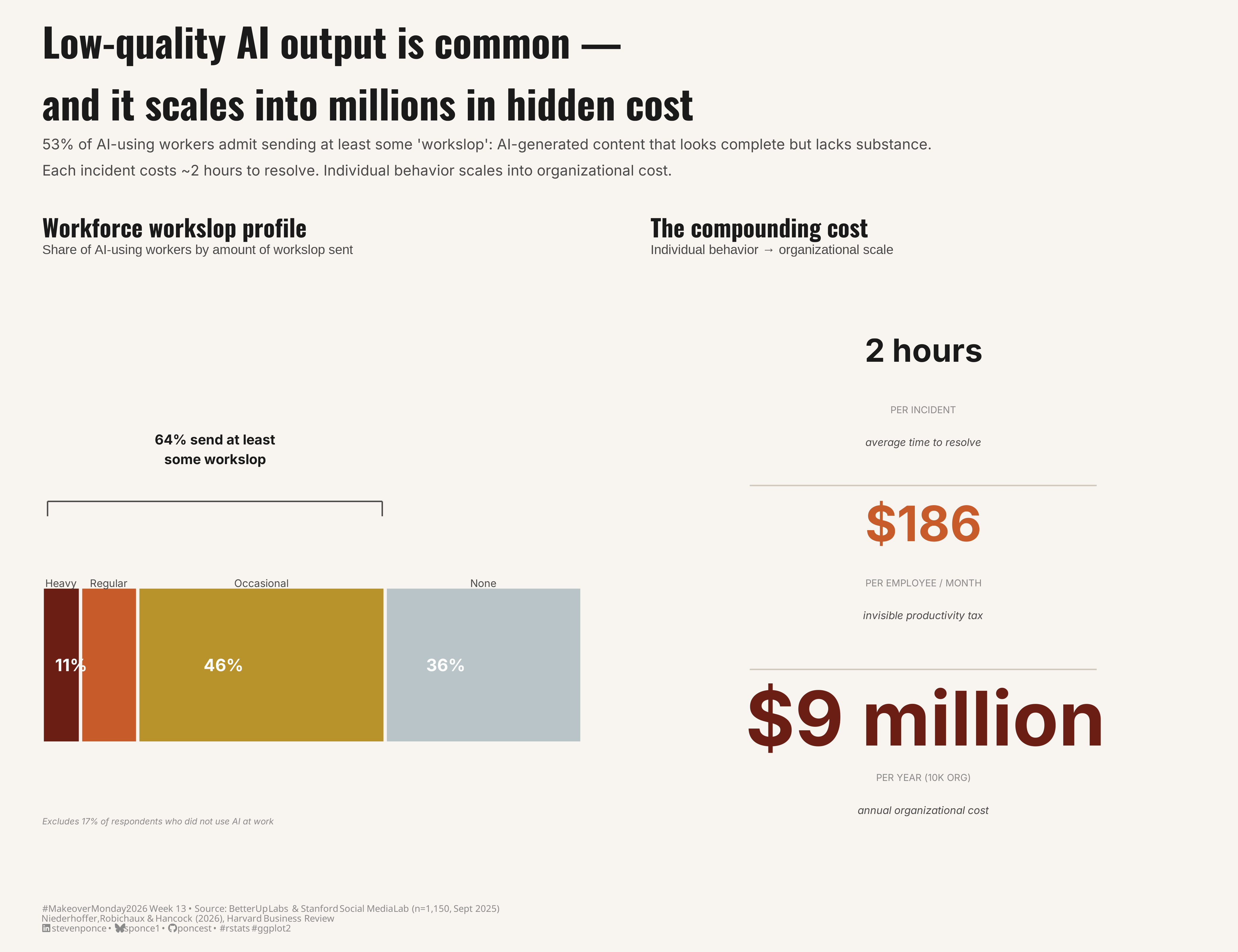
53% of AI-using workers admit sending at least some ‘workslop’: AI-generated content that looks complete but lacks substance. Each incident costs ~2 hours to resolve. Individual behavior scales into organizational cost.

MakeoverMonday
Data Visualization
R Programming
2026
A two-panel makeover redesigning an HBR bar chart on AI ‘workslop’ into a behavior-to-cost system narrative. The left panel uses a stacked composition bar to show that 64% of AI-using workers send at least some low-quality AI output, binned into four severity levels. The right panel presents a cost cascade — 2 hours per incident, $186 per employee per month, $9 million per year — using progressive typography to convey compounding organizational impact.
Author

Steven Ponce

Published

March 30, 2026

Original

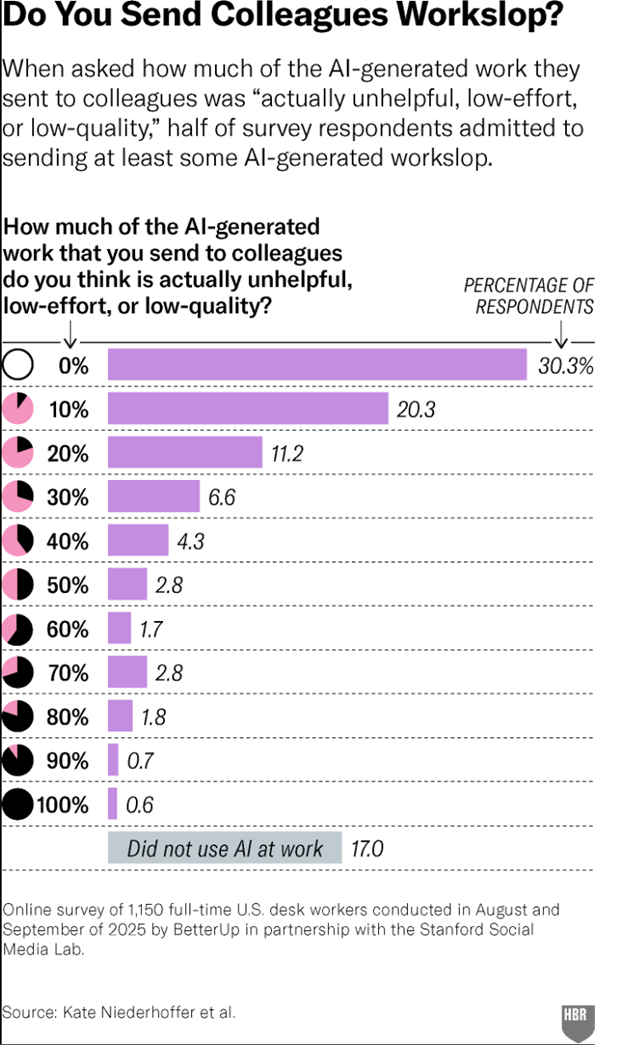
The original visualization comes from Why People Create AI Workslop

Original visualization

Makeover

Figure 1: A two-panel data visualization titled “Low-quality AI output is common — and it scales into millions in hidden cost.” The left panel shows a horizontal stacked bar chart depicting the workforce workslop profile among AI-using workers (n ≈ 952). Segments are color-coded by severity: Heavy (7%, deep crimson), Regular (11%, burnt orange), Occasional (46%, amber), and None (36%, gray-blue). A bracket above the three non-zero segments highlights that 64% of AI-using workers send at least some workslop. The right panel presents a cost cascade in progressively larger typography: 2 hours per incident (average time to resolve), $186 per employee per month (invisible productivity tax), and $9 million per year for a 10,000-person organization (annual organizational cost). A footnote states that 17% of respondents who did not use AI at work are excluded. Source: BetterUp Labs and Stanford Social Media Lab survey of 1,150 U.S. desk workers, September 2025; Niederhoffer, Robichaux, and Hancock (2026), Harvard Business Review.

Steps to Create this Graphic

1. Load Packages & Setup

Show code
```{r}
#| label: load
#| warning: false
#| message: false      
#| results: "hide"     

## 1. LOAD PACKAGES & SETUP ----
suppressPackageStartupMessages({
  if (!require("pacman")) install.packages("pacman")
  pacman::p_load(
    tidyverse, ggtext, showtext, scales, 
  glue, janitor, readxl, patchwork
)
})

### |- figure size ----
camcorder::gg_record(
  dir    = here::here("temp_plots"),
  device = "png",
  width  = 13,
  height = 10,
  units  = "in",
  dpi    = 320
)

# Source utility functions
suppressMessages(source(here::here("R/utils/fonts.R")))
source(here::here("R/utils/social_icons.R"))
source(here::here("R/utils/image_utils.R"))
source(here::here("R/themes/base_theme.R"))
```

2. Read in the Data

Show code
```{r}
#| label: read
#| include: true
#| eval: true
#| warning: false
#| 

df_raw <- readxl::read_xlsx(
  here::here("data/MakeoverMonday/2026/MM 2026W13.xlsx")) |>
  clean_names()
```

3. Examine the Data

Show code
```{r}
#| label: examine
#| include: true
#| eval: true
#| results: 'hide'
#| warning: false

glimpse(df_raw)
skimr::skim_without_charts(df_raw)
```

4. Tidy Data

Show code
```{r}
#| label: tidy
#| warning: false

### |- left panel: bin the distribution ----
df_bins <- df_raw |>
  mutate(
    workslop_num = suppressWarnings(as.numeric(workslop_pct)),
    bin = case_when(
      is.na(workslop_num) ~ NA_character_,
      workslop_num == 0 ~ "None",
      workslop_num <= 30 ~ "Occasional",
      workslop_num <= 60 ~ "Regular",
      workslop_num >= 70 ~ "Heavy"
    ),
    bin = factor(bin, levels = c("None", "Occasional", "Regular", "Heavy"))
  ) |>
  filter(!is.na(bin)) |>
  group_by(bin) |>
  summarise(pct = sum(respondent_pct), .groups = "drop") |>
  mutate(pct_rescaled = pct / sum(pct) * 100)

### |- right panel: cost cascade values (hand-encoded, BetterUp/Stanford) ----
# Source: BetterUp Labs + Stanford Social Media Lab, n=1,150, Sept 2025
# https://www.betterup.com/workslop
# Values: 2 hrs/incident; $186/employee/month; $9M/year for 10k-person org
```

5. Visualization Parameters

Show code
```{r}
#| label: params
#| include: true
#| warning: false

### |- Colors ----
colors <- get_theme_colors(
  palette = list(
    none       = "#B8C4C8",   
    occasional = "#B8922A",   
    regular    = "#C75B2A",   
    heavy      = "#6B1F14",  
    # Supporting
    background = "#F8F5F0",
    text_dark  = "#1A1A1A",
    text_mid   = "#4A4A4A",
    text_light = "#8A8A8A",
    divider    = "#D0C8BC",
    # Annotation accent
    anchor     = "#1A1A1A"
  )
)

# Named vector for stacked bar fill mapping
bin_colors <- c(
  "None"       = colors$palette$none,
  "Occasional" = colors$palette$occasional,
  "Regular"    = colors$palette$regular,
  "Heavy"      = colors$palette$heavy
)

### |- titles and caption ----
title_text    <- str_glue("Low-quality AI output is common —\nand it scales into millions in hidden cost")

subtitle_text <- str_glue(
  "53% of AI-using workers admit sending at least some 'workslop': AI-generated content that looks complete but lacks substance.\n",
  "Each incident costs ~2 hours to resolve. Individual behavior scales into organizational cost."
)

caption_text <- create_mm_caption(
   mm_year     = 2026,
  mm_week     = 13,
  source_text = "BetterUp Labs & Stanford Social Media Lab (n=1,150, Sept 2025)<br>
                 Niederhoffer, Robichaux & Hancock (2026), Harvard Business Review"
)

### |- fonts ----
setup_fonts()
fonts <- get_font_families()

### |- plot theme ----
base_theme <- create_base_theme(colors)

weekly_theme <- extend_weekly_theme(
  base_theme,
  theme(
    # Panel
    plot.background  = element_rect(fill = colors$palette$background, color = NA),
    panel.background = element_rect(fill = colors$palette$background, color = NA),
    panel.grid       = element_blank(),
    axis.ticks       = element_blank(),
    # Text
    axis.text        = element_blank(),
    axis.title       = element_blank(),
    # Margins
    plot.margin      = margin(8, 12, 8, 12)
  )
)

theme_set(weekly_theme)
```

6. Plot

Show code
```{r}
#| label: plot
#| warning: false

### |- LEFT PANEL: Stacked composition bar ----

# Derived annotation values
sends_some_pct <- df_bins |>
  filter(bin != "None") |>
  summarise(total = sum(pct_rescaled)) |>
  pull(total) |>
  round(0)

none_pct <- df_bins |>
  filter(bin == "None") |>
  pull(pct_rescaled)

df_bins_pos <- df_bins |>
  arrange(desc(as.integer(bin))) |>
  mutate(
    x_end   = cumsum(pct_rescaled),
    x_start = x_end - pct_rescaled,
    x_mid   = (x_start + x_end) / 2
  )

p_left <- ggplot(df_bins, aes(x = pct_rescaled, y = "", fill = bin)) +
  geom_col(
    position  = position_stack(reverse = FALSE),
    width     = 0.42,
    color     = colors$palette$background,
    linewidth = 1.2
  ) +
  geom_text(
    data = df_bins |> filter(pct_rescaled >= 9),
    aes(label = glue("{round(pct_rescaled, 0)}%")),
    position = position_stack(vjust = 0.5, reverse = FALSE),
    color = "white",
    size = 4.5,
    fontface = "bold",
    family = fonts$text
  ) +
  geom_text(
    data = df_bins_pos,
    aes(x = x_mid, label = bin),
    y = 1.22,
    color = colors$palette$text_mid,
    size = 2.8,
    fontface = "plain",
    family = fonts$text,
    hjust = 0.5,
    inherit.aes = FALSE
  ) +
  annotate(
    "text",
    x = sends_some_pct / 2,
    y = 1.58,
    label = glue("{sends_some_pct}% send at least\nsome workslop"),
    size = 3.6,
    color = colors$palette$text_dark,
    fontface = "bold",
    family = fonts$text,
    hjust = 0.5,
    lineheight = 1.2
  ) +
  annotate(
    "segment",
    x = 1, xend = sends_some_pct - 1,
    y = 1.44, yend = 1.44,
    color = colors$palette$text_mid, linewidth = 0.5
  ) +
  annotate("segment",
    x = 1, xend = 1,
    y = 1.40, yend = 1.44,
    color = colors$palette$text_mid, linewidth = 0.5
  ) +
  annotate("segment",
    x = sends_some_pct - 1, xend = sends_some_pct - 1,
    y = 1.40, yend = 1.44,
    color = colors$palette$text_mid, linewidth = 0.5
  ) +
  annotate(
    "text",
    x = 0, y = 0.58,
    label = "Excludes 17% of respondents who did not use AI at work",
    size = 2.3,
    color = colors$palette$text_light,
    hjust = 0,
    family = fonts$text,
    fontface = "italic"
  ) +
  scale_fill_manual(values = bin_colors) +
  scale_x_continuous(
    expand = expansion(mult = c(0, 0.01)),
    limits = c(0, 100)
  ) +
  scale_y_discrete(expand = expansion(add = c(0.55, 1.05))) +
  labs(
    title    = "Workforce workslop profile",
    subtitle = "Share of AI-using workers by amount of workslop sent"
  ) +
  theme(
    legend.position = "none",
    axis.text = element_blank(),
    axis.title = element_blank(),
    panel.grid = element_blank(),
    axis.ticks = element_blank(),
    plot.title = element_text(
      size   = 18,
      face   = "bold",
      color  = colors$palette$text_dark,
      family = fonts$title,
      margin = margin(b = 3)
    ),
    plot.subtitle = element_text(
      size   = 10,
      color  = colors$palette$text_mid,
      family = 'sans',
      margin = margin(b = 12)
    ),
    plot.margin = margin(12, 24, 12, 12)
  )


### |- RIGHT PANEL: Cost cascade ----

y_pos <- c(0.82, 0.50, 0.14)

cascade_sizes <- c(8.5, 13, 20)

p_right <- ggplot() +
  xlim(0, 1) +
  ylim(0, 1) +
  annotate("text",
    x = 0.5, y = y_pos[1] + 0.09,
    label = "2 hours",
    size = cascade_sizes[1],
    fontface = "bold",
    color = colors$palette$text_dark,
    family = fonts$text,
    hjust = 0.5
  ) +
  annotate("text",
    x = 0.5, y = y_pos[1] - 0.02,
    label = "PER INCIDENT",
    size = 2.5,
    color = colors$palette$text_light,
    family = fonts$text,
    hjust = 0.5
  ) +
  annotate("text",
    x = 0.5, y = y_pos[1] - 0.08,
    label = "average time to resolve",
    size = 2.8,
    color = colors$palette$text_mid,
    family = fonts$text,
    hjust = 0.5,
    fontface = "italic"
  ) +
  annotate("segment",
    x = 0.15, xend = 0.85,
    y = (y_pos[1] + y_pos[2]) / 2,
    yend = (y_pos[1] + y_pos[2]) / 2,
    color = colors$palette$divider,
    linewidth = 0.5
  ) +
  annotate("text",
    x = 0.5, y = y_pos[2] + 0.09,
    label = "$186",
    size = cascade_sizes[2],
    fontface = "bold",
    color = colors$palette$regular,
    family = fonts$text,
    hjust = 0.5
  ) +
  annotate("text",
    x = 0.5, y = y_pos[2] - 0.02,
    label = "PER EMPLOYEE / MONTH",
    size = 2.5,
    color = colors$palette$text_light,
    family = fonts$text,
    hjust = 0.5
  ) +
  annotate("text",
    x = 0.5, y = y_pos[2] - 0.08,
    label = "invisible productivity tax",
    size = 2.8,
    color = colors$palette$text_mid,
    family = fonts$text,
    hjust = 0.5,
    fontface = "italic"
  ) +
  annotate("segment",
    x = 0.15, xend = 0.85,
    y = (y_pos[2] + y_pos[3]) / 2,
    yend = (y_pos[2] + y_pos[3]) / 2,
    color = colors$palette$divider,
    linewidth = 0.5
  ) +
  annotate("text",
    x = 0.5, y = y_pos[3] + 0.09,
    label = "$9 million",
    size = cascade_sizes[3],
    fontface = "bold",
    color = colors$palette$heavy,
    family = fonts$text,
    hjust = 0.5
  ) +
  annotate("text",
    x = 0.5, y = y_pos[3] - 0.02,
    label = "PER YEAR (10K ORG)",
    size = 2.5,
    color = colors$palette$text_light,
    family = fonts$text,
    hjust = 0.5
  ) +
  annotate("text",
    x = 0.5, y = y_pos[3] - 0.08,
    label = "annual organizational cost",
    size = 2.8,
    color = colors$palette$text_mid,
    family = fonts$text,
    hjust = 0.5,
    fontface = "italic"
  ) +
  labs(
    title    = "The compounding cost",
    subtitle = "Individual behavior \u2192 organizational scale"
  ) +
  theme(
    plot.title = element_text(
      size   = 18,
      face   = "bold",
      color  = colors$palette$text_dark,
      family = fonts$title,
      margin = margin(b = 3)
    ),
    plot.subtitle = element_text(
      size   = 10,
      color  = colors$palette$text_mid,
      family = 'sans',
      margin = margin(b = 12)
    ),
    panel.grid = element_blank(),
    axis.text = element_blank(),
    axis.ticks = element_blank(),
    plot.margin = margin(12, 12, 12, 24)
  )

### |- Combined Plots ----
combined_plots <- p_left + p_right +
  plot_layout(widths = c(1, 1)) +
  plot_annotation(
    title = title_text,
    subtitle = subtitle_text,
    caption = caption_text,
    theme = theme(
      plot.title = element_text(
        size        = 30,
        face        = "bold",
        color       = colors$palette$text_dark,
        family      = fonts$title,
        lineheight  = 1.3,
        margin      = margin(b = 8)
      ),
      plot.subtitle = element_text(
        size        = 11,
        color       = colors$palette$text_mid,
        family      = fonts$text,
        lineheight  = 1.5,
        margin      = margin(b = 18)
      ),
      plot.caption = element_markdown(
        size        = 7,
        color       = colors$palette$text_light,
        family      = fonts$caption,
        linewidth   = 1.3,
        hjust       = 0,
        margin      = margin(t = 14)
      ),
      plot.background = element_rect(fill = colors$palette$background, color = NA),
      plot.margin = margin(20, 20, 14, 20)
    )
  )
```

7. Save

Show code
```{r}
#| label: save
#| warning: false

### |-  plot image ----  
save_plot_patchwork(
  plot = combined_plots , 
  type = "makeovermonday", 
  year = current_year,
  week = current_week,
  width = 13, 
  height = 10
  )
```

8. Session Info

TipExpand for Session Info
R version 4.3.1 (2023-06-16 ucrt)
Platform: x86_64-w64-mingw32/x64 (64-bit)
Running under: Windows 11 x64 (build 26100)

Matrix products: default


locale:
[1] LC_COLLATE=English_United States.utf8 
[2] LC_CTYPE=English_United States.utf8   
[3] LC_MONETARY=English_United States.utf8
[4] LC_NUMERIC=C                          
[5] LC_TIME=English_United States.utf8    

time zone: America/New_York
tzcode source: internal

attached base packages:
[1] stats     graphics  grDevices utils     datasets  methods   base     

other attached packages:
 [1] here_1.0.2      patchwork_1.3.2 readxl_1.4.5    janitor_2.2.1  
 [5] glue_1.8.0      scales_1.4.0    showtext_0.9-7  showtextdb_3.0 
 [9] sysfonts_0.8.9  ggtext_0.1.2    lubridate_1.9.5 forcats_1.0.1  
[13] stringr_1.6.0   dplyr_1.2.0     purrr_1.2.1     readr_2.2.0    
[17] tidyr_1.3.2     tibble_3.2.1    ggplot2_4.0.2   tidyverse_2.0.0
[21] pacman_0.5.1   

loaded via a namespace (and not attached):
 [1] gtable_0.3.6       xfun_0.56          htmlwidgets_1.6.4  tzdb_0.5.0        
 [5] yulab.utils_0.2.4  vctrs_0.7.1        tools_4.3.1        generics_0.1.4    
 [9] curl_7.0.0         gifski_1.32.0-2    pkgconfig_2.0.3    ggplotify_0.1.3   
[13] RColorBrewer_1.1-3 skimr_2.2.2        S7_0.2.0           lifecycle_1.0.5   
[17] compiler_4.3.1     farver_2.1.2       repr_1.1.7         codetools_0.2-19  
[21] snakecase_0.11.1   litedown_0.9       htmltools_0.5.9    yaml_2.3.12       
[25] pillar_1.11.1      camcorder_0.1.0    magick_2.8.6       commonmark_2.0.0  
[29] tidyselect_1.2.1   digest_0.6.39      stringi_1.8.7      labeling_0.4.3    
[33] rsvg_2.6.2         rprojroot_2.1.1    fastmap_1.2.0      grid_4.3.1        
[37] cli_3.6.5          magrittr_2.0.3     base64enc_0.1-6    withr_3.0.2       
[41] rappdirs_0.3.4     timechange_0.4.0   rmarkdown_2.30     otel_0.2.0        
[45] cellranger_1.1.0   hms_1.1.4          evaluate_1.0.5     knitr_1.51        
[49] markdown_2.0       gridGraphics_0.5-1 rlang_1.1.7        gridtext_0.1.6    
[53] Rcpp_1.1.1         xml2_1.5.2         svglite_2.1.3      rstudioapi_0.18.0 
[57] jsonlite_2.0.0     R6_2.6.1           fs_1.6.7           systemfonts_1.3.2 

9. GitHub Repository

TipExpand for GitHub Repo

The complete code for this analysis is available in mm_2026_13.qmd.

For the full repository, click here.

10. References

TipExpand for References

Primary Data (Makeover Monday):

  1. Makeover Monday 2026 Week 13: AI Workslop Survey

  2. Original Article: Why People Create AI ‘Workslop’—and How to Stop It

    • Authors: Kate Niederhoffer, Alexi Robichaux, and Jeffrey T. Hancock
    • Source: Harvard Business Review, January 2026

Source Data:

  1. Dataset: 2026 Week 13 — AI Workslop Survey
    • Source: BetterUp Labs & Stanford Social Media Lab via data.world/makeovermonday
    • Data includes: Distribution of respondents by self-reported share of AI-generated work sent to colleagues that is unhelpful, low-effort, or low-quality (0%–100% in 10-point bins, plus non-users)
    • Scope: 12 response categories; n = 1,150 full-time U.S. desk workers, online survey conducted September 2025
  2. Supplementary Research: Workslop: The Hidden Cost of AI-Generated Busywork
    • Source: BetterUp Labs & Stanford Social Media Lab
    • Coverage: Organizational cost metrics (2 hrs/incident, $186/employee/month, $9M/year for 10k-person org); emotional impact; workslop flow direction (peer/up/down)
  3. Related HBR Article: AI-Generated ‘Workslop’ Is Destroying Productivity
    • Authors: Kate Niederhoffer et al.
    • Source: Harvard Business Review, September 2025

Note: The 12-row MM dataset covers self-reported sending behavior only. Supplementary cost metrics (2 hrs, $186/month, $9M/year) are drawn directly from BetterUp Labs & Stanford Social Media Lab published findings and are not derived from the MM dataset. The 17% of respondents who did not use AI at work were excluded before rescaling the remaining distribution to 100%; all percentages shown in the left panel reflect AI-using workers only (n ≈ 952).

11. Custom Functions Documentation

Note📦 Custom Helper Functions

This analysis uses custom functions from my personal module library for efficiency and consistency across projects.

Functions Used:

  • fonts.R: setup_fonts(), get_font_families() - Font management with showtext
  • social_icons.R: create_social_caption() - Generates formatted social media captions
  • image_utils.R: save_plot() - Consistent plot saving with naming conventions
  • base_theme.R: create_base_theme(), extend_weekly_theme(), get_theme_colors() - Custom ggplot2 themes

Why custom functions?
These utilities standardize theming, fonts, and output across all my data visualizations. The core analysis (data tidying and visualization logic) uses only standard tidyverse packages.

Source Code:
View all custom functions → GitHub: R/utils

Back to top

Citation

BibTeX citation:
@online{ponce2026,
  author = {Ponce, Steven},
  title = {Low-Quality {AI} Output Is Common —\textless Br\textgreater
    and It Scales into Millions in Hidden Cost},
  date = {2026-03-30},
  url = {https://stevenponce.netlify.app/data_visualizations/MakeoverMonday/2026/mm_2026_13.html},
  langid = {en}
}
For attribution, please cite this work as:
Ponce, Steven. 2026. “Low-Quality AI Output Is Common —<Br>and It Scales into Millions in Hidden Cost.” March 30, 2026. https://stevenponce.netlify.app/data_visualizations/MakeoverMonday/2026/mm_2026_13.html.
Source Code
---
title: "Low-quality AI output is common —<br>and it scales into millions in hidden cost"
subtitle: "53% of AI-using workers admit sending at least some 'workslop': AI-generated content that looks complete but lacks substance. Each incident costs ~2 hours to resolve. Individual behavior scales into organizational cost."
description: "A two-panel makeover redesigning an HBR bar chart on AI 'workslop' into a behavior-to-cost system narrative. The left panel uses a stacked composition bar to show that 64% of AI-using workers send at least some low-quality AI output, binned into four severity levels. The right panel presents a cost cascade — 2 hours per incident, $186 per employee per month, $9 million per year — using progressive typography to convey compounding organizational impact."
date: "2026-03-30"
author:
  - name: "Steven Ponce"
    url: "https://stevenponce.netlify.app"
citation:
  url: "https://stevenponce.netlify.app/data_visualizations/MakeoverMonday/2026/mm_2026_13.html"
categories: ["MakeoverMonday", "Data Visualization", "R Programming", "2026"]   
tags: [
  "makeover-monday",
  "ai-workplace",
  "workslop",
  "stacked-bar-chart",
  "patchwork",
  "ggplot2",
  "survey-data",
  "behavioral-data",
  "cost-analysis",
  "typography",
  "two-panel",
  "hbr",
  "workforce",
  "organizational-cost"
]
image: "thumbnails/mm_2026_13.png"
format:
  html:
    toc: true
    toc-depth: 5
    code-link: true
    code-fold: true
    code-tools: true
    code-summary: "Show code"
    self-contained: true
    theme: 
      light: [flatly, assets/styling/custom_styles.scss]
      dark: [darkly, assets/styling/custom_styles_dark.scss]
editor_options: 
  chunk_output_type: inline
execute: 
  freeze: true                                      
  cache: true                                       
  error: false
  message: false
  warning: false
  eval: true
editor: 
  markdown: 
    wrap: 72
---

```{r}
#| label: setup-links
#| include: false

# CENTRALIZED LINK MANAGEMENT

## Project-specific info 
current_year <- 2026
current_week <- 13
project_file <- "mm_2026_13.qmd"
project_image <- "mm_2026_13.png"

## Data Sources
data_main <- "https://data.world/makeovermonday/2026w13-ai-workslop"
data_secondary <- "https://data.world/makeovermonday/2026w13-ai-workslop"

## Repository Links  
repo_main <- "https://github.com/poncest/personal-website/"
repo_file <- paste0("https://github.com/poncest/personal-website/blob/master/data_visualizations/MakeoverMonday/", current_year, "/", project_file)

## External Resources/Images
chart_original <- "https://raw.githubusercontent.com/poncest/MakeoverMonday/refs/heads/master/2026/Week_13/original_chart.png"

## Organization/Platform Links
org_primary <- "https://www.ons.gov.uk/employmentandlabourmarket/peoplenotinwork/unemployment/datasets/regionalunemploymentbyagex02"
org_secondary <- "https://www.ons.gov.uk/employmentandlabourmarket/peoplenotinwork/unemployment/datasets/regionalunemploymentbyagex02"

# Helper function to create markdown links
create_link <- function(text, url) {
  paste0("[", text, "](", url, ")")
}

# Helper function for citation-style links
create_citation_link <- function(text, url, title = NULL) {
  if (is.null(title)) {
    paste0("[", text, "](", url, ")")
  } else {
    paste0("[", text, "](", url, ' "', title, '")')
  }
}
```

### Original

The original visualization comes from `r create_link("Why People Create AI Workslop", data_secondary)`
![Original visualization](https://raw.githubusercontent.com/poncest/MakeoverMonday/refs/heads/master/2026/Week_13/original_chart.png)

### Makeover

![A two-panel data visualization titled "Low-quality AI output is common — and it scales into millions in hidden cost." The left panel shows a horizontal stacked bar chart depicting the workforce workslop profile among AI-using workers (n ≈ 952). Segments are color-coded by severity: Heavy (7%, deep crimson), Regular (11%, burnt orange), Occasional (46%, amber), and None (36%, gray-blue). A bracket above the three non-zero segments highlights that 64% of AI-using workers send at least some workslop. The right panel presents a cost cascade in progressively larger typography: 2 hours per incident (average time to resolve), $186 per employee per month (invisible productivity tax), and $9 million per year for a 10,000-person organization (annual organizational cost). A footnote states that 17% of respondents who did not use AI at work are excluded. Source: BetterUp Labs and Stanford Social Media Lab survey of 1,150 U.S. desk workers, September 2025; Niederhoffer, Robichaux, and Hancock (2026), Harvard Business Review.](mm_2026_13.png){#fig-1}

### [**Steps to Create this Graphic**]{.mark}

#### [1. Load Packages & Setup]{.smallcaps}

```{r}
#| label: load
#| warning: false
#| message: false      
#| results: "hide"     

## 1. LOAD PACKAGES & SETUP ----
suppressPackageStartupMessages({
  if (!require("pacman")) install.packages("pacman")
  pacman::p_load(
    tidyverse, ggtext, showtext, scales, 
  glue, janitor, readxl, patchwork
)
})

### |- figure size ----
camcorder::gg_record(
  dir    = here::here("temp_plots"),
  device = "png",
  width  = 13,
  height = 10,
  units  = "in",
  dpi    = 320
)

# Source utility functions
suppressMessages(source(here::here("R/utils/fonts.R")))
source(here::here("R/utils/social_icons.R"))
source(here::here("R/utils/image_utils.R"))
source(here::here("R/themes/base_theme.R"))
```

#### [2. Read in the Data]{.smallcaps}

```{r}
#| label: read
#| include: true
#| eval: true
#| warning: false
#| 

df_raw <- readxl::read_xlsx(
  here::here("data/MakeoverMonday/2026/MM 2026W13.xlsx")) |>
  clean_names()
```

#### [3. Examine the Data]{.smallcaps}

```{r}
#| label: examine
#| include: true
#| eval: true
#| results: 'hide'
#| warning: false

glimpse(df_raw)
skimr::skim_without_charts(df_raw)
```

#### [4. Tidy Data]{.smallcaps}

```{r}
#| label: tidy
#| warning: false

### |- left panel: bin the distribution ----
df_bins <- df_raw |>
  mutate(
    workslop_num = suppressWarnings(as.numeric(workslop_pct)),
    bin = case_when(
      is.na(workslop_num) ~ NA_character_,
      workslop_num == 0 ~ "None",
      workslop_num <= 30 ~ "Occasional",
      workslop_num <= 60 ~ "Regular",
      workslop_num >= 70 ~ "Heavy"
    ),
    bin = factor(bin, levels = c("None", "Occasional", "Regular", "Heavy"))
  ) |>
  filter(!is.na(bin)) |>
  group_by(bin) |>
  summarise(pct = sum(respondent_pct), .groups = "drop") |>
  mutate(pct_rescaled = pct / sum(pct) * 100)

### |- right panel: cost cascade values (hand-encoded, BetterUp/Stanford) ----
# Source: BetterUp Labs + Stanford Social Media Lab, n=1,150, Sept 2025
# https://www.betterup.com/workslop
# Values: 2 hrs/incident; $186/employee/month; $9M/year for 10k-person org
```

#### [5. Visualization Parameters]{.smallcaps}

```{r}
#| label: params
#| include: true
#| warning: false

### |- Colors ----
colors <- get_theme_colors(
  palette = list(
    none       = "#B8C4C8",   
    occasional = "#B8922A",   
    regular    = "#C75B2A",   
    heavy      = "#6B1F14",  
    # Supporting
    background = "#F8F5F0",
    text_dark  = "#1A1A1A",
    text_mid   = "#4A4A4A",
    text_light = "#8A8A8A",
    divider    = "#D0C8BC",
    # Annotation accent
    anchor     = "#1A1A1A"
  )
)

# Named vector for stacked bar fill mapping
bin_colors <- c(
  "None"       = colors$palette$none,
  "Occasional" = colors$palette$occasional,
  "Regular"    = colors$palette$regular,
  "Heavy"      = colors$palette$heavy
)

### |- titles and caption ----
title_text    <- str_glue("Low-quality AI output is common —\nand it scales into millions in hidden cost")

subtitle_text <- str_glue(
  "53% of AI-using workers admit sending at least some 'workslop': AI-generated content that looks complete but lacks substance.\n",
  "Each incident costs ~2 hours to resolve. Individual behavior scales into organizational cost."
)

caption_text <- create_mm_caption(
   mm_year     = 2026,
  mm_week     = 13,
  source_text = "BetterUp Labs & Stanford Social Media Lab (n=1,150, Sept 2025)<br>
                 Niederhoffer, Robichaux & Hancock (2026), Harvard Business Review"
)

### |- fonts ----
setup_fonts()
fonts <- get_font_families()

### |- plot theme ----
base_theme <- create_base_theme(colors)

weekly_theme <- extend_weekly_theme(
  base_theme,
  theme(
    # Panel
    plot.background  = element_rect(fill = colors$palette$background, color = NA),
    panel.background = element_rect(fill = colors$palette$background, color = NA),
    panel.grid       = element_blank(),
    axis.ticks       = element_blank(),
    # Text
    axis.text        = element_blank(),
    axis.title       = element_blank(),
    # Margins
    plot.margin      = margin(8, 12, 8, 12)
  )
)

theme_set(weekly_theme)
```

#### [6. Plot]{.smallcaps}

```{r}
#| label: plot
#| warning: false

### |- LEFT PANEL: Stacked composition bar ----

# Derived annotation values
sends_some_pct <- df_bins |>
  filter(bin != "None") |>
  summarise(total = sum(pct_rescaled)) |>
  pull(total) |>
  round(0)

none_pct <- df_bins |>
  filter(bin == "None") |>
  pull(pct_rescaled)

df_bins_pos <- df_bins |>
  arrange(desc(as.integer(bin))) |>
  mutate(
    x_end   = cumsum(pct_rescaled),
    x_start = x_end - pct_rescaled,
    x_mid   = (x_start + x_end) / 2
  )

p_left <- ggplot(df_bins, aes(x = pct_rescaled, y = "", fill = bin)) +
  geom_col(
    position  = position_stack(reverse = FALSE),
    width     = 0.42,
    color     = colors$palette$background,
    linewidth = 1.2
  ) +
  geom_text(
    data = df_bins |> filter(pct_rescaled >= 9),
    aes(label = glue("{round(pct_rescaled, 0)}%")),
    position = position_stack(vjust = 0.5, reverse = FALSE),
    color = "white",
    size = 4.5,
    fontface = "bold",
    family = fonts$text
  ) +
  geom_text(
    data = df_bins_pos,
    aes(x = x_mid, label = bin),
    y = 1.22,
    color = colors$palette$text_mid,
    size = 2.8,
    fontface = "plain",
    family = fonts$text,
    hjust = 0.5,
    inherit.aes = FALSE
  ) +
  annotate(
    "text",
    x = sends_some_pct / 2,
    y = 1.58,
    label = glue("{sends_some_pct}% send at least\nsome workslop"),
    size = 3.6,
    color = colors$palette$text_dark,
    fontface = "bold",
    family = fonts$text,
    hjust = 0.5,
    lineheight = 1.2
  ) +
  annotate(
    "segment",
    x = 1, xend = sends_some_pct - 1,
    y = 1.44, yend = 1.44,
    color = colors$palette$text_mid, linewidth = 0.5
  ) +
  annotate("segment",
    x = 1, xend = 1,
    y = 1.40, yend = 1.44,
    color = colors$palette$text_mid, linewidth = 0.5
  ) +
  annotate("segment",
    x = sends_some_pct - 1, xend = sends_some_pct - 1,
    y = 1.40, yend = 1.44,
    color = colors$palette$text_mid, linewidth = 0.5
  ) +
  annotate(
    "text",
    x = 0, y = 0.58,
    label = "Excludes 17% of respondents who did not use AI at work",
    size = 2.3,
    color = colors$palette$text_light,
    hjust = 0,
    family = fonts$text,
    fontface = "italic"
  ) +
  scale_fill_manual(values = bin_colors) +
  scale_x_continuous(
    expand = expansion(mult = c(0, 0.01)),
    limits = c(0, 100)
  ) +
  scale_y_discrete(expand = expansion(add = c(0.55, 1.05))) +
  labs(
    title    = "Workforce workslop profile",
    subtitle = "Share of AI-using workers by amount of workslop sent"
  ) +
  theme(
    legend.position = "none",
    axis.text = element_blank(),
    axis.title = element_blank(),
    panel.grid = element_blank(),
    axis.ticks = element_blank(),
    plot.title = element_text(
      size   = 18,
      face   = "bold",
      color  = colors$palette$text_dark,
      family = fonts$title,
      margin = margin(b = 3)
    ),
    plot.subtitle = element_text(
      size   = 10,
      color  = colors$palette$text_mid,
      family = 'sans',
      margin = margin(b = 12)
    ),
    plot.margin = margin(12, 24, 12, 12)
  )


### |- RIGHT PANEL: Cost cascade ----

y_pos <- c(0.82, 0.50, 0.14)

cascade_sizes <- c(8.5, 13, 20)

p_right <- ggplot() +
  xlim(0, 1) +
  ylim(0, 1) +
  annotate("text",
    x = 0.5, y = y_pos[1] + 0.09,
    label = "2 hours",
    size = cascade_sizes[1],
    fontface = "bold",
    color = colors$palette$text_dark,
    family = fonts$text,
    hjust = 0.5
  ) +
  annotate("text",
    x = 0.5, y = y_pos[1] - 0.02,
    label = "PER INCIDENT",
    size = 2.5,
    color = colors$palette$text_light,
    family = fonts$text,
    hjust = 0.5
  ) +
  annotate("text",
    x = 0.5, y = y_pos[1] - 0.08,
    label = "average time to resolve",
    size = 2.8,
    color = colors$palette$text_mid,
    family = fonts$text,
    hjust = 0.5,
    fontface = "italic"
  ) +
  annotate("segment",
    x = 0.15, xend = 0.85,
    y = (y_pos[1] + y_pos[2]) / 2,
    yend = (y_pos[1] + y_pos[2]) / 2,
    color = colors$palette$divider,
    linewidth = 0.5
  ) +
  annotate("text",
    x = 0.5, y = y_pos[2] + 0.09,
    label = "$186",
    size = cascade_sizes[2],
    fontface = "bold",
    color = colors$palette$regular,
    family = fonts$text,
    hjust = 0.5
  ) +
  annotate("text",
    x = 0.5, y = y_pos[2] - 0.02,
    label = "PER EMPLOYEE / MONTH",
    size = 2.5,
    color = colors$palette$text_light,
    family = fonts$text,
    hjust = 0.5
  ) +
  annotate("text",
    x = 0.5, y = y_pos[2] - 0.08,
    label = "invisible productivity tax",
    size = 2.8,
    color = colors$palette$text_mid,
    family = fonts$text,
    hjust = 0.5,
    fontface = "italic"
  ) +
  annotate("segment",
    x = 0.15, xend = 0.85,
    y = (y_pos[2] + y_pos[3]) / 2,
    yend = (y_pos[2] + y_pos[3]) / 2,
    color = colors$palette$divider,
    linewidth = 0.5
  ) +
  annotate("text",
    x = 0.5, y = y_pos[3] + 0.09,
    label = "$9 million",
    size = cascade_sizes[3],
    fontface = "bold",
    color = colors$palette$heavy,
    family = fonts$text,
    hjust = 0.5
  ) +
  annotate("text",
    x = 0.5, y = y_pos[3] - 0.02,
    label = "PER YEAR (10K ORG)",
    size = 2.5,
    color = colors$palette$text_light,
    family = fonts$text,
    hjust = 0.5
  ) +
  annotate("text",
    x = 0.5, y = y_pos[3] - 0.08,
    label = "annual organizational cost",
    size = 2.8,
    color = colors$palette$text_mid,
    family = fonts$text,
    hjust = 0.5,
    fontface = "italic"
  ) +
  labs(
    title    = "The compounding cost",
    subtitle = "Individual behavior \u2192 organizational scale"
  ) +
  theme(
    plot.title = element_text(
      size   = 18,
      face   = "bold",
      color  = colors$palette$text_dark,
      family = fonts$title,
      margin = margin(b = 3)
    ),
    plot.subtitle = element_text(
      size   = 10,
      color  = colors$palette$text_mid,
      family = 'sans',
      margin = margin(b = 12)
    ),
    panel.grid = element_blank(),
    axis.text = element_blank(),
    axis.ticks = element_blank(),
    plot.margin = margin(12, 12, 12, 24)
  )

### |- Combined Plots ----
combined_plots <- p_left + p_right +
  plot_layout(widths = c(1, 1)) +
  plot_annotation(
    title = title_text,
    subtitle = subtitle_text,
    caption = caption_text,
    theme = theme(
      plot.title = element_text(
        size        = 30,
        face        = "bold",
        color       = colors$palette$text_dark,
        family      = fonts$title,
        lineheight  = 1.3,
        margin      = margin(b = 8)
      ),
      plot.subtitle = element_text(
        size        = 11,
        color       = colors$palette$text_mid,
        family      = fonts$text,
        lineheight  = 1.5,
        margin      = margin(b = 18)
      ),
      plot.caption = element_markdown(
        size        = 7,
        color       = colors$palette$text_light,
        family      = fonts$caption,
        linewidth   = 1.3,
        hjust       = 0,
        margin      = margin(t = 14)
      ),
      plot.background = element_rect(fill = colors$palette$background, color = NA),
      plot.margin = margin(20, 20, 14, 20)
    )
  )
```

#### [7. Save]{.smallcaps}

```{r}
#| label: save
#| warning: false

### |-  plot image ----  
save_plot_patchwork(
  plot = combined_plots , 
  type = "makeovermonday", 
  year = current_year,
  week = current_week,
  width = 13, 
  height = 10
  )
```

#### [8. Session Info]{.smallcaps}

::: {.callout-tip collapse="true"}
##### Expand for Session Info

```{r, echo = FALSE}
#| eval: true
#| warning: false

sessionInfo()
```
:::

#### [9. GitHub Repository]{.smallcaps}

::: {.callout-tip collapse="true"}
##### Expand for GitHub Repo

The complete code for this analysis is available in `r create_link(project_file, repo_file)`.

For the full repository, `r create_link("click here", repo_main)`.
:::


#### [10. References]{.smallcaps}

::: {.callout-tip collapse="true"}
##### Expand for References

**Primary Data (Makeover Monday):**

1. Makeover Monday `r current_year` Week `r current_week`: `r create_link("AI Workslop Survey", data_main)`

2. Original Article: `r create_link("Why People Create AI 'Workslop'—and How to Stop It", "https://hbr.org/2026/01/why-people-create-ai-workslop-and-how-to-stop-it")`
   - Authors: Kate Niederhoffer, Alexi Robichaux, and Jeffrey T. Hancock
   - Source: Harvard Business Review, January 2026

**Source Data:**

3. Dataset: `r create_link("2026 Week 13 — AI Workslop Survey", "https://data.world/makeovermonday/2026w13")`
   - Source: BetterUp Labs & Stanford Social Media Lab via data.world/makeovermonday
   - Data includes: Distribution of respondents by self-reported share of AI-generated work sent to colleagues that is unhelpful, low-effort, or low-quality (0%–100% in 10-point bins, plus non-users)
   - Scope: 12 response categories; n = 1,150 full-time U.S. desk workers, online survey conducted September 2025

4. Supplementary Research: `r create_link("Workslop: The Hidden Cost of AI-Generated Busywork", "https://www.betterup.com/workslop")`
   - Source: BetterUp Labs & Stanford Social Media Lab
   - Coverage: Organizational cost metrics (2 hrs/incident, $186/employee/month, $9M/year for 10k-person org); emotional impact; workslop flow direction (peer/up/down)

5. Related HBR Article: `r create_link("AI-Generated 'Workslop' Is Destroying Productivity", "https://hbr.org/2025/09/ai-generated-workslop-is-destroying-productivity")`
   - Authors: Kate Niederhoffer et al.
   - Source: Harvard Business Review, September 2025

**Note:** The 12-row MM dataset covers self-reported sending behavior only. Supplementary cost metrics (2 hrs, $186/month, $9M/year) are drawn directly from BetterUp Labs & Stanford Social Media Lab published findings and are not derived from the MM dataset. The 17% of respondents who did not use AI at work were excluded before rescaling the remaining distribution to 100%; all percentages shown in the left panel reflect AI-using workers only (n ≈ 952).
:::


#### [11. Custom Functions Documentation]{.smallcaps}

::: {.callout-note collapse="true"}
##### 📦 Custom Helper Functions

This analysis uses custom functions from my personal module library for efficiency and consistency across projects.

**Functions Used:**

-   **`fonts.R`**: `setup_fonts()`, `get_font_families()` - Font management with showtext
-   **`social_icons.R`**: `create_social_caption()` - Generates formatted social media captions
-   **`image_utils.R`**: `save_plot()` - Consistent plot saving with naming conventions
-   **`base_theme.R`**: `create_base_theme()`, `extend_weekly_theme()`, `get_theme_colors()` - Custom ggplot2 themes

**Why custom functions?**\
These utilities standardize theming, fonts, and output across all my data visualizations. The core analysis (data tidying and visualization logic) uses only standard tidyverse packages.

**Source Code:**\
View all custom functions → [GitHub: R/utils](https://github.com/poncest/personal-website/tree/master/R)
:::

© 2024 Steven Ponce

Source Issues
