• Steven Ponce
  • About
  • Data Visualizations
  • Projects
  • Resume
  • Email

On this page

  • Original
  • Makeover
  • Steps to Create this Graphic
    • 1. Load Packages & Setup
    • 2. Read in the Data
    • 3. Examine the Data
    • 4. Tidy Data
    • 5. Visualization Parameters
    • 6. Plot
    • 7. Save
    • 8. Session Info
    • 9. GitHub Repository
    • 10. References
    • 11. Custom Functions Documentation

The Rivalry That Became a Gap

  • Show All Code
  • Hide All Code

  • View Source

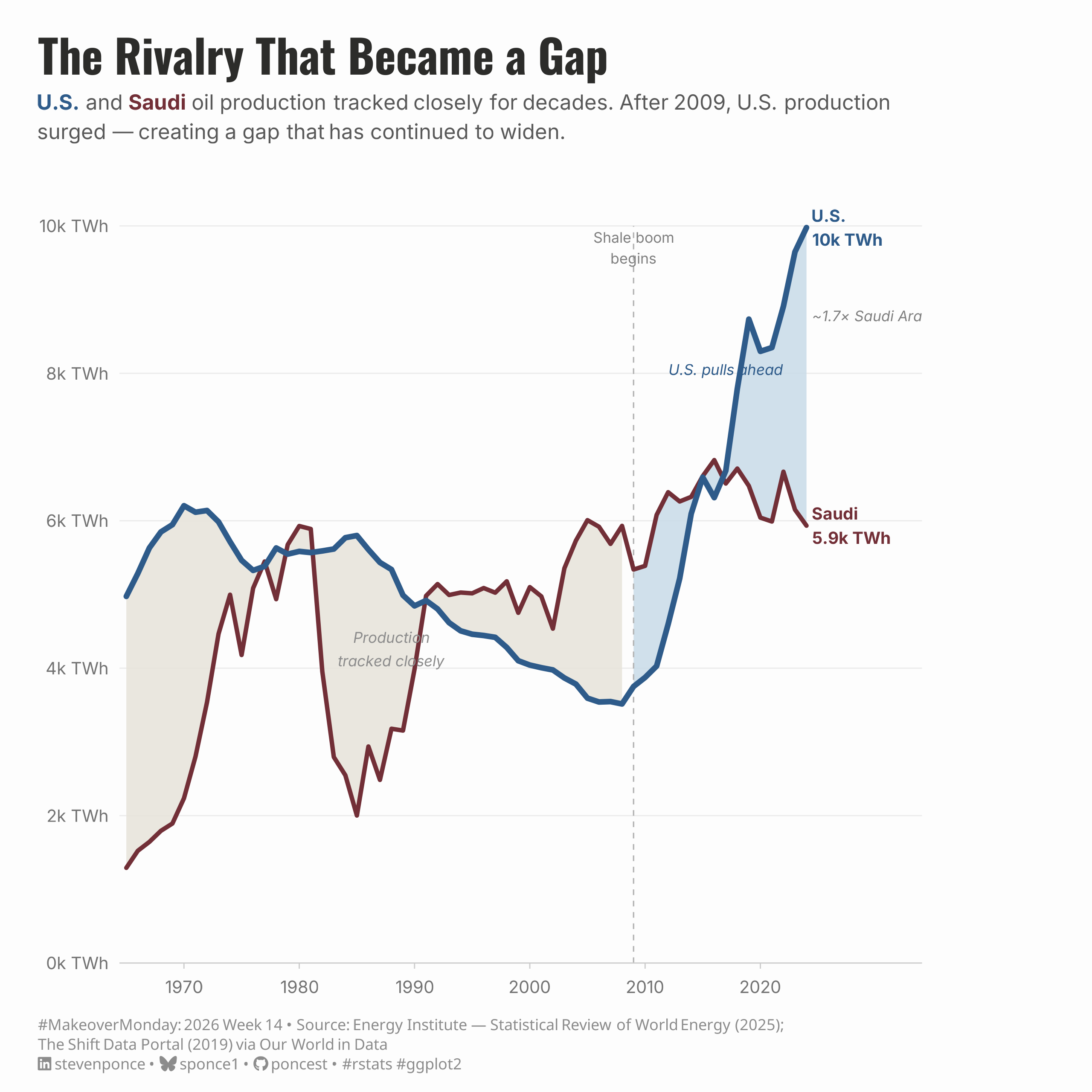
U.S. and Saudi oil production tracked closely for decades. After 2009, U.S. production surged — creating a gap that has continued to widen.

MakeoverMonday
Data Visualization
R Programming
2026
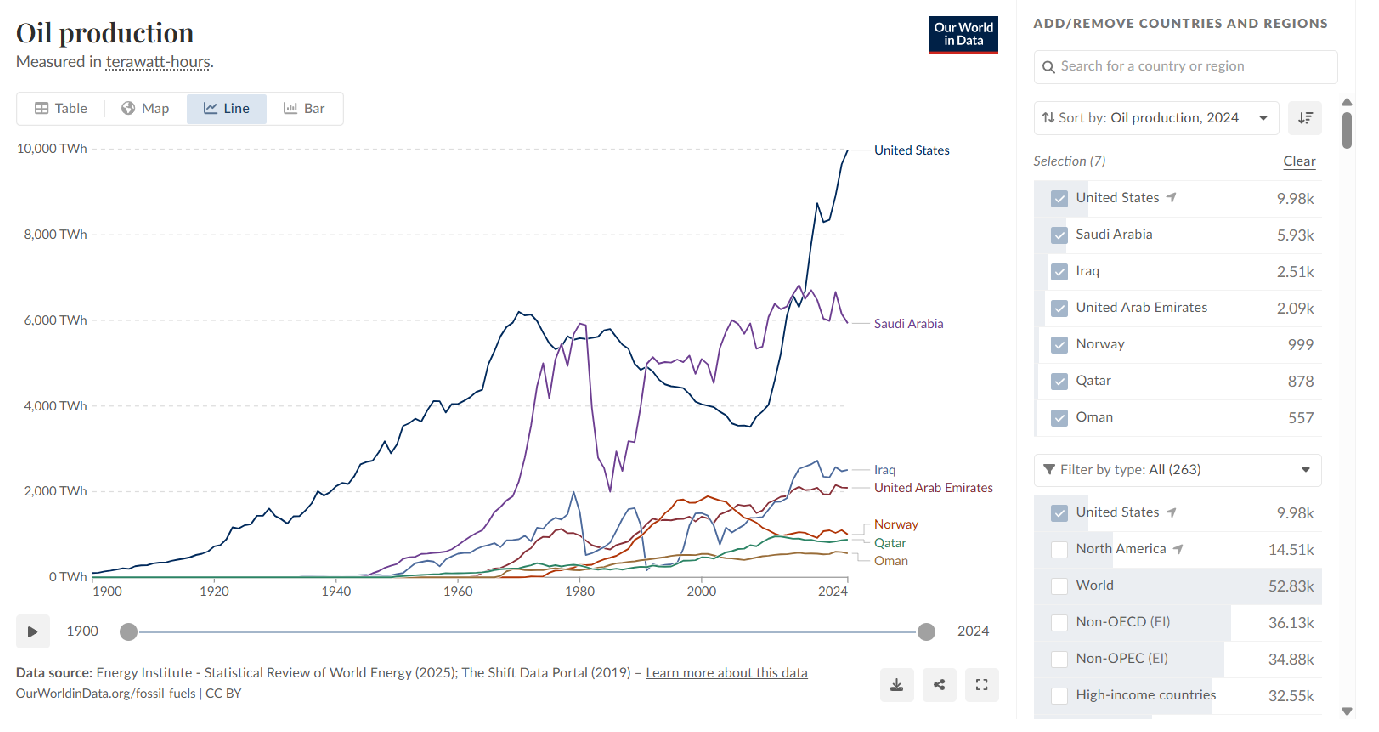
U.S. and Saudi Arabia oil production tracked closely for decades — then shale changed everything. This gap chart uses dual-shaded ribbon fills to encode two eras: competitive parity before 2009 and accelerating U.S. dominance after. Redesigned from an Our World in Data multi-line chart to reduce cognitive load and foreground the structural shift in global oil leadership.
Author

Steven Ponce

Published

April 6, 2026

Original

The original visualization comes from Global Oil Production

Original visualization

Makeover

Figure 1: A gap chart showing U.S. and Saudi Arabia oil production in terawatt-hours from 1965 to 2024. The area between the two lines is shaded in two colors: warm gray before 2009, labeled “Production tracked closely,” and steel blue after 2009, labeled “U.S. pulls ahead.” A dashed vertical line marks the 2009 shale boom inflection point. The U.S. line ends at 10k TWh in 2024; Saudi Arabia at 5.9k TWh. An annotation notes that U.S. output is approximately 1.7 times that of Saudi Arabia. The chart illustrates a structural shift from decades of competitive parity to clear U.S. dominance following the shale revolution.

Steps to Create this Graphic

1. Load Packages & Setup

Show code
```{r}
#| label: load
#| warning: false
#| message: false      
#| results: "hide"     

## 1. LOAD PACKAGES & SETUP ----
suppressPackageStartupMessages({
  if (!require("pacman")) install.packages("pacman")
  pacman::p_load(
    tidyverse, ggtext, showtext, scales, 
  glue, janitor
)
})

### |- figure size ----
camcorder::gg_record(
  dir    = here::here("temp_plots"),
  device = "png",
  width  = 8,
  height = 8,
  units  = "in",
  dpi    = 320
)

# Source utility functions
suppressMessages(source(here::here("R/utils/fonts.R")))
source(here::here("R/utils/social_icons.R"))
source(here::here("R/utils/image_utils.R"))
source(here::here("R/themes/base_theme.R"))
```

2. Read in the Data

Show code
```{r}
#| label: read
#| include: true
#| eval: true
#| warning: false
#| 

df_raw <- read_csv(
  here::here("data/MakeoverMonday/2026/oil-production-by-country.csv")) |>
  clean_names()
```

3. Examine the Data

Show code
```{r}
#| label: examine
#| include: true
#| eval: true
#| results: 'hide'
#| warning: false

glimpse(df_raw)
skimr::skim_without_charts(df_raw)
```

4. Tidy Data

Show code
```{r}
#| label: tidy
#| warning: false

df_two <- df_raw |>
  filter(
    entity %in% c("United States", "Saudi Arabia"),
    year >= 1965
  ) |>
  mutate(oil_k = oil / 1000) |>
  select(entity, year, oil_k)

df_wide <- df_two |>
  pivot_wider(names_from = entity, values_from = oil_k) |>
  rename(us = `United States`, saudi = `Saudi Arabia`) |>
  mutate(era = if_else(year < 2009, "rivalry", "gap"))

# Endpoint values for labels
us_2024    <- df_wide |> filter(year == 2024) |> pull(us)
saudi_2024 <- df_wide |> filter(year == 2024) |> pull(saudi)

# Ratio for "nearly 2×" annotation 
ratio_2024 <- round(us_2024 / saudi_2024, 1)

# Label anchor positions
us_1988    <- df_wide |> filter(year == 1988) |> pull(us)
saudi_1988 <- df_wide |> filter(year == 1988) |> pull(saudi)
rival_mid  <- (us_1988 + saudi_1988) / 2

# Gap label
us_2018    <- df_wide |> filter(year == 2018) |> pull(us)
saudi_2018 <- df_wide |> filter(year == 2018) |> pull(saudi)
gap_mid    <- (us_2018 + saudi_2018) / 2
```

5. Visualization Parameters

Show code
```{r}
#| label: params
#| include: true
#| warning: false

### |-  plot aesthetics ----
colors <- get_theme_colors(
  palette = list(
    us         = "#2E5B8A",
    saudi      = "#722F37",
    fill_gap   = "#C8DAE8",
    fill_rival = "#E8E4DC",
    annot      = "#5A5A5A",
    text       = "#2C2C2A"
  )
)

### |-  titles and caption ----
title_text    <- str_glue("The Rivalry That Became a Gap")

subtitle_text <- str_glue(
  "<span style='color:{colors$palette$us}'>**U.S.**</span> and ",
  "<span style='color:{colors$palette$saudi}'>**Saudi**</span> oil production ",
  "tracked closely for decades. After 2009, U.S. production surged — ",
  "creating a gap that has continued to widen."
)

caption_text <- create_mm_caption(
  mm_year = 2026,
  mm_week = 14,
  source_text = "Energy Institute — Statistical Review of World Energy (2025);<br>The Shift Data Portal (2019) via Our World in Data"
)

### |-  fonts ----
setup_fonts()
fonts <- get_font_families()

### |-  plot theme ----
base_theme   <- create_base_theme(colors)

weekly_theme <- extend_weekly_theme(
  base_theme,
  theme(
    axis.title        = element_blank(),
    axis.text.x       = element_text(size = 9, color = "gray45"),
    axis.text.y       = element_text(size = 9, color = "gray45"),
    axis.line.x       = element_line(color = "gray80", linewidth = 0.3),
    axis.ticks.x      = element_line(color = "gray80", linewidth = 0.3),
    axis.ticks.length = unit(3, "pt"),
    
    panel.grid.major.y = element_line(color = "gray92", linewidth = 0.3),
    panel.grid.major.x = element_blank(),
    panel.grid.minor   = element_blank(),
    
    plot.margin = margin(t = 20, r = 90, b = 10, l = 20)
  )
)

theme_set(weekly_theme)
```

6. Plot

Show code
```{r}
#| label: plot
#| warning: false

### |-  main plot ----
p <- ggplot(df_wide, aes(x = year)) +
  
  # Geoms
  geom_ribbon(
    data    = df_wide |> filter(era == "rivalry"),
    mapping = aes(ymin = saudi, ymax = us),
    fill    = colors$palette$fill_rival,
    alpha   = 0.9
  ) +
  geom_ribbon(
    data    = df_wide |> filter(era == "gap"),
    mapping = aes(ymin = saudi, ymax = us),
    fill    = colors$palette$fill_gap,
    alpha   = 0.85
  ) +
  annotate(
    "segment",
    x = 2009, xend = 2009,
    y = 0, yend = 10,
    color = "gray70",
    linewidth = 0.35,
    linetype = "dashed"
  ) +
  geom_line(
    aes(y = saudi),
    color = colors$palette$saudi,
    linewidth = 1.1,
    lineend = "round"
  ) +
  geom_line(
    aes(y = us),
    color = colors$palette$us,
    linewidth = 1.4,
    lineend = "round"
  ) +
  
  # Annotate
  annotate(
    "text",
    x = 2024.5,
    y = us_2024,
    label = glue("U.S.\n{round(us_2024, 1)}k TWh"),
    hjust = 0,
    size = 3.1,
    fontface = "bold",
    color = colors$palette$us,
    lineheight = 1.2
  ) +
  annotate(
    "text",
    x = 2024.5,
    y = saudi_2024,
    label = glue("Saudi\n{round(saudi_2024, 1)}k TWh"),
    hjust = 0,
    size = 3.1,
    fontface = "bold",
    color = colors$palette$saudi,
    lineheight = 1.2
  ) +
  annotate(
    "text",
    x        = 2024.5,
    y        = us_2024 - 1.2,
    label    = glue("\u007e{ratio_2024}\u00d7 Saudi Arabia"),
    hjust    = 0,
    size     = 2.7,
    color    = "gray50",
    fontface = "italic"
  ) +
  annotate(
    "text",
    x          = 1988,
    y          = rival_mid,
    label      = "Production\ntracked closely",
    hjust      = 0.5,
    size       = 2.8,
    color      = "gray55",
    fontface   = "italic",
    lineheight = 1.3
  ) +
  annotate(
    "text",
    x          = 2017,
    y          = gap_mid + 0.8,
    label      = "U.S. pulls ahead",
    hjust      = 0.5,
    size       = 2.8,
    color      = colors$palette$us,
    fontface   = "italic"
  ) +
  annotate(
    "text",
    x          = 2009,
    y          = 9.7,
    label      = "Shale boom\nbegins",
    hjust      = 0.5,
    size       = 2.7,
    color      = "gray50",
    lineheight = 1.2
  ) +
  
  # Scales
  scale_x_continuous(
    breaks = seq(1970, 2020, by = 10),
    expand = expansion(mult = c(0.01, 0.16))
  ) +
  scale_y_continuous(
    labels = label_number(suffix = "k TWh", accuracy = 1),
    breaks = seq(0, 10, by = 2),
    limits = c(0, 10.5),
    expand = expansion(mult = c(0, 0.02))
  ) +
  
  # Labs
  labs(
    title    = title_text,
    subtitle = subtitle_text,
    caption  = caption_text
  ) +
  
  # Theme
  theme(
    plot.title = element_text(
      size = 24, face = "bold", color = colors$palette$text,
      margin = margin(b = 6), family = fonts$title
    ),
    plot.subtitle = element_textbox_simple(
      size = 11, color = "gray35",
      margin = margin(b = 16), family = fonts$subtitle,
      lineheight = 1.4
    ),
    plot.caption = element_textbox_simple(
      size = 8, color = "gray55", family = fonts$caption,
      margin = margin(t = 12),
      lineheight = 1.3
    )
  )
```

7. Save

Show code
```{r}
#| label: save
#| warning: false

### |-  plot image ----  
save_plot(
  plot = p, 
  type = "makeovermonday", 
  year = current_year,
  week = current_week,
  width = 8, 
  height = 8
  )
```

8. Session Info

TipExpand for Session Info
R version 4.3.1 (2023-06-16 ucrt)
Platform: x86_64-w64-mingw32/x64 (64-bit)
Running under: Windows 11 x64 (build 26100)

Matrix products: default


locale:
[1] LC_COLLATE=English_United States.utf8 
[2] LC_CTYPE=English_United States.utf8   
[3] LC_MONETARY=English_United States.utf8
[4] LC_NUMERIC=C                          
[5] LC_TIME=English_United States.utf8    

time zone: America/New_York
tzcode source: internal

attached base packages:
[1] stats     graphics  grDevices utils     datasets  methods   base     

other attached packages:
 [1] here_1.0.2      janitor_2.2.1   glue_1.8.0      scales_1.4.0   
 [5] showtext_0.9-7  showtextdb_3.0  sysfonts_0.8.9  ggtext_0.1.2   
 [9] lubridate_1.9.5 forcats_1.0.1   stringr_1.6.0   dplyr_1.2.0    
[13] purrr_1.2.1     readr_2.2.0     tidyr_1.3.2     tibble_3.2.1   
[17] ggplot2_4.0.2   tidyverse_2.0.0 pacman_0.5.1   

loaded via a namespace (and not attached):
 [1] gtable_0.3.6       xfun_0.56          htmlwidgets_1.6.4  tzdb_0.5.0        
 [5] vctrs_0.7.1        tools_4.3.1        generics_0.1.4     curl_7.0.0        
 [9] parallel_4.3.1     gifski_1.32.0-2    pkgconfig_2.0.3    skimr_2.2.2       
[13] RColorBrewer_1.1-3 S7_0.2.0           lifecycle_1.0.5    compiler_4.3.1    
[17] farver_2.1.2       textshaping_1.0.4  repr_1.1.7         codetools_0.2-19  
[21] snakecase_0.11.1   litedown_0.9       htmltools_0.5.9    yaml_2.3.12       
[25] pillar_1.11.1      crayon_1.5.3       camcorder_0.1.0    magick_2.8.6      
[29] commonmark_2.0.0   tidyselect_1.2.1   digest_0.6.39      stringi_1.8.7     
[33] rsvg_2.6.2         rprojroot_2.1.1    fastmap_1.2.0      grid_4.3.1        
[37] cli_3.6.5          magrittr_2.0.3     base64enc_0.1-6    withr_3.0.2       
[41] bit64_4.6.0-1      timechange_0.4.0   rmarkdown_2.30     bit_4.6.0         
[45] otel_0.2.0         ragg_1.5.0         hms_1.1.4          evaluate_1.0.5    
[49] knitr_1.51         markdown_2.0       rlang_1.1.7        gridtext_0.1.6    
[53] Rcpp_1.1.1         xml2_1.5.2         svglite_2.1.3      rstudioapi_0.18.0 
[57] vroom_1.7.0        jsonlite_2.0.0     R6_2.6.1           systemfonts_1.3.2 

9. GitHub Repository

TipExpand for GitHub Repo

The complete code for this analysis is available in mm_2026_14.qmd.

For the full repository, click here.

10. References

TipExpand for References

Primary Data (Makeover Monday): 1. Makeover Monday 2026 Week 14: Global Oil Production 2. Original Chart: Oil Production by Country — Our World in Data - Source: Our World in Data interactive explorer (CC BY 4.0) - Authors: Hannah Ritchie, Pablo Rosado, and Max Roser (2023)

Source Data: 3. Energy Institute — Statistical Review of World Energy (2025) - Coverage: Oil production by country, 1965–2024 - Unit: Terawatt-hours (converted from exajoules by Our World in Data)

  1. The Shift Data Portal — Energy Production from Fossil Fuels (2019)
    • Coverage: Historical production series, 1900–1964 (pre-Energy Institute period)
    • Note: Not used in this chart — visualization begins at 1965

Full citation (per Our World in Data): > Energy Institute - Statistical Review of World Energy (2025); The Shift Data Portal (2019) – with major processing by Our World in Data. “Oil production” [dataset]. Retrieved from https://ourworldindata.org/grapher/oil-production-by-country

Note: This redesign focuses on the United States and Saudi Arabia only (1965–2024), where the rivalry-to-gap narrative is most legible. The five remaining countries in the dataset (Iraq, UAE, Norway, Qatar, Oman) are excluded from the final chart; at this scale they compress to near-zero and add no analytical value to the central story. Production values are reported in terawatt-hours as supplied by Our World in Data; no additional unit conversion was applied.

11. Custom Functions Documentation

Note📦 Custom Helper Functions

This analysis uses custom functions from my personal module library for efficiency and consistency across projects.

Functions Used:

  • fonts.R: setup_fonts(), get_font_families() - Font management with showtext
  • social_icons.R: create_social_caption() - Generates formatted social media captions
  • image_utils.R: save_plot() - Consistent plot saving with naming conventions
  • base_theme.R: create_base_theme(), extend_weekly_theme(), get_theme_colors() - Custom ggplot2 themes

Why custom functions?
These utilities standardize theming, fonts, and output across all my data visualizations. The core analysis (data tidying and visualization logic) uses only standard tidyverse packages.

Source Code:
View all custom functions → GitHub: R/utils

Back to top

Citation

BibTeX citation:
@online{ponce2026,
  author = {Ponce, Steven},
  title = {The {Rivalry} {That} {Became} a {Gap}},
  date = {2026-04-06},
  url = {https://stevenponce.netlify.app/data_visualizations/MakeoverMonday/2026/mm_2026_14.html},
  langid = {en}
}
For attribution, please cite this work as:
Ponce, Steven. 2026. “The Rivalry That Became a Gap.” April 6, 2026. https://stevenponce.netlify.app/data_visualizations/MakeoverMonday/2026/mm_2026_14.html.
Source Code
---
title: "The Rivalry That Became a Gap"
subtitle: "U.S. and Saudi oil production tracked closely for decades. After 2009, U.S. production surged — creating a gap that has continued to widen."
description: "U.S. and Saudi Arabia oil production tracked closely for decades — then shale changed everything. This gap chart uses dual-shaded ribbon fills to encode two eras: competitive parity before 2009 and accelerating U.S. dominance after. Redesigned from an Our World in Data multi-line chart to reduce cognitive load and foreground the structural shift in global oil leadership."
date: "2026-04-06"
author:
  - name: "Steven Ponce"
    url: "https://stevenponce.netlify.app"
citation:
  url: "https://stevenponce.netlify.app/data_visualizations/MakeoverMonday/2026/mm_2026_14.html"
categories: ["MakeoverMonday", "Data Visualization", "R Programming", "2026"]   
tags: [
  "makeover-monday",
  "data-visualization",
  "ggplot2",
  "energy",
  "oil-production",
  "geopolitics",
  "ribbon-chart",
  "time-series",
  "United-States",
  "Saudi-Arabia",
  "shale-revolution",
  "two-country-comparison"
]
image: "thumbnails/mm_2026_14.png"
format:
  html:
    toc: true
    toc-depth: 5
    code-link: true
    code-fold: true
    code-tools: true
    code-summary: "Show code"
    self-contained: true
    theme: 
      light: [flatly, assets/styling/custom_styles.scss]
      dark: [darkly, assets/styling/custom_styles_dark.scss]
editor_options: 
  chunk_output_type: inline
execute: 
  freeze: true                                      
  cache: true                                       
  error: false
  message: false
  warning: false
  eval: true
editor: 
  markdown: 
    wrap: 72
---

```{r}
#| label: setup-links
#| include: false

# CENTRALIZED LINK MANAGEMENT

## Project-specific info 
current_year <- 2026
current_week <- 14
project_file <- "mm_2026_14.qmd"
project_image <- "mm_2026_14.png"

## Data Sources
data_main <- "https://data.world/makeovermonday/2026w14"
data_secondary <- "https://data.world/makeovermonday/2026w14"

## Repository Links  
repo_main <- "https://github.com/poncest/personal-website/"
repo_file <- paste0("https://github.com/poncest/personal-website/blob/master/data_visualizations/MakeoverMonday/", current_year, "/", project_file)

## External Resources/Images
chart_original <- "https://raw.githubusercontent.com/poncest/MakeoverMonday/refs/heads/master/2026/Week_14/original_chart.png"

## Organization/Platform Links
org_primary <- "https://ourworldindata.org/grapher/oil-production-by-country"
org_secondary <- "https://ourworldindata.org/grapher/oil-production-by-country"

# Helper function to create markdown links
create_link <- function(text, url) {
  paste0("[", text, "](", url, ")")
}

# Helper function for citation-style links
create_citation_link <- function(text, url, title = NULL) {
  if (is.null(title)) {
    paste0("[", text, "](", url, ")")
  } else {
    paste0("[", text, "](", url, ' "', title, '")')
  }
}
```

### Original

The original visualization comes from `r create_link("Global Oil Production", data_secondary)`
![Original visualization](https://raw.githubusercontent.com/poncest/MakeoverMonday/refs/heads/master/2026/Week_14/original_chart.png)

### Makeover

![A gap chart showing U.S. and Saudi Arabia oil production in terawatt-hours from 1965 to 2024. The area between the two lines is shaded in two colors: warm gray before 2009, labeled "Production tracked closely," and steel blue after 2009, labeled "U.S. pulls ahead." A dashed vertical line marks the 2009 shale boom inflection point. The U.S. line ends at 10k TWh in 2024; Saudi Arabia at 5.9k TWh. An annotation notes that U.S. output is approximately 1.7 times that of Saudi Arabia. The chart illustrates a structural shift from decades of competitive parity to clear U.S. dominance following the shale revolution.](mm_2026_14.png){#fig-1}

### [**Steps to Create this Graphic**]{.mark}

#### [1. Load Packages & Setup]{.smallcaps}

```{r}
#| label: load
#| warning: false
#| message: false      
#| results: "hide"     

## 1. LOAD PACKAGES & SETUP ----
suppressPackageStartupMessages({
  if (!require("pacman")) install.packages("pacman")
  pacman::p_load(
    tidyverse, ggtext, showtext, scales, 
  glue, janitor
)
})

### |- figure size ----
camcorder::gg_record(
  dir    = here::here("temp_plots"),
  device = "png",
  width  = 8,
  height = 8,
  units  = "in",
  dpi    = 320
)

# Source utility functions
suppressMessages(source(here::here("R/utils/fonts.R")))
source(here::here("R/utils/social_icons.R"))
source(here::here("R/utils/image_utils.R"))
source(here::here("R/themes/base_theme.R"))
```

#### [2. Read in the Data]{.smallcaps}

```{r}
#| label: read
#| include: true
#| eval: true
#| warning: false
#| 

df_raw <- read_csv(
  here::here("data/MakeoverMonday/2026/oil-production-by-country.csv")) |>
  clean_names()

```

#### [3. Examine the Data]{.smallcaps}

```{r}
#| label: examine
#| include: true
#| eval: true
#| results: 'hide'
#| warning: false

glimpse(df_raw)
skimr::skim_without_charts(df_raw)
```

#### [4. Tidy Data]{.smallcaps}

```{r}
#| label: tidy
#| warning: false

df_two <- df_raw |>
  filter(
    entity %in% c("United States", "Saudi Arabia"),
    year >= 1965
  ) |>
  mutate(oil_k = oil / 1000) |>
  select(entity, year, oil_k)

df_wide <- df_two |>
  pivot_wider(names_from = entity, values_from = oil_k) |>
  rename(us = `United States`, saudi = `Saudi Arabia`) |>
  mutate(era = if_else(year < 2009, "rivalry", "gap"))

# Endpoint values for labels
us_2024    <- df_wide |> filter(year == 2024) |> pull(us)
saudi_2024 <- df_wide |> filter(year == 2024) |> pull(saudi)

# Ratio for "nearly 2×" annotation 
ratio_2024 <- round(us_2024 / saudi_2024, 1)

# Label anchor positions
us_1988    <- df_wide |> filter(year == 1988) |> pull(us)
saudi_1988 <- df_wide |> filter(year == 1988) |> pull(saudi)
rival_mid  <- (us_1988 + saudi_1988) / 2

# Gap label
us_2018    <- df_wide |> filter(year == 2018) |> pull(us)
saudi_2018 <- df_wide |> filter(year == 2018) |> pull(saudi)
gap_mid    <- (us_2018 + saudi_2018) / 2
```

#### [5. Visualization Parameters]{.smallcaps}

```{r}
#| label: params
#| include: true
#| warning: false

### |-  plot aesthetics ----
colors <- get_theme_colors(
  palette = list(
    us         = "#2E5B8A",
    saudi      = "#722F37",
    fill_gap   = "#C8DAE8",
    fill_rival = "#E8E4DC",
    annot      = "#5A5A5A",
    text       = "#2C2C2A"
  )
)

### |-  titles and caption ----
title_text    <- str_glue("The Rivalry That Became a Gap")

subtitle_text <- str_glue(
  "<span style='color:{colors$palette$us}'>**U.S.**</span> and ",
  "<span style='color:{colors$palette$saudi}'>**Saudi**</span> oil production ",
  "tracked closely for decades. After 2009, U.S. production surged — ",
  "creating a gap that has continued to widen."
)

caption_text <- create_mm_caption(
  mm_year = 2026,
  mm_week = 14,
  source_text = "Energy Institute — Statistical Review of World Energy (2025);<br>The Shift Data Portal (2019) via Our World in Data"
)

### |-  fonts ----
setup_fonts()
fonts <- get_font_families()

### |-  plot theme ----
base_theme   <- create_base_theme(colors)

weekly_theme <- extend_weekly_theme(
  base_theme,
  theme(
    axis.title        = element_blank(),
    axis.text.x       = element_text(size = 9, color = "gray45"),
    axis.text.y       = element_text(size = 9, color = "gray45"),
    axis.line.x       = element_line(color = "gray80", linewidth = 0.3),
    axis.ticks.x      = element_line(color = "gray80", linewidth = 0.3),
    axis.ticks.length = unit(3, "pt"),
    
    panel.grid.major.y = element_line(color = "gray92", linewidth = 0.3),
    panel.grid.major.x = element_blank(),
    panel.grid.minor   = element_blank(),
    
    plot.margin = margin(t = 20, r = 90, b = 10, l = 20)
  )
)

theme_set(weekly_theme)
```

#### [6. Plot]{.smallcaps}

```{r}
#| label: plot
#| warning: false

### |-  main plot ----
p <- ggplot(df_wide, aes(x = year)) +
  
  # Geoms
  geom_ribbon(
    data    = df_wide |> filter(era == "rivalry"),
    mapping = aes(ymin = saudi, ymax = us),
    fill    = colors$palette$fill_rival,
    alpha   = 0.9
  ) +
  geom_ribbon(
    data    = df_wide |> filter(era == "gap"),
    mapping = aes(ymin = saudi, ymax = us),
    fill    = colors$palette$fill_gap,
    alpha   = 0.85
  ) +
  annotate(
    "segment",
    x = 2009, xend = 2009,
    y = 0, yend = 10,
    color = "gray70",
    linewidth = 0.35,
    linetype = "dashed"
  ) +
  geom_line(
    aes(y = saudi),
    color = colors$palette$saudi,
    linewidth = 1.1,
    lineend = "round"
  ) +
  geom_line(
    aes(y = us),
    color = colors$palette$us,
    linewidth = 1.4,
    lineend = "round"
  ) +
  
  # Annotate
  annotate(
    "text",
    x = 2024.5,
    y = us_2024,
    label = glue("U.S.\n{round(us_2024, 1)}k TWh"),
    hjust = 0,
    size = 3.1,
    fontface = "bold",
    color = colors$palette$us,
    lineheight = 1.2
  ) +
  annotate(
    "text",
    x = 2024.5,
    y = saudi_2024,
    label = glue("Saudi\n{round(saudi_2024, 1)}k TWh"),
    hjust = 0,
    size = 3.1,
    fontface = "bold",
    color = colors$palette$saudi,
    lineheight = 1.2
  ) +
  annotate(
    "text",
    x        = 2024.5,
    y        = us_2024 - 1.2,
    label    = glue("\u007e{ratio_2024}\u00d7 Saudi Arabia"),
    hjust    = 0,
    size     = 2.7,
    color    = "gray50",
    fontface = "italic"
  ) +
  annotate(
    "text",
    x          = 1988,
    y          = rival_mid,
    label      = "Production\ntracked closely",
    hjust      = 0.5,
    size       = 2.8,
    color      = "gray55",
    fontface   = "italic",
    lineheight = 1.3
  ) +
  annotate(
    "text",
    x          = 2017,
    y          = gap_mid + 0.8,
    label      = "U.S. pulls ahead",
    hjust      = 0.5,
    size       = 2.8,
    color      = colors$palette$us,
    fontface   = "italic"
  ) +
  annotate(
    "text",
    x          = 2009,
    y          = 9.7,
    label      = "Shale boom\nbegins",
    hjust      = 0.5,
    size       = 2.7,
    color      = "gray50",
    lineheight = 1.2
  ) +
  
  # Scales
  scale_x_continuous(
    breaks = seq(1970, 2020, by = 10),
    expand = expansion(mult = c(0.01, 0.16))
  ) +
  scale_y_continuous(
    labels = label_number(suffix = "k TWh", accuracy = 1),
    breaks = seq(0, 10, by = 2),
    limits = c(0, 10.5),
    expand = expansion(mult = c(0, 0.02))
  ) +
  
  # Labs
  labs(
    title    = title_text,
    subtitle = subtitle_text,
    caption  = caption_text
  ) +
  
  # Theme
  theme(
    plot.title = element_text(
      size = 24, face = "bold", color = colors$palette$text,
      margin = margin(b = 6), family = fonts$title
    ),
    plot.subtitle = element_textbox_simple(
      size = 11, color = "gray35",
      margin = margin(b = 16), family = fonts$subtitle,
      lineheight = 1.4
    ),
    plot.caption = element_textbox_simple(
      size = 8, color = "gray55", family = fonts$caption,
      margin = margin(t = 12),
      lineheight = 1.3
    )
  )
```

#### [7. Save]{.smallcaps}

```{r}
#| label: save
#| warning: false

### |-  plot image ----  
save_plot(
  plot = p, 
  type = "makeovermonday", 
  year = current_year,
  week = current_week,
  width = 8, 
  height = 8
  )
```

#### [8. Session Info]{.smallcaps}

::: {.callout-tip collapse="true"}
##### Expand for Session Info

```{r, echo = FALSE}
#| eval: true
#| warning: false

sessionInfo()
```
:::

#### [9. GitHub Repository]{.smallcaps}

::: {.callout-tip collapse="true"}
##### Expand for GitHub Repo

The complete code for this analysis is available in `r create_link(project_file, repo_file)`.

For the full repository, `r create_link("click here", repo_main)`.
:::


#### [10. References]{.smallcaps}

::: {.callout-tip collapse="true"}
##### Expand for References
**Primary Data (Makeover Monday):**
1. Makeover Monday `r current_year` Week `r current_week`: `r create_link("Global Oil Production", data_main)`
2. Original Chart: `r create_link("Oil Production by Country — Our World in Data", "https://ourworldindata.org/grapher/oil-production-by-country")`
   - Source: Our World in Data interactive explorer (CC BY 4.0)
   - Authors: Hannah Ritchie, Pablo Rosado, and Max Roser (2023)

**Source Data:**
3. `r create_link("Energy Institute — Statistical Review of World Energy (2025)", "https://www.energyinst.org/statistical-review/")`
   - Coverage: Oil production by country, 1965–2024
   - Unit: Terawatt-hours (converted from exajoules by Our World in Data)

4. `r create_link("The Shift Data Portal — Energy Production from Fossil Fuels (2019)", "https://www.theshiftdataportal.org/")`
   - Coverage: Historical production series, 1900–1964 (pre-Energy Institute period)
   - Note: Not used in this chart — visualization begins at 1965

**Full citation (per Our World in Data):**
> Energy Institute - Statistical Review of World Energy (2025); The Shift Data Portal (2019) – with major processing by Our World in Data. "Oil production" [dataset]. Retrieved from https://ourworldindata.org/grapher/oil-production-by-country

**Note:** This redesign focuses on the United States and Saudi Arabia only (1965–2024), where the rivalry-to-gap narrative is most legible. The five remaining countries in the dataset (Iraq, UAE, Norway, Qatar, Oman) are excluded from the final chart; at this scale they compress to near-zero and add no analytical value to the central story. Production values are reported in terawatt-hours as supplied by Our World in Data; no additional unit conversion was applied.
:::


#### [11. Custom Functions Documentation]{.smallcaps}

::: {.callout-note collapse="true"}
##### 📦 Custom Helper Functions

This analysis uses custom functions from my personal module library for efficiency and consistency across projects.

**Functions Used:**

-   **`fonts.R`**: `setup_fonts()`, `get_font_families()` - Font management with showtext
-   **`social_icons.R`**: `create_social_caption()` - Generates formatted social media captions
-   **`image_utils.R`**: `save_plot()` - Consistent plot saving with naming conventions
-   **`base_theme.R`**: `create_base_theme()`, `extend_weekly_theme()`, `get_theme_colors()` - Custom ggplot2 themes

**Why custom functions?**\
These utilities standardize theming, fonts, and output across all my data visualizations. The core analysis (data tidying and visualization logic) uses only standard tidyverse packages.

**Source Code:**\
View all custom functions → [GitHub: R/utils](https://github.com/poncest/personal-website/tree/master/R)
:::

© 2024 Steven Ponce

Source Issues
