• Steven Ponce
  • About
  • Data Visualizations
  • Projects
  • Resume
  • Email

On this page

  • Challenge
  • Visualization
  • Steps to Create this Graphic
    • 1. Load Packages & Setup
    • 2. Read in the Data
    • 3. Examine the Data
    • 4. Tidy Data
    • 5. Visualization Parameters
    • 6. Plot
    • 7. Save
    • 8. Session Info
    • 9. GitHub Repository
    • 10. References
    • 11. Custom Functions Documentation

Some Countries Are Exiting Fossil Fuels Fast. Others Are Standing Still.

  • Show All Code
  • Hide All Code

  • View Source

Annualized change in fossil fuel share of electricity generation, 2010–2023 (percentage points per year). Leftward arrows signal progress; rightward arrows signal backsliding.

SWDchallenge
Data Visualization
R Programming
2026
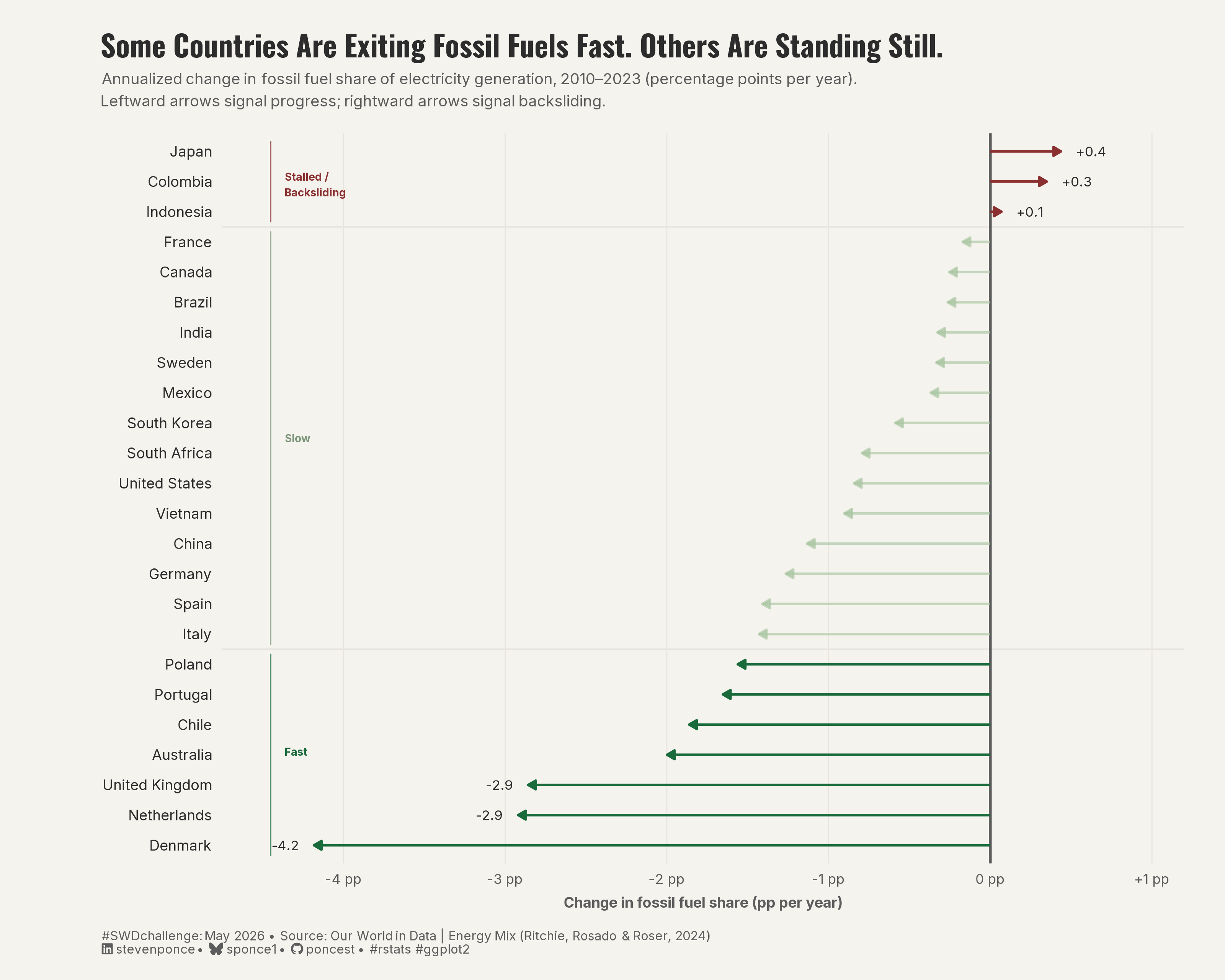
Arrow chart exploring how quickly 25 countries are reducing their reliance on fossil fuel electricity. Using annualized rates of change from 2010–2023, this visualization reveals a wide gap between fast movers like Denmark (−4.2 pp/year) and countries that have stalled or reversed course. Built as part of the SWD May 2026 Human + AI challenge using R/ggplot2 and Claude.
Author

Steven Ponce

Published

May 1, 2026

Challenge

Explore how human + AI can work together to create more effective data communication. This month’s challenge invites you to experiment, think critically, and share what you learn.

Additional information can be found HERE

Visualization

Figure 1: Arrow chart titled “Some Countries Are Exiting Fossil Fuels Fast. Others Are Standing Still.” Horizontal arrows show the annualized change in fossil fuel share of electricity generation for 25 countries between 2010 and 2023, measured in percentage points per year. Leftward arrows indicate progress; rightward arrows indicate backsliding. Countries are grouped into three tiers. In the Fast tier, Denmark leads at −4.2 pp per year, followed by the Netherlands and the United Kingdom at −2.9 pp per year. In the Slow tier, 14 countries show modest leftward movement, with most declining less than 1 pp per year. In the Stalled or Backsliding tier, Japan (+0.4), Colombia (+0.3), and Indonesia (+0.1) show rightward arrows, meaning their fossil fuel share grew over the period. Data source: Our World in Data, Energy Mix (Ritchie, Rosado and Roser, 2024).

Steps to Create this Graphic

1. Load Packages & Setup

Show code
```{r}
#| label: load

if (!require("pacman")) install.packages("pacman")
pacman::p_load(
  tidyverse, ggtext, showtext, janitor,     
  scales, glue    
)

### |- figure size ---- 
camcorder::gg_record(
  dir    = here::here("temp_plots"),
  device = "png",
  width  = 10,
  height = 8,
  units  = "in",
  dpi    = 320
)

# Source utility functions
suppressMessages(source(here::here("R/utils/fonts.R")))
source(here::here("R/utils/social_icons.R"))
source(here::here("R/utils/image_utils.R"))
source(here::here("R/themes/base_theme.R"))
```

2. Read in the Data

Show code
```{r}
#| label: read

raw_data <- read_csv(
  here::here("data/SWDchallenge/2026/owid-energy-data.csv"),
  show_col_types = FALSE
)
```

3. Examine the Data

Show code
```{r}
#| label: examine
#| include: true
#| eval: true
#| results: 'hide'
#| warning: false

glimpse(raw_data)
```

4. Tidy Data

Show code
```{r}
#| label: tidy
#| output: false

### |- define year window ----
year_start <- 2010
year_end <- 2023

### |- countries to include ----
# G20 + notable peers; filtered to those with complete data in both endpoints
# Excludes aggregates (EU, World) and small island states
selected_countries <- c(
  "Australia", "Brazil", "Canada", "Chile", "China",
  "Colombia", "Denmark", "France", "Germany", "India",
  "Indonesia", "Italy", "Japan", "Mexico", "Netherlands",
  "Poland", "Portugal", "South Africa", "South Korea",
  "Spain", "Sweden", "Türkiye", "United Kingdom",
  "United States", "Vietnam"
)

### |- extract endpoint values ----
df_endpoints <- raw_data |>
  filter(
    country %in% selected_countries,
    year %in% c(year_start, year_end),
    !is.na(fossil_share_elec)
  ) |>
  select(country, year, fossil_share_elec) |>
  pivot_wider(
    names_from = year,
    values_from = fossil_share_elec,
    names_prefix = "fossil_"
  ) |>
  # drop any country missing either endpoint
  filter(!is.na(fossil_2010), !is.na(fossil_2023))

### |- compute annualized exit rate ----
n_years <- year_end - year_start

df_rates <- df_endpoints |>
  mutate(
    # total pp change (negative = exit; positive = backslide)
    pp_change = fossil_2023 - fossil_2010,
    # annualized rate in pp/year
    annual_rate = pp_change / n_years,
    # tier based on annual decline rate — 3 tiers for visual clarity
    tier = case_when(
      annual_rate <= -1.5 ~ "Fast",
      annual_rate < 0 ~ "Slow",
      TRUE ~ "Stalled / Backsliding"
    ),
    tier = factor(tier, levels = c(
      "Fast", "Slow", "Stalled / Backsliding"
    ))
  ) |>
  arrange(annual_rate) |>
  mutate(country = fct_inorder(country))

### |- label data with outward positioning ----
df_label <- df_rates |>
  filter(
    row_number() <= 3 |
      row_number() > (n() - 3) |
      annual_rate > 0
  ) |>
  distinct(country, .keep_all = TRUE) |>
  mutate(
    label_x = case_when(
      annual_rate < 0 ~ annual_rate - 0.10,
      annual_rate > 0 ~ annual_rate + 0.10,
      TRUE ~ annual_rate
    ),
    label_hjust = case_when(
      annual_rate < 0 ~ 1,
      annual_rate > 0 ~ 0,
      TRUE ~ 0.5
    )
  )

### |- tier separator y-positions ----
df_tier_breaks <- df_rates |>
  mutate(y_int = as.integer(country)) |>
  group_by(tier) |>
  summarise(y_min = min(y_int), .groups = "drop") |>
  filter(tier != first(levels(df_rates$tier))) |>
  mutate(separator = y_min - 0.5)
```

5. Visualization Parameters

Show code
```{r}
#| label: params

### |- plot aesthetics ----
colors <- get_theme_colors(
  palette = list(
    "background"  = "#F5F3EE",
    "text"        = "#2C2C2C",
    "subtext"     = "#5C5C5C",
    "grid"        = "#E8E5DF",
    "fast"        = "#1A6B3C",
    "slow"        = "#A8C5A0",
    "stalled"     = "#8B3030"
  )
)

bg_col <- colors$palette$background
text_col <- colors$palette$text
sub_col <- colors$palette$subtext
grid_col <- colors$palette$grid

# tier color lookup — 3 tiers
tier_colors <- c(
  "Fast" = colors$palette$fast,
  "Slow" = colors$palette$slow,
  "Stalled / Backsliding" = colors$palette$stalled
)

### |- titles and caption ----
title_text <- "Some Countries Are Exiting Fossil Fuels Fast. Others Are Standing Still."

subtitle_text <- glue(
  "Annualized change in fossil fuel share of electricity generation, ",
  "{year_start}–{year_end} (percentage points per year).<br>",
  "Leftward arrows signal progress; rightward arrows signal backsliding."
)

caption_text <- create_swd_caption(
  year = 2026,
  month = "May",
  source_text = "Our World in Data | Energy Mix (Ritchie, Rosado & Roser, 2024)"
)

### |- fonts ----
setup_fonts()
fonts <- get_font_families()

### |- base theme ----
base_theme <- create_base_theme(colors)

weekly_theme <- extend_weekly_theme(
  base_theme,
  theme(
    plot.background = element_rect(fill = bg_col, color = NA),
    panel.background = element_rect(fill = bg_col, color = NA),

    # grid: vertical only
    panel.grid.major.x = element_line(color = grid_col, linewidth = 0.3),
    panel.grid.major.y = element_blank(),
    panel.grid.minor = element_blank(),

    # axes
    axis.title.x = element_text(
      color = sub_col, size = 8.5, family = fonts$text,
      margin = margin(t = 6)
    ),
    axis.title.y = element_blank(),
    axis.text.x = element_text(color = sub_col, size = 8, family = fonts$text),
    axis.text.y = element_text(
      color = text_col, size = 8.5, family = fonts$text, hjust = 1
    ),
    axis.ticks = element_blank(),

    # no legend 
    legend.position = "none",

    # titles
    plot.title = element_text(
      family = fonts$title, face = "bold",
      size = 17, color = text_col,
      margin = margin(b = 6)
    ),
    plot.subtitle = element_markdown(
      family = fonts$text, size = 9, color = sub_col,
      lineheight = 1.45, margin = margin(b = 14)
    ),
    plot.caption = element_markdown(
      family = fonts$text, size = 7.5, color = sub_col,
      hjust = 0, margin = margin(t = 12)
    ),
    plot.margin = margin(20, 24, 14, 60)
  )
)

theme_set(weekly_theme)

### |- tier bracket annotations ----
df_tier_labels <- df_rates |>
  mutate(y_int = as.integer(country)) |>
  group_by(tier) |>
  summarise(
    y_top = max(y_int) + 0.35,
    y_bot = min(y_int) - 0.35,
    y_mid = (max(y_int) + min(y_int)) / 2,
    .groups = "drop"
  ) |>
  mutate(
    label_color = tier_colors[as.character(tier)],
    label_text = case_when(
      tier == "Stalled / Backsliding" ~ "Stalled /\nBacksliding",
      TRUE ~ as.character(tier)
    ),
    y_label = case_when(
      tier == "Stalled / Backsliding" ~ y_mid - 0.10,
      tier == "Fast" ~ y_mid + 0.10,
      TRUE ~ y_mid
    ),
    label_color = case_when(
      tier == "Slow" ~ "#7A9478",
      TRUE ~ label_color
    )
  )
```

6. Plot

Show code
```{r}
#| label: plot
#| output: false

### |- main plot ----
p <- ggplot(df_rates, aes(y = country, color = tier)) +

  # Geoms
  geom_hline(
    data = df_tier_breaks,
    aes(yintercept = separator),
    color = grid_col,
    linewidth = 0.45,
    linetype = "solid",
    inherit.aes = FALSE
  ) +
  geom_vline(
    xintercept = 0,
    color = sub_col,
    linewidth = 0.8,
    linetype = "solid"
  ) +
  geom_segment(
    aes(
      x = 0,
      xend = annual_rate,
      yend = country,
      alpha = tier
    ),
    linewidth = 0.7,
    lineend = "butt",
    arrow = arrow(
      length = unit(0.18, "cm"),
      type = "closed"
    )
  ) +
  geom_text(
    data = df_label,
    aes(
      x = label_x,
      y = country,
      label = sprintf("%+.1f", annual_rate),
      hjust = label_hjust
    ),
    vjust = 0.5,
    size = 2.8,
    family = fonts$text,
    color = text_col,
    fontface = "plain",
    inherit.aes = FALSE
  ) +
  # Annotate
  annotate(
    "segment",
    x = -4.45,
    xend = -4.45,
    y = df_tier_labels$y_bot,
    yend = df_tier_labels$y_top,
    color = df_tier_labels$label_color,
    linewidth = 0.4,
    alpha = 0.75
  ) +
  annotate(
    "text",
    x = -4.36,
    y = df_tier_labels$y_label,
    label = df_tier_labels$label_text,
    color = df_tier_labels$label_color,
    size = 2.25,
    hjust = 0,
    vjust = 0.5,
    fontface = "bold",
    family = fonts$text
  ) +

  # Scales
  scale_color_manual(values = tier_colors) +
  scale_alpha_manual(
    values = c(
      "Fast" = 1,
      "Slow" = 0.65,
      "Stalled / Backsliding" = 1
    ),
    guide = "none"
  ) +
  scale_x_continuous(
    name = "Change in fossil fuel share (pp per year)",
    labels = label_number(suffix = " pp", style_positive = "plus"),
    breaks = c(-4, -3, -2, -1, 0, 1),
    limits = c(-4.75, 1.20),
    expand = expansion(mult = c(0, 0))
  ) +
  guides(color = "none") +
  coord_cartesian(clip = "off") +
  # Labs
  labs(
    title = title_text,
    subtitle = subtitle_text,
    caption = caption_text,
    y = NULL
  )
```

7. Save

Show code
```{r}
#| label: save

### |-  plot image ----  
save_plot(
  p, 
  type = 'swd', 
  year = 2026, 
  month = 05, 
  width  = 10,
  height = 8,
  )
```

8. Session Info

TipExpand for Session Info
R version 4.5.3 (2026-03-11 ucrt)
Platform: x86_64-w64-mingw32/x64
Running under: Windows 11 x64 (build 26100)

Matrix products: default
  LAPACK version 3.12.1

locale:
[1] LC_COLLATE=English_United States.utf8 
[2] LC_CTYPE=English_United States.utf8   
[3] LC_MONETARY=English_United States.utf8
[4] LC_NUMERIC=C                          
[5] LC_TIME=English_United States.utf8    

time zone: America/New_York
tzcode source: internal

attached base packages:
[1] stats     graphics  grDevices utils     datasets  methods   base     

other attached packages:
 [1] here_1.0.2      glue_1.8.0      scales_1.4.0    janitor_2.2.1  
 [5] showtext_0.9-8  showtextdb_3.0  sysfonts_0.8.9  ggtext_0.1.2   
 [9] lubridate_1.9.5 forcats_1.0.1   stringr_1.6.0   dplyr_1.2.1    
[13] purrr_1.2.2     readr_2.2.0     tidyr_1.3.2     tibble_3.3.1   
[17] ggplot2_4.0.3   tidyverse_2.0.0 pacman_0.5.1   

loaded via a namespace (and not attached):
 [1] gtable_0.3.6       xfun_0.57          htmlwidgets_1.6.4  tzdb_0.5.0        
 [5] vctrs_0.7.3        tools_4.5.3        generics_0.1.4     curl_7.0.0        
 [9] parallel_4.5.3     gifski_1.32.0-2    pkgconfig_2.0.3    RColorBrewer_1.1-3
[13] S7_0.2.1           lifecycle_1.0.5    compiler_4.5.3     farver_2.1.2      
[17] textshaping_1.0.5  codetools_0.2-20   snakecase_0.11.1   litedown_0.9      
[21] htmltools_0.5.9    yaml_2.3.12        pillar_1.11.1      crayon_1.5.3      
[25] camcorder_0.1.0    magick_2.9.1       commonmark_2.0.0   tidyselect_1.2.1  
[29] digest_0.6.39      stringi_1.8.7      rsvg_2.7.0         rprojroot_2.1.1   
[33] fastmap_1.2.0      grid_4.5.3         cli_3.6.6          magrittr_2.0.5    
[37] withr_3.0.2        bit64_4.6.0-1      timechange_0.4.0   rmarkdown_2.31    
[41] bit_4.6.0          otel_0.2.0         ragg_1.5.2         hms_1.1.4         
[45] evaluate_1.0.5     knitr_1.51         markdown_2.0       rlang_1.2.0       
[49] gridtext_0.1.6     Rcpp_1.1.1         xml2_1.5.2         svglite_2.2.2     
[53] rstudioapi_0.18.0  vroom_1.7.1        jsonlite_2.0.0     R6_2.6.1          
[57] systemfonts_1.3.2 

9. GitHub Repository

TipExpand for GitHub Repo

The complete code for this analysis is available in swd_2026_05.qmd. For the full repository, click here.

10. References

TipExpand for References

SWD Challenge: - Storytelling with Data: human + AI

Data Sources: - All data are synthetic and illustrative. Timelines were constructed to reflect plausible oncology drug development and launch timing ranges. No specific product, company, or trial is depicted.

Background References: - U.S. Food & Drug Administration. (2024). Novel Drug Approvals for 2024. https://www.fda.gov/patients/drug-development-process/step-3-clinical-research - Deloitte. (2024). Measuring the return from pharmaceutical innovation. https://www.deloitte.com/global/en/Industries/life-sciences/research/measuring-return-pharmaceutical-innovation.html

Book Reference: - Knaflic, C. N. (2019). storytelling with data: let’s practice! Wiley.

11. Custom Functions Documentation

Note📦 Custom Helper Functions

This analysis uses custom functions from my personal module library for efficiency and consistency across projects.

Functions Used:

  • fonts.R: setup_fonts(), get_font_families() - Font management with showtext
  • social_icons.R: create_social_caption() - Generates formatted social media captions
  • image_utils.R: save_plot() - Consistent plot saving with naming conventions
  • base_theme.R: create_base_theme(), extend_weekly_theme(), get_theme_colors() - Custom ggplot2 themes

Why custom functions?
These utilities standardize theming, fonts, and output across all my data visualizations. The core analysis (data tidying and visualization logic) uses only standard tidyverse packages.

Source Code:
View all custom functions → GitHub: R/utils

Back to top

Citation

BibTeX citation:
@online{ponce2026,
  author = {Ponce, Steven},
  title = {Some {Countries} {Are} {Exiting} {Fossil} {Fuels} {Fast.}
    {Others} {Are} {Standing} {Still.}},
  date = {2026-05-01},
  url = {https://stevenponce.netlify.app/data_visualizations/SWD%20Challenge/2026/swd_2026_05.html},
  langid = {en}
}
For attribution, please cite this work as:
Ponce, Steven. 2026. “Some Countries Are Exiting Fossil Fuels Fast. Others Are Standing Still.” May 1. https://stevenponce.netlify.app/data_visualizations/SWD%20Challenge/2026/swd_2026_05.html.
Source Code
---
title: "Some Countries Are Exiting Fossil Fuels Fast. Others Are Standing Still."
subtitle: "Annualized change in fossil fuel share of electricity generation, 2010–2023 (percentage points per year). Leftward arrows signal progress; rightward arrows signal backsliding."
description: "Arrow chart exploring how quickly 25 countries are reducing their reliance on fossil fuel electricity. Using annualized rates of change from 2010–2023, this visualization reveals a wide gap between fast movers like Denmark (−4.2 pp/year) and countries that have stalled or reversed course. Built as part of the SWD May 2026 Human + AI challenge using R/ggplot2 and Claude."
date: "2026-05-01"
author:
  - name: "Steven Ponce"
    url: "https://stevenponce.netlify.app"
citation:
  url: "https://stevenponce.netlify.app/data_visualizations/SWD%20Challenge/2026/swd_2026_05.html" 
categories: ["SWDchallenge", "Data Visualization", "R Programming", "2026"]
tags: [
  "arrow-chart",
  "energy",
  "fossil-fuels",
  "energy-transition",
  "climate",
  "OWID",
  "ggplot2",
  "human-AI-collaboration",
  "annotation",
  "ranking"
]
image: "thumbnails/swd_2026_05.png"
format:
  html:
    toc: true
    toc-depth: 5
    code-link: true
    code-fold: true
    code-tools: true
    code-summary: "Show code"
    self-contained: true
editor_options: 
  chunk_output_type: inline
execute: 
  freeze: true                                          
  cache: true                                                   
  error: false
  message: false
  warning: false
  eval: true
---

### Challenge

Explore how human + AI can work together to create more effective data communication. This month’s challenge invites you to experiment, think critically, and share what you learn.

Additional information can be found [HERE](hhttps://community.storytellingwithdata.com/challenges/may-2026-human-ai)

### Visualization
![Arrow chart titled "Some Countries Are Exiting Fossil Fuels Fast. Others Are Standing Still." Horizontal arrows show the annualized change in fossil fuel share of electricity generation for 25 countries between 2010 and 2023, measured in percentage points per year. Leftward arrows indicate progress; rightward arrows indicate backsliding. Countries are grouped into three tiers. In the Fast tier, Denmark leads at −4.2 pp per year, followed by the Netherlands and the United Kingdom at −2.9 pp per year. In the Slow tier, 14 countries show modest leftward movement, with most declining less than 1 pp per year. In the Stalled or Backsliding tier, Japan (+0.4), Colombia (+0.3), and Indonesia (+0.1) show rightward arrows, meaning their fossil fuel share grew over the period. Data source: Our World in Data, Energy Mix (Ritchie, Rosado and Roser, 2024).](swd_2026_05.png){#fig-1}

### [**Steps to Create this Graphic**]{.mark}

#### [1. Load Packages & Setup]{.smallcaps}

```{r}
#| label: load

if (!require("pacman")) install.packages("pacman")
pacman::p_load(
  tidyverse, ggtext, showtext, janitor,     
  scales, glue    
)

### |- figure size ---- 
camcorder::gg_record(
  dir    = here::here("temp_plots"),
  device = "png",
  width  = 10,
  height = 8,
  units  = "in",
  dpi    = 320
)

# Source utility functions
suppressMessages(source(here::here("R/utils/fonts.R")))
source(here::here("R/utils/social_icons.R"))
source(here::here("R/utils/image_utils.R"))
source(here::here("R/themes/base_theme.R"))
```

#### [2. Read in the Data]{.smallcaps}

```{r}
#| label: read

raw_data <- read_csv(
  here::here("data/SWDchallenge/2026/owid-energy-data.csv"),
  show_col_types = FALSE
)
```

#### [3. Examine the Data]{.smallcaps}

```{r}
#| label: examine
#| include: true
#| eval: true
#| results: 'hide'
#| warning: false

glimpse(raw_data)
```

#### [4. Tidy Data]{.smallcaps}

```{r}
#| label: tidy
#| output: false

### |- define year window ----
year_start <- 2010
year_end <- 2023

### |- countries to include ----
# G20 + notable peers; filtered to those with complete data in both endpoints
# Excludes aggregates (EU, World) and small island states
selected_countries <- c(
  "Australia", "Brazil", "Canada", "Chile", "China",
  "Colombia", "Denmark", "France", "Germany", "India",
  "Indonesia", "Italy", "Japan", "Mexico", "Netherlands",
  "Poland", "Portugal", "South Africa", "South Korea",
  "Spain", "Sweden", "Türkiye", "United Kingdom",
  "United States", "Vietnam"
)

### |- extract endpoint values ----
df_endpoints <- raw_data |>
  filter(
    country %in% selected_countries,
    year %in% c(year_start, year_end),
    !is.na(fossil_share_elec)
  ) |>
  select(country, year, fossil_share_elec) |>
  pivot_wider(
    names_from = year,
    values_from = fossil_share_elec,
    names_prefix = "fossil_"
  ) |>
  # drop any country missing either endpoint
  filter(!is.na(fossil_2010), !is.na(fossil_2023))

### |- compute annualized exit rate ----
n_years <- year_end - year_start

df_rates <- df_endpoints |>
  mutate(
    # total pp change (negative = exit; positive = backslide)
    pp_change = fossil_2023 - fossil_2010,
    # annualized rate in pp/year
    annual_rate = pp_change / n_years,
    # tier based on annual decline rate — 3 tiers for visual clarity
    tier = case_when(
      annual_rate <= -1.5 ~ "Fast",
      annual_rate < 0 ~ "Slow",
      TRUE ~ "Stalled / Backsliding"
    ),
    tier = factor(tier, levels = c(
      "Fast", "Slow", "Stalled / Backsliding"
    ))
  ) |>
  arrange(annual_rate) |>
  mutate(country = fct_inorder(country))

### |- label data with outward positioning ----
df_label <- df_rates |>
  filter(
    row_number() <= 3 |
      row_number() > (n() - 3) |
      annual_rate > 0
  ) |>
  distinct(country, .keep_all = TRUE) |>
  mutate(
    label_x = case_when(
      annual_rate < 0 ~ annual_rate - 0.10,
      annual_rate > 0 ~ annual_rate + 0.10,
      TRUE ~ annual_rate
    ),
    label_hjust = case_when(
      annual_rate < 0 ~ 1,
      annual_rate > 0 ~ 0,
      TRUE ~ 0.5
    )
  )

### |- tier separator y-positions ----
df_tier_breaks <- df_rates |>
  mutate(y_int = as.integer(country)) |>
  group_by(tier) |>
  summarise(y_min = min(y_int), .groups = "drop") |>
  filter(tier != first(levels(df_rates$tier))) |>
  mutate(separator = y_min - 0.5)
```

#### [5. Visualization Parameters]{.smallcaps}

```{r}
#| label: params

### |- plot aesthetics ----
colors <- get_theme_colors(
  palette = list(
    "background"  = "#F5F3EE",
    "text"        = "#2C2C2C",
    "subtext"     = "#5C5C5C",
    "grid"        = "#E8E5DF",
    "fast"        = "#1A6B3C",
    "slow"        = "#A8C5A0",
    "stalled"     = "#8B3030"
  )
)

bg_col <- colors$palette$background
text_col <- colors$palette$text
sub_col <- colors$palette$subtext
grid_col <- colors$palette$grid

# tier color lookup — 3 tiers
tier_colors <- c(
  "Fast" = colors$palette$fast,
  "Slow" = colors$palette$slow,
  "Stalled / Backsliding" = colors$palette$stalled
)

### |- titles and caption ----
title_text <- "Some Countries Are Exiting Fossil Fuels Fast. Others Are Standing Still."

subtitle_text <- glue(
  "Annualized change in fossil fuel share of electricity generation, ",
  "{year_start}–{year_end} (percentage points per year).<br>",
  "Leftward arrows signal progress; rightward arrows signal backsliding."
)

caption_text <- create_swd_caption(
  year = 2026,
  month = "May",
  source_text = "Our World in Data | Energy Mix (Ritchie, Rosado & Roser, 2024)"
)

### |- fonts ----
setup_fonts()
fonts <- get_font_families()

### |- base theme ----
base_theme <- create_base_theme(colors)

weekly_theme <- extend_weekly_theme(
  base_theme,
  theme(
    plot.background = element_rect(fill = bg_col, color = NA),
    panel.background = element_rect(fill = bg_col, color = NA),

    # grid: vertical only
    panel.grid.major.x = element_line(color = grid_col, linewidth = 0.3),
    panel.grid.major.y = element_blank(),
    panel.grid.minor = element_blank(),

    # axes
    axis.title.x = element_text(
      color = sub_col, size = 8.5, family = fonts$text,
      margin = margin(t = 6)
    ),
    axis.title.y = element_blank(),
    axis.text.x = element_text(color = sub_col, size = 8, family = fonts$text),
    axis.text.y = element_text(
      color = text_col, size = 8.5, family = fonts$text, hjust = 1
    ),
    axis.ticks = element_blank(),

    # no legend 
    legend.position = "none",

    # titles
    plot.title = element_text(
      family = fonts$title, face = "bold",
      size = 17, color = text_col,
      margin = margin(b = 6)
    ),
    plot.subtitle = element_markdown(
      family = fonts$text, size = 9, color = sub_col,
      lineheight = 1.45, margin = margin(b = 14)
    ),
    plot.caption = element_markdown(
      family = fonts$text, size = 7.5, color = sub_col,
      hjust = 0, margin = margin(t = 12)
    ),
    plot.margin = margin(20, 24, 14, 60)
  )
)

theme_set(weekly_theme)

### |- tier bracket annotations ----
df_tier_labels <- df_rates |>
  mutate(y_int = as.integer(country)) |>
  group_by(tier) |>
  summarise(
    y_top = max(y_int) + 0.35,
    y_bot = min(y_int) - 0.35,
    y_mid = (max(y_int) + min(y_int)) / 2,
    .groups = "drop"
  ) |>
  mutate(
    label_color = tier_colors[as.character(tier)],
    label_text = case_when(
      tier == "Stalled / Backsliding" ~ "Stalled /\nBacksliding",
      TRUE ~ as.character(tier)
    ),
    y_label = case_when(
      tier == "Stalled / Backsliding" ~ y_mid - 0.10,
      tier == "Fast" ~ y_mid + 0.10,
      TRUE ~ y_mid
    ),
    label_color = case_when(
      tier == "Slow" ~ "#7A9478",
      TRUE ~ label_color
    )
  )

```

#### [6. Plot]{.smallcaps}

```{r}
#| label: plot
#| output: false

### |- main plot ----
p <- ggplot(df_rates, aes(y = country, color = tier)) +

  # Geoms
  geom_hline(
    data = df_tier_breaks,
    aes(yintercept = separator),
    color = grid_col,
    linewidth = 0.45,
    linetype = "solid",
    inherit.aes = FALSE
  ) +
  geom_vline(
    xintercept = 0,
    color = sub_col,
    linewidth = 0.8,
    linetype = "solid"
  ) +
  geom_segment(
    aes(
      x = 0,
      xend = annual_rate,
      yend = country,
      alpha = tier
    ),
    linewidth = 0.7,
    lineend = "butt",
    arrow = arrow(
      length = unit(0.18, "cm"),
      type = "closed"
    )
  ) +
  geom_text(
    data = df_label,
    aes(
      x = label_x,
      y = country,
      label = sprintf("%+.1f", annual_rate),
      hjust = label_hjust
    ),
    vjust = 0.5,
    size = 2.8,
    family = fonts$text,
    color = text_col,
    fontface = "plain",
    inherit.aes = FALSE
  ) +
  # Annotate
  annotate(
    "segment",
    x = -4.45,
    xend = -4.45,
    y = df_tier_labels$y_bot,
    yend = df_tier_labels$y_top,
    color = df_tier_labels$label_color,
    linewidth = 0.4,
    alpha = 0.75
  ) +
  annotate(
    "text",
    x = -4.36,
    y = df_tier_labels$y_label,
    label = df_tier_labels$label_text,
    color = df_tier_labels$label_color,
    size = 2.25,
    hjust = 0,
    vjust = 0.5,
    fontface = "bold",
    family = fonts$text
  ) +

  # Scales
  scale_color_manual(values = tier_colors) +
  scale_alpha_manual(
    values = c(
      "Fast" = 1,
      "Slow" = 0.65,
      "Stalled / Backsliding" = 1
    ),
    guide = "none"
  ) +
  scale_x_continuous(
    name = "Change in fossil fuel share (pp per year)",
    labels = label_number(suffix = " pp", style_positive = "plus"),
    breaks = c(-4, -3, -2, -1, 0, 1),
    limits = c(-4.75, 1.20),
    expand = expansion(mult = c(0, 0))
  ) +
  guides(color = "none") +
  coord_cartesian(clip = "off") +
  # Labs
  labs(
    title = title_text,
    subtitle = subtitle_text,
    caption = caption_text,
    y = NULL
  )
```

#### [7. Save]{.smallcaps}

```{r}
#| label: save

### |-  plot image ----  
save_plot(
  p, 
  type = 'swd', 
  year = 2026, 
  month = 05, 
  width  = 10,
  height = 8,
  )
```

#### [8. Session Info]{.smallcaps}

::: {.callout-tip collapse="true"}
##### Expand for Session Info

```{r, echo = FALSE}
#| eval: true
#| warning: false

sessionInfo()
```
:::

#### [9. GitHub Repository]{.smallcaps}

::: {.callout-tip collapse="true"}
##### Expand for GitHub Repo

The complete code for this analysis is available in [`swd_2026_05.qmd`](https://github.com/poncest/personal-website/tree/master/data_visualizations/SWD%20Challenge/2026/swd_2026_05.qmd). For the full repository, [click here](https://github.com/poncest/personal-website/).
:::

#### [10. References]{.smallcaps}
::: {.callout-tip collapse="true"}
##### Expand for References
**SWD Challenge:**
- Storytelling with Data: [human + AI](https://community.storytellingwithdata.com/challenges/apr-2026-visualize-a-timeline)

**Data Sources:**
- All data are synthetic and illustrative. Timelines were constructed to reflect
plausible oncology drug development and launch timing ranges. No specific product,
company, or trial is depicted.

**Background References:**
- U.S. Food & Drug Administration. (2024). *Novel Drug Approvals for 2024*. 
<https://www.fda.gov/patients/drug-development-process/step-3-clinical-research>
- Deloitte. (2024). *Measuring the return from pharmaceutical innovation*. 
<https://www.deloitte.com/global/en/Industries/life-sciences/research/measuring-return-pharmaceutical-innovation.html>

**Book Reference:**
- Knaflic, C. N. (2019). *storytelling with data: let's practice!* Wiley.
:::


#### [11. Custom Functions Documentation]{.smallcaps}

::: {.callout-note collapse="true"}
##### 📦 Custom Helper Functions

This analysis uses custom functions from my personal module library for efficiency and consistency across projects.

**Functions Used:**

-   **`fonts.R`**: `setup_fonts()`, `get_font_families()` - Font management with showtext
-   **`social_icons.R`**: `create_social_caption()` - Generates formatted social media captions
-   **`image_utils.R`**: `save_plot()` - Consistent plot saving with naming conventions
-   **`base_theme.R`**: `create_base_theme()`, `extend_weekly_theme()`, `get_theme_colors()` - Custom ggplot2 themes

**Why custom functions?**\
These utilities standardize theming, fonts, and output across all my data visualizations. The core analysis (data tidying and visualization logic) uses only standard tidyverse packages.

**Source Code:**\
View all custom functions → [GitHub: R/utils](https://github.com/poncest/personal-website/tree/master/R)
:::

© 2024 Steven Ponce

Source Issues