• Steven Ponce
  • About
  • Data Visualizations
  • Projects
  • Resume
  • Email

On this page

  • Executive Overview
  • Strategic Questions This Simulator Examines
  • Analytical Design: A Multi-Objective Framework
  • Data Foundations and Modeling Discipline
    • Literature-Based Inputs
    • Modeled Strategic Scenarios
  • Simulation Approach
  • Dashboard Structure
    • Executive Brief
    • Portfolio Builder
    • Trade-off Explorer
    • Methods & Data
  • What the Simulator Reveals
  • Scope and Limitations
  • Why This Framework Is Useful
  • Appendix: Methodology & Build Notes
    • Data Sources
    • Application Architecture
  • Purpose, Scope, and Disclaimer
  • Closing

Designing an Executive-Grade R&D Portfolio Simulator

A case study in multi-objective decision support for pharmaceutical R&D strategy

R Programming
Shiny
Pharmaceutical Strategy
2026
An interactive R Shiny simulator demonstrating how literature-based parameters can support structured strategic reasoning about pharmaceutical R&D portfolio allocation.
Author

Steven Ponce

Published

January 7, 2026

🚀 Live app:
Pharma R&D Portfolio Simulator

💻 Source code:
GitHub repository


Executive Overview

Pharmaceutical R&D portfolio decisions are rarely about optimizing a single metric.
They require balancing near-term output, execution risk, capital efficiency, speed, and long-term learning—often under conditions of uncertainty and incomplete information.

This project presents an interactive R Shiny simulator designed to support structured strategic reasoning about R&D portfolio allocation. Rather than predicting outcomes or recommending specific investments, the simulator provides a transparent framework for exploring how portfolio strategies perform under different strategic priorities.

The emphasis is on decision support, not prescription.

For organizations navigating pipeline trade-offs, this distinction matters: the goal is clarity about how choices behave, not claims about what to choose.


Strategic Questions This Simulator Examines

The simulator is designed to help explore questions commonly faced by R&D leadership and portfolio governance teams:

  • How do different portfolio configurations perform across competing strategic objectives?
  • When do objectives align, and when do they meaningfully diverge?
  • What trade-offs emerge between maximizing near-term approvals and building long-term optionality?
  • How sensitive are portfolio outcomes to therapeutic area risk profiles?
  • Under what conditions does specialization outperform diversification?

These questions are addressed through probability-weighted simulation, not forecasting.


Analytical Design: A Multi-Objective Framework

Rather than optimizing for a single outcome, portfolios are evaluated across five strategic objectives, each representing a different organizational priority:

  1. Maximize Expected Approvals – total approvals over the portfolio lifecycle
  2. Predictability – approvals per asset (execution reliability)
  3. Learning Optionality – early-stage asset exposure as a proxy for discovery
  4. Speed to Market – approvals per year
  5. Capital Efficiency – approvals per $100M invested

No objective is treated as universally “correct.” Trade-offs are expected and explicitly surfaced.


Data Foundations and Modeling Discipline

Literature-Based Inputs

Baseline parameters are drawn from peer-reviewed and industry sources, including:

  • Phase transition success rates (Norstella / Citeline)
  • Trial duration estimates (Wong et al., Biostatistics)
  • R&D cost estimates (JAMA Network Open)
  • Therapeutic-area-specific success profiles (ACSH)

Empirical therapeutic areas include:

  • Overall (industry average)
  • Oncology
  • Vaccines
  • Anti-Infectives

Modeled Strategic Scenarios

Where direct literature estimates do not exist, explicit modeling assumptions are applied to explore strategic postures (e.g., fast-track timelines, cost-efficient rare disease focus). These assumptions are documented, adjustable, and intentionally simplified.

The simulator distinguishes clearly between empirical inputs and modeled scenarios.


Simulation Approach

Portfolio outcomes are calculated using probability-weighted attrition modeling.

Rather than assuming all assets progress through all phases, costs and timelines are weighted by historical phase-transition probabilities. This reflects real-world portfolio economics, where early failures reduce downstream costs and timelines.

Key outputs include:

  • Expected approvals
  • Probability-weighted total cost
  • Average development timeline
  • Normalized efficiency metrics

This approach emphasizes structural realism over predictive precision.


Dashboard Structure

The simulator is organized into four complementary views:

Executive Brief
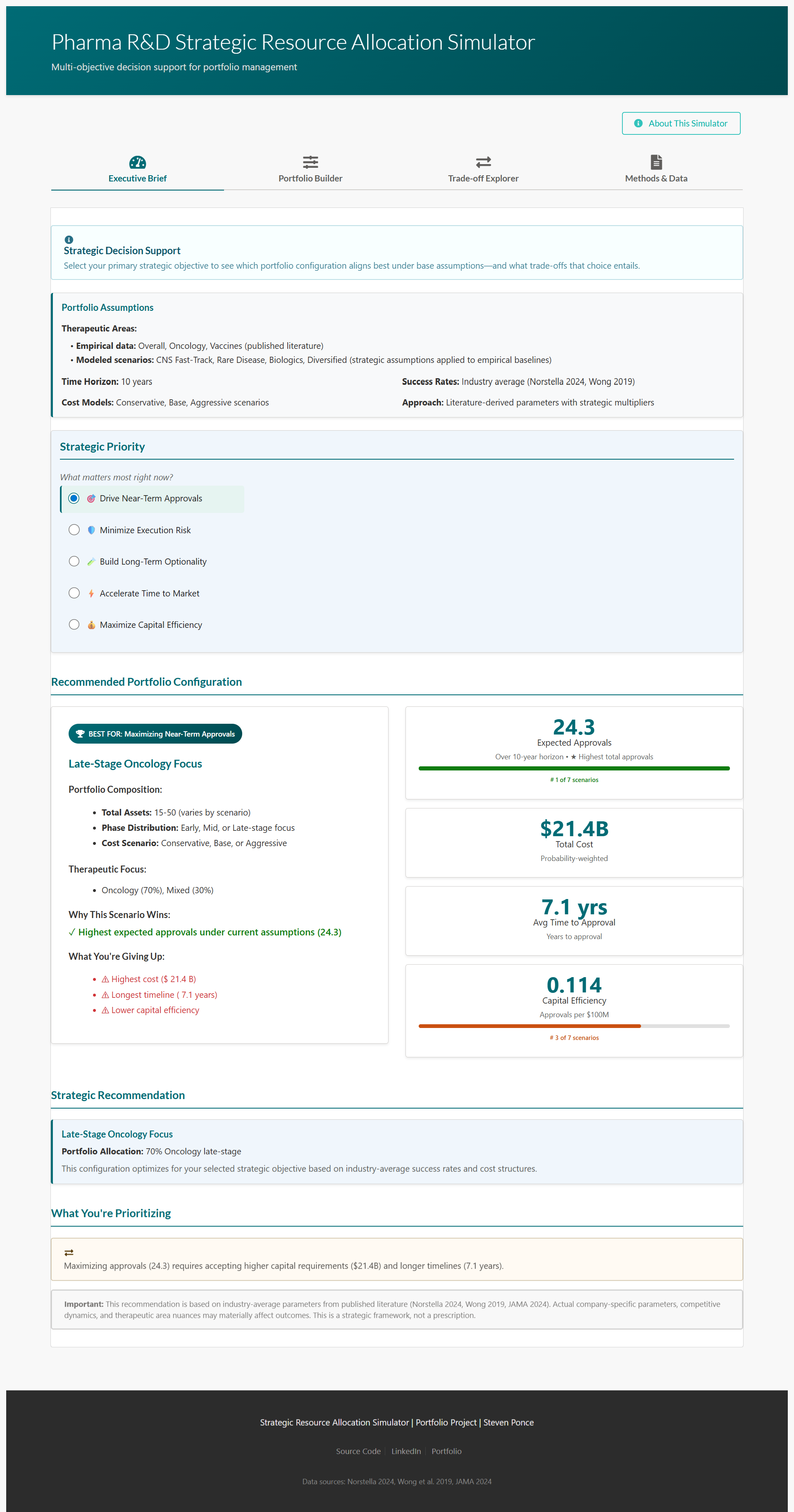
An executive-facing entry point that allows users to select a strategic priority and view:

  • Suggested portfolio configurations aligned with selected priority
  • Key performance metrics
  • Explicit trade-offs (“what improves” vs. “what is sacrificed”)

Portfolio Builder
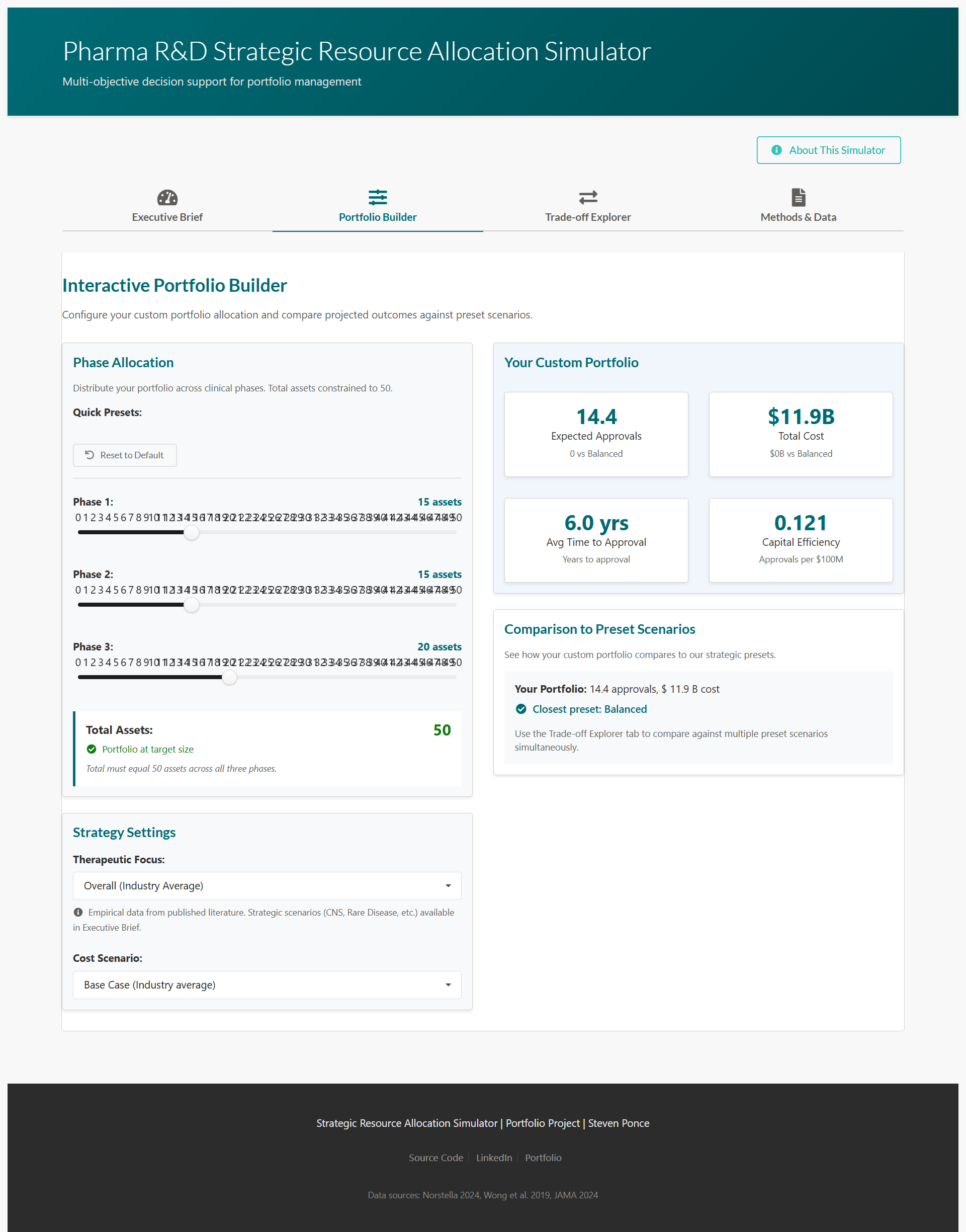
An interactive workspace for configuring:

  • Phase allocation (early vs. late)
  • Therapeutic area focus
  • Cost assumptions

with real-time feedback against strategic KPIs and preset scenarios.

Trade-off Explorer
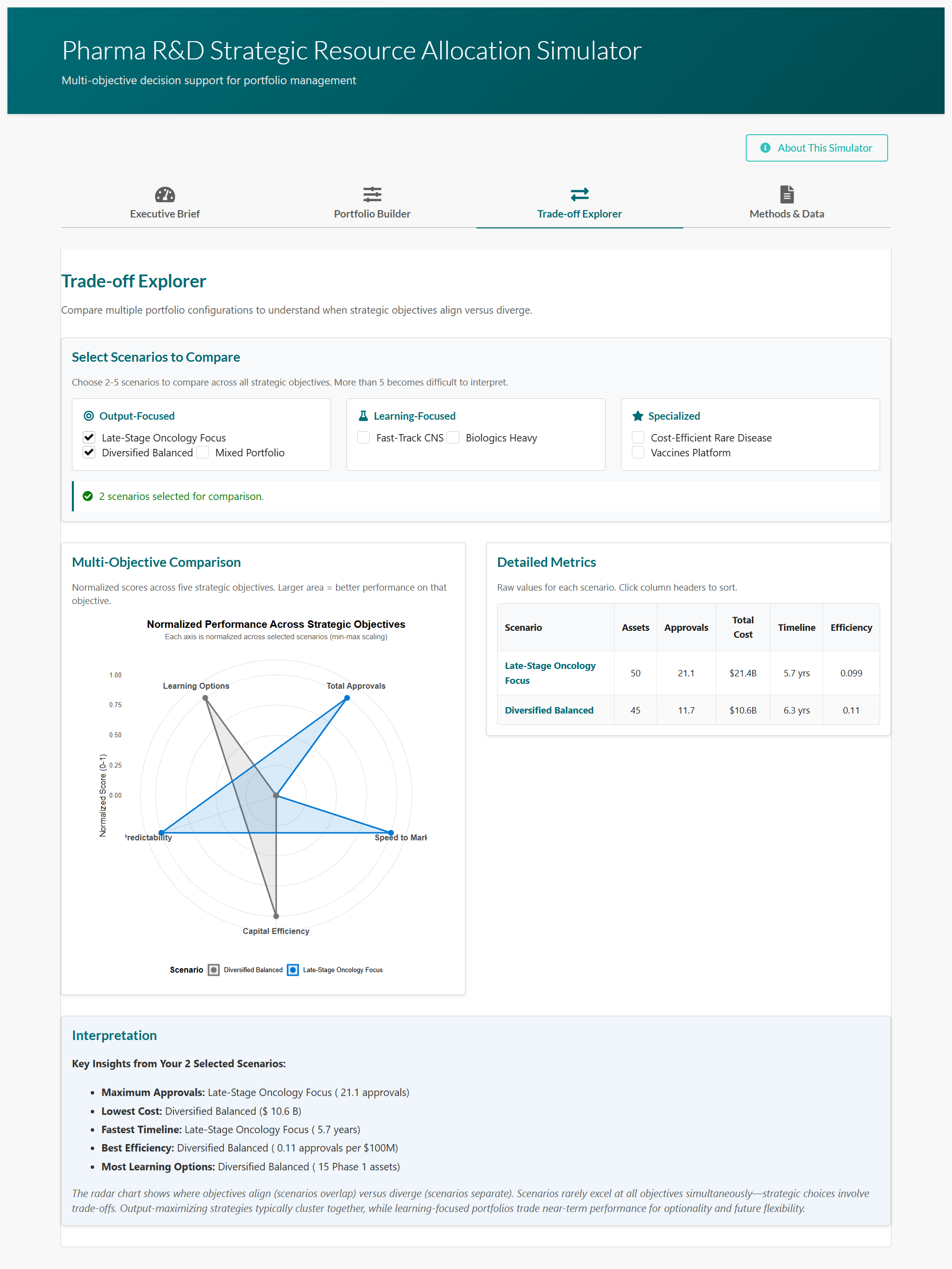
A comparative analysis view that enables:

  • Multi-scenario selection
  • Normalized radar-chart comparison across objectives
  • Side-by-side metrics with dynamic interpretation

Methods & Data
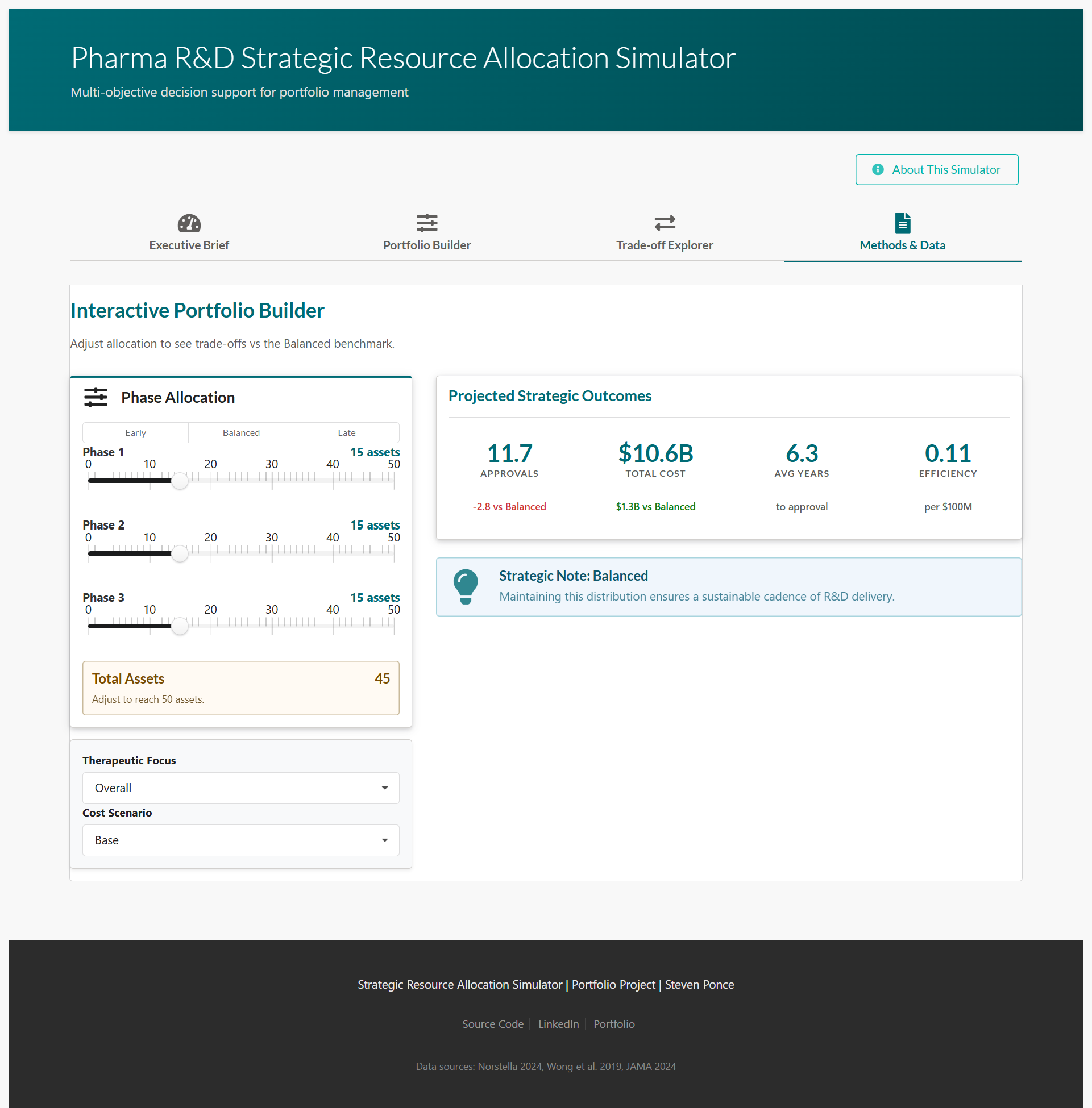
A transparency-focused section documenting:

  • Data sources and citations
  • Modeling assumptions
  • Normalization logic
  • Known limitations

What the Simulator Reveals

Across scenarios and assumptions, several consistent patterns emerge:

  • Output-maximizing strategies tend to cluster, particularly when late-stage assets dominate the portfolio.
  • Learning-focused portfolios often diverge from output-focused ones, highlighting a fundamental trade-off between near-term results and long-term optionality.
  • Therapeutic area risk profiles materially affect outcome magnitude, even when strategy rankings remain stable.
  • Under certain conditions, objectives align—simplifying decisions. Under others, trade-offs become unavoidable and must be made explicit.

These findings are descriptive, not prescriptive.


Scope and Limitations

This simulator intentionally does not:

  • Predict individual asset outcomes
  • Model company-specific pipelines or proprietary data
  • Estimate valuation, NPV, or financial return
  • Account for competitive dynamics or regulatory acceleration pathways

Learning optionality is proxied by early-stage asset exposure, not measured scientific output.
All simulations assume independent trial outcomes and industry-average parameters.

These constraints are deliberate to preserve interpretability and avoid overreach.


Why This Framework Is Useful

Strategic portfolio discussions often fail not due to lack of data, but due to implicit priorities and unexamined trade-offs.

This simulator provides a structured way to:

  • Make priorities explicit
  • Compare strategies on common footing
  • Explore sensitivity to assumptions
  • Support disciplined executive discussion

It is designed as a thinking tool, not a decision engine.


Appendix: Methodology & Build Notes

Data Sources

  • Norstella/Citeline (2024) – Phase transition probabilities
  • Wong et al., Biostatistics (2019) – Trial duration estimates
  • JAMA Network Open (2024) – R&D cost benchmarks
  • ACSH (2020) – Therapeutic area success profiles

Application Architecture

  • R Shiny with shiny.semantic (Appsilon framework)
  • Modular architecture (4 independent tabs)
  • ggiraph + fmsb for interactive visualizations
  • reactable for data tables

Purpose, Scope, and Disclaimer

This simulator is an independent analytical exercise created for portfolio and educational purposes only.

It is not affiliated with, endorsed by, or produced by any pharmaceutical company.

All parameters are derived from publicly available peer-reviewed literature. No representation is made regarding applicability to specific company contexts.

This work does not constitute investment advice, clinical guidance, or strategic recommendations.


Closing

This project demonstrates how analytical restraint, transparency, and multi-objective framing can be combined into an executive-grade decision-support application.

By focusing on structure rather than prediction, the simulator helps clarify how strategic choices behave—without claiming to know what should be chosen.


Back to top

Citation

BibTeX citation:
@online{ponce2026,
  author = {Ponce, Steven},
  title = {Designing an {Executive-Grade} {R\&D} {Portfolio}
    {Simulator}},
  date = {2026-01-07},
  url = {https://stevenponce.netlify.app/projects/standalone_visualizations/sa_2026-01-07.html},
  langid = {en}
}
For attribution, please cite this work as:
Ponce, Steven. 2026. “Designing an Executive-Grade R&D Portfolio Simulator.” January 7, 2026. https://stevenponce.netlify.app/projects/standalone_visualizations/sa_2026-01-07.html.
Source Code
---
title: "Designing an Executive-Grade R&D Portfolio Simulator"
subtitle: "A case study in multi-objective decision support for pharmaceutical R&D strategy"
description: "An interactive R Shiny simulator demonstrating how literature-based parameters can support structured strategic reasoning about pharmaceutical R&D portfolio allocation."
date: "2026-01-07"
author:
  - name: "Steven Ponce"
    url: "https://stevenponce.netlify.app"
    orcid: "0000-0003-4457-1633"

citation:    
    url: "https://stevenponce.netlify.app/projects/standalone_visualizations/sa_2026-01-07.html"
categories: ["R Programming", "Shiny", "Pharmaceutical Strategy", "2026"]
tags: ["r-shiny", "simulation", "portfolio-strategy", "multi-objective", "decision-support", "pharmaceutical"]
image: "thumbnails/sa_2026-01-07.png"
format:
  html:
    toc: true
    toc-depth: 4
    code-link: true
    code-fold: true
    code-tools: true
    code-summary: "Show code"
    self-contained: true
    theme:
      light: [flatly, assets/styling/custom_styles.scss]
      dark: [darkly, assets/styling/custom_styles_dark.scss]
editor_options:  
  chunk_output_type: inline
execute:
  freeze: true
  cache: true
  error: false
  message: false
  warning: false
  eval: true
editor: 
  markdown: 
    wrap: 72
---

```{r setup}
#| label: setup
#| include: false
knitr::opts_chunk$set(dev = "png", fig.width = 9, fig.height = 10, dpi = 320)
```

🚀 **Live app:**  
[Pharma R&D Portfolio Simulator](https://0l6jpd-steven-ponce.shinyapps.io/Pharma_R-D/)

💻 **Source code:**  
[GitHub repository](https://github.com/poncest/Pharma_R-D/tree/main)

------------------------------------------------------------------------

## Executive Overview

Pharmaceutical R&D portfolio decisions are rarely about optimizing a single metric.\
They require balancing **near-term output**, **execution risk**, **capital efficiency**, **speed**, and **long-term learning**—often under conditions of uncertainty and incomplete information.

This project presents an **interactive R Shiny simulator** designed to support *structured strategic reasoning* about R&D portfolio allocation. Rather than predicting outcomes or recommending specific investments, the simulator provides a transparent framework for exploring **how portfolio strategies perform under different strategic priorities**.

The emphasis is on **decision support**, not prescription.

For organizations navigating pipeline trade-offs, this distinction matters: 
the goal is clarity about *how* choices behave, not claims about *what* to choose.

------------------------------------------------------------------------

## Strategic Questions This Simulator Examines

The simulator is designed to help explore questions commonly faced by R&D leadership and portfolio governance teams:

-   How do different portfolio configurations perform across competing strategic objectives?
-   When do objectives align, and when do they meaningfully diverge?
-   What trade-offs emerge between maximizing near-term approvals and building long-term optionality?
-   How sensitive are portfolio outcomes to therapeutic area risk profiles?
-   Under what conditions does specialization outperform diversification?

These questions are addressed through **probability-weighted simulation**, not forecasting.

------------------------------------------------------------------------

## Analytical Design: A Multi-Objective Framework

Rather than optimizing for a single outcome, portfolios are evaluated across **five strategic objectives**, each representing a different organizational priority:

1.  **Maximize Expected Approvals** – total approvals over the portfolio lifecycle\
2.  **Predictability** – approvals per asset (execution reliability)\
3.  **Learning Optionality** – early-stage asset exposure as a proxy for discovery\
4.  **Speed to Market** – approvals per year\
5.  **Capital Efficiency** – approvals per \$100M invested

No objective is treated as universally “correct.” Trade-offs are expected and explicitly surfaced.

------------------------------------------------------------------------

## Data Foundations and Modeling Discipline

### Literature-Based Inputs

Baseline parameters are drawn from peer-reviewed and industry sources, including:

-   Phase transition success rates (Norstella / Citeline)
-   Trial duration estimates (Wong et al., *Biostatistics*)
-   R&D cost estimates (JAMA Network Open)
-   Therapeutic-area-specific success profiles (ACSH)

Empirical therapeutic areas include:

-   Overall (industry average)
-   Oncology
-   Vaccines
-   Anti-Infectives

### Modeled Strategic Scenarios

Where direct literature estimates do not exist, **explicit modeling assumptions** are applied to explore strategic postures (e.g., fast-track timelines, cost-efficient rare disease focus). These assumptions are documented, adjustable, and intentionally simplified.

The simulator distinguishes clearly between **empirical inputs** and **modeled scenarios**.

------------------------------------------------------------------------

## Simulation Approach

Portfolio outcomes are calculated using **probability-weighted attrition modeling**.

Rather than assuming all assets progress through all phases, costs and timelines are weighted by historical phase-transition probabilities. This reflects real-world portfolio economics, where early failures reduce downstream costs and timelines.

Key outputs include:

-   Expected approvals\
-   Probability-weighted total cost\
-   Average development timeline\
-   Normalized efficiency metrics

This approach emphasizes **structural realism** over predictive precision.

------------------------------------------------------------------------

## Dashboard Structure

The simulator is organized into four complementary views:

### Executive Brief

![](https://raw.githubusercontent.com/poncest/Pharma_R-D/main/screenshots/executive_brief.png)

An executive-facing entry point that allows users to select a strategic priority and view:

-   Suggested portfolio configurations aligned with selected priority\
-   Key performance metrics\
-   Explicit trade-offs (“what improves” vs. “what is sacrificed”)

### Portfolio Builder

![](https://raw.githubusercontent.com/poncest/Pharma_R-D/main/screenshots/portfolio_builder.png)
An interactive workspace for configuring:

-   Phase allocation (early vs. late)
-   Therapeutic area focus
-   Cost assumptions

with real-time feedback against strategic KPIs and preset scenarios.

### Trade-off Explorer

![](https://raw.githubusercontent.com/poncest/Pharma_R-D/main/screenshots/tradeoff_builder.png)

A comparative analysis view that enables:

-   Multi-scenario selection\
-   Normalized radar-chart comparison across objectives\
-   Side-by-side metrics with dynamic interpretation

### Methods & Data

![](https://raw.githubusercontent.com/poncest/Pharma_R-D/main/screenshots/method_data.png)

A transparency-focused section documenting:

-   Data sources and citations\
-   Modeling assumptions\
-   Normalization logic\
-   Known limitations

------------------------------------------------------------------------

## What the Simulator Reveals

Across scenarios and assumptions, several consistent patterns emerge:

-   Output-maximizing strategies tend to cluster, particularly when late-stage assets dominate the portfolio.
-   Learning-focused portfolios often diverge from output-focused ones, highlighting a fundamental trade-off between near-term results and long-term optionality.
-   Therapeutic area risk profiles materially affect outcome magnitude, even when strategy rankings remain stable.
-   Under certain conditions, objectives align—simplifying decisions. Under others, trade-offs become unavoidable and must be made explicit.

These findings are descriptive, not prescriptive.

------------------------------------------------------------------------

## Scope and Limitations

This simulator intentionally does **not**:

-   Predict individual asset outcomes\
-   Model company-specific pipelines or proprietary data\
-   Estimate valuation, NPV, or financial return\
-   Account for competitive dynamics or regulatory acceleration pathways

Learning optionality is proxied by early-stage asset exposure, not measured scientific output.\
All simulations assume independent trial outcomes and industry-average parameters.

These constraints are deliberate to preserve interpretability and avoid overreach.

------------------------------------------------------------------------

## Why This Framework Is Useful

Strategic portfolio discussions often fail not due to lack of data, but due to **implicit priorities and unexamined trade-offs**.

This simulator provides a structured way to:

-   Make priorities explicit\
-   Compare strategies on common footing\
-   Explore sensitivity to assumptions\
-   Support disciplined executive discussion

It is designed as a **thinking tool**, not a decision engine.

------------------------------------------------------------------------

## Appendix: Methodology & Build Notes {.collapse}

### Data Sources

- Norstella/Citeline (2024) – Phase transition probabilities
- Wong et al., *Biostatistics* (2019) – Trial duration estimates
- JAMA Network Open (2024) – R&D cost benchmarks
- ACSH (2020) – Therapeutic area success profiles

### Application Architecture

- R Shiny with shiny.semantic (Appsilon framework)
- Modular architecture (4 independent tabs)
- ggiraph + fmsb for interactive visualizations
- reactable for data tables

------------------------------------------------------------------------

## Purpose, Scope, and Disclaimer

This simulator is an independent analytical exercise created for
portfolio and educational purposes only.

It is not affiliated with, endorsed by, or produced by any pharmaceutical company.

All parameters are derived from publicly available peer-reviewed literature.
No representation is made regarding applicability to specific company contexts.

This work does not constitute investment advice, clinical guidance, or
strategic recommendations.

------------------------------------------------------------------------

## Closing

This project demonstrates how **analytical restraint, transparency, and multi-objective framing** can be combined into an executive-grade decision-support application.

By focusing on structure rather than prediction, the simulator helps clarify *how* strategic choices behave—without claiming to know *what* should be chosen.

------------------------------------------------------------------------

© 2024 Steven Ponce

Source Issues